There’s nothing that patience, skill, parts, and plenty of money can’t fix
Issue 42 : May/Jun 2005
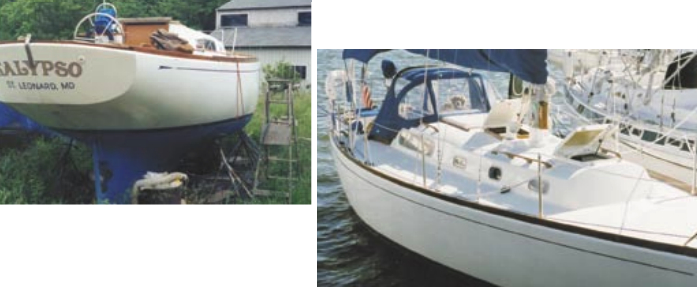
I have three lingering images of Kalypso: first, lying idyllically for sale at the end of a private pier on the beautiful upper reaches of St. Leonard Creek, Maryland, almost two years ago; second, sitting stripped bare on blocks with improvised plywood hatches on a cold March morning a year later; and third, entering her slip in Solomons Island on the Chesapeake Bay this fall, looking and sailing better than when she was launched in 1967.
I should have known there would be a lot to learn when I asked the previous owner of the Morgan 34 that first day about the unusual spelling of Kalypso on the transom. With humor, he replied that “k” substitutes for “c” in the Greek alphabet. With hindsight I know that “k” is no substitute for “c” in the English alphabet, particularly for words such as “cash” and “calamity” when rebuilding a boat launched more than half a human life ago. Unlike humans, however, old fiberglass boats can be returned to youth by a highly skilled plastic surgeon, plentiful parts, and a parting pocketbook.
First sighting
Her lines are so classically beautiful that I have now learned to expect a thumbs-up sign from other sailors upon entering a new harbor. Her previous owner advertised correctly that she was often complimented by Hinckley owners. In my mind now, comparisons fall short. Charley Morgan (see profile in March 2005 issue) was already a premier designer/builder when the Morgan 34 was conceived in the early Vietnam War era, just before his America’s Cup forays. I marveled at Kalypso’s transom overhang, teak toerail, and solid shallow-draft hull, all of which are far removed from the efficient layout, spade keel, and thin test-tank hulls of today. I admit that I wasn’t in a mood to look closely for furrows or flaws in the old lady. This beauty was best courted in dim light. I was enamored and planned my proposal. I asked myself, “What is sailing about, after all?”
My proposal was made shortly after obtaining an objective opinion one cold January morning. A leading surveyor from Annapolis drove the hour to Solomons, and after a few expensive minutes said, “The hull looks good, and the deck is dry.”
Should I admit it? That was enough for me. I decided not to watch the rest of the six-hour survey and didn’t read his subsequent report flogging her flaws until after Kalypso was mine.
It would have been easy to walk into a full-service marina, hand them the survey, and say, “Go to it,” for the going rate of $55 to 75 per hour. At that price, however, I could have bought two new boats by the time they’d worked their way through Kalypso’s long list of problems. It seemed to me that a 35-year-old boat deserved a more personal (and cheaper) restoration, even if its new owner had little knowledge of what to do.
The best solution
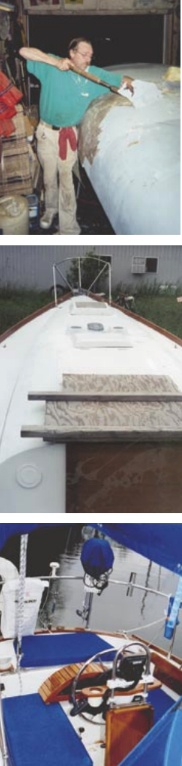
It took me a while to find the best solution: Bruce Gay, of the Long Beach Boat Company, in St. Leonard, Maryland. With more than 30 years’ experience in all phases of boat repair, Bruce has established a niche business, working personally with owners of all skill levels who are willing to put some elbow grease into rebuilding their older boats. I wanted to learn about my boat and help in making the repairs in addition to cutting expenses. He had the expertise. We agreed on a program for replacing all the hardware and rigging, painting the deck and hull, and making major and minor mechanical improvements. It seemed a good deal. Eventually, I was proved right, although I had a few doubts along the way.
The low point came a few months later. In the Ides of March when Kalypso was a shell and the weather was from hell, I threatened myself with buying a gallon of stinkpot fuel, a cigarette lighter, and . . . you guessed it! By then, we had removed all the old hardware and filled the holes temporarily with silicone, cut plywood covers for the hatches (which Bruce was refinishing in his shop), and sanded most of the deck when the fundamental question hit me: “Why didn’t I just buy a new boat at the Annapolis Boat Show last fall?” My funk was fomented after some vandals trashed Kalypso. They pried off the makeshift plywood companionway, stole some tools, and fired off the extinguishers in her saloon. Then I had to clean up the additional powder from the police fingerprint expert.
My deal with Bruce was that he would undertake the project personally. While I would assist with the unskilled work (of which there was a lot), the timetable depended on Bruce’s schedule. I had to accept the fact that he had other customers. And if he got sick, bitten by a snake, or impaled on a nail (all of which happened), the project would be put on hold. Add bad weather (major snowstorms, 28 straight days of spring rain, and Hurricane Isabel), and a lot of time sailed by with little progress.
Chain of problems
I learned quickly that fixing a known problem on an old boat almost inevitably leads to finding an unknown one. This is not all bad; it’s better to know your problems than not. But it adds time and expense. One project, for example, was to replace the Cutless bearing. In the process we found that the shaft was scored and had to be replaced. The rudder had to be removed to get the shaft out, and we then found that the bolts holding up the rudder had to be replaced (a specialty machine-shop job). This also involved removing the steering quadrant and then finding that the cable nuts were corroded. Since the shaft stuffing box needed service, I decided that I might as well buy a new dripless stuffing box. What started out as a small $250 sub-project ended up costing in excess of $2,500 to fix related problems. Toward the end, the standing joke was that Kalypso should be renamed the Yard and Bay Boat.
During this period I could always brighten my mood by shopping. The sailboat parts business was floating high in dot-com waters and good deals were just a keystroke away. Almost everything for Kalypso’s refit (except the paint, some cabinetry, sail work, new canvas, and cushions) was purchased on the Internet. I saved thousands of dollars buying and installing equipment, as compared with retail vendor and marina prices. Rigging, lifelines, electronics, plumbing, electrical equipment, and innumerable other items came from SailNet.com. Concentrating your purchasing power yields even bigger discounts; I could hardly wait to get my rebate certificates in the mail each week. A lot of practical advice on what to buy came by asking dumb questions in the chat rooms hosted by SailNet.
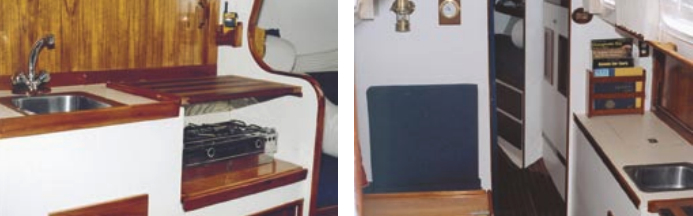
Bargains on sale
Hardware and fasteners were replaced at Bosunsupplies.com. Various supplies were purchased on sale from Westmarine.com and Boatus.com. Specialty websites also came in handy for items such as a helm seat from Teakflex.com. Teak door louvers were purchased directly from Thailand at Thaiteakmarine.com. These merchants were all knowledgeable, efficient, and friendly. I also scoured eBay for bargains. My final winning bid was a five-inch fossil shark tooth from the ancient Chesapeake to serve as the boat’s talisman.
Of course, if I had sent Kalypso to one of the full-service marinas last fall, the work probably would have been finished by spring, and my story would be unremarkable. My only surprise might have been the size of the bill and, probably, I wouldn’t even know what was meant by “replace the Cutless bearing, refurbish the steering quadrant, and so on.”
I still spent more than twice as much on the rebuild as I did on Kalypso’s initial purchase. Having been involved every day of the rebuild, however, I am familiar with every moving part in the bilge. I know how my new seacocks and plumbing work. I know where the new electrical wires lead, and what fuses they take. I have confidence in my new portlights, knowing how they were installed. Since all the hardware is new, I have no leaks.
Granted, I still might not be able to fix some of this equipment if it broke at sea, but at least I could identify the problem. This knowledge could be invaluable some night in a storm. Moreover, working personally with an experienced and talented professional like Bruce yielded innumerable tips on maintenance which will save me many dollars in years ahead and add to my boating enjoyment. Most important, I have the satisfaction of knowing that I contributed to the restoration of my boat and met many interesting people along the way.
Rewarding process
If I ever need more convincing that the process of restoring an old boat is rewarding, I will think of the sailboat next to Kalypso in the yard all those months. It was an unfinished 40-footer on a custom steel stand. The owner bought the boat on his honeymoon in London in the early 1970s, and it was shipped to Baltimore on a freighter with the newlyweds. They had high hopes of finishing construction and sailing to New Zealand. Until the mid-1980s, he and his wife worked on the boat together for a few weeks each summer. Then they moved away, and jobs interfered with progress. But they held onto the dream. When the boatyard closed, they moved her to the present location in Maryland and continued to make improvements. He told me with great enthusiasm about all the projects they still plan. It is now more than 30 years later, the boat has never been in the water, and this couple is still happily married. He now looks forward to his grandchildren finishing the work and sailing to New Zealand.
What is sailing about, after all?
Thank you to Sailrite Enterprises, Inc., for providing free access to back issues of Good Old Boat through intellectual property rights. Sailrite.com