How to equip your boat for the wild blue yonder
Issue 46 : Jan/Feb 2006
Visit a marina, yacht club, or boat show, and you will meet or hear of sailors who are planning a long cruise or circumnavigation. Many own older boats whose movements are not restricted by banks and insurance companies. A surprising number intend to go solo or with only one other person, usually a spouse or significant other.
I have met these happy and self-reliant sailors in ports around the globe, and I know that every day brings them a new experience or achievement. Satisfactory voyaging depends to a great extent on mindset, but the second most vital ingredient is proper equipment. There must be the proper tools as well as an energetic interest to make a cruise possible. Here is my list of what equipment makes singlehanded and shorthanded sailing safer and less exhausting.
The proper vessel
It goes without saying that the solo skipper must have the proper vessel in addition to the skills to sail her alone. For most people what constitutes a proper vessel is based more on assets than convictions. It is a happy coincidence that older boats are frequently of better construction than newer ones and that, because they are older, they are cheaper. I will not try to define a proper vessel, other than to state some of my own prejudices and preferences.
To leave no doubt that I am subjective, I reject any vessel that is aesthetically challenged. If you intend to spend much time on board a boat, she must be attractive to you. Would you want a significant other of whom you apologetically say that at least he is good at bringing home the bacon or that she cooks gourmet dinners? Fortunately, sailboats to sailors resemble taxes to politicians — rarely do they look unattractive.
For me, the boat must be strongly constructed. I know about new materials and methods of construction, breaking strengths and such, but I seek old-fashioned strength. I want a thick, overbuilt hull, a long keel, oversize mast and rigging, massive chainplates, and the like. These would raise building costs so much today that the boats would become too expensive for most markets. Fortunately, scores of older boats meet these criteria. For a variety of reasons, my preferred cruiser is of fairly high dis- placement. I also like double-enders.
To offset the inevitably less-than-optimal sailing abilities of the heavy-dis- placement cruising vessel, she should have a high-aspect rig, as well as light-air sails. A cutter rig is most practical because it best allows adjusting the sail plan to the circumstances. A sloop will do. I reject gaff rigs and schooners and — for vessels under 40 feet — ketches and yawls. They are all pretty and a joy to see but not to sail.
The boat must be small enough to allow one person to handle all tasks but not so small that even daring sailors doubt your good judgment. Something between 27 and 37 feet in length makes sense to me. Her full or long keel encapsulates the ballast. Her rudder is strongly attached to skeg or keel. She must have a functional interior with sufficient headroom to stand up and comfortable places to sit and sleep.
Some readers will be up in arms about my preferences. But every boat is a compromise, so subjectivity is inevitable. For instance, is 27 to 37 feet really the right size boat for a particular skipper? It depends on many factors, such as the skipper’s physique, the boat’s design, and the planned voyages. Follow your own preferences and insights, but be aware that comfort and safety are increased if the boat tracks and heaves-to well and remains a stable platform in deteriorating conditions.
Fin-keel boats tend to be at a disadvantage in this regard but have attractive characteristics in other regards. Remember, though, that we are discussing cruisers, not racers. No boat can excel at both.
When all is said and done, the most decisive factor in making singlehanded voyaging safe and successful is the skipper. There’s no better way to determine if he or she is up to the challenge than by setting sail and experiencing it.
Vital and desirable gear
I can speak of the days long gone when passagemaking inventories of navigation instruments consisted of compass, sextant, depth sounder, and perhaps an RDF. It’s not that we were all Luddites in those days. For the smaller yacht there was simply not much else available. Power consumption, weight, and size ruled out most of the more advanced equipment that began to appear first on ships.
Today’s modern yachts, even those used primarily for daysailing, frequently sport more electronics than a freighter of 35 years ago. In my opinion, the keep-it-simple principle remains valid but only to a degree. No one should depend on gadgetry, but certain equipment does make sailing safer and easier and overcomes some of the commonly encountered problems in solo sailing. This gear is equally useful on the fully crewed yacht. Even the low-budget sailor can now take some of the pain out of singlehanded sailing.
I will not dwell on those items whose need or desirability goes without saying: good sails for heavy weather and light air, adequate ground tackle, a functional galley.
The most immediate disadvantage in singlehanded sailing is that the sailor’s two hands remain in close proximity to each other. Skilled as they may be, this one pair can never fully compensate for the lack of other hands when tasks must be performed simultaneously in different locations. Planning and equipment can largely alleviate the problem. For this reason, I regard 15 pieces of equipment as either crucial or highly desirable for solo cruising.
1. A self-steering device
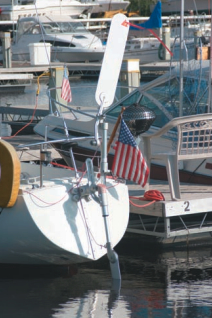
Few pieces of gear compensate for the lack of crew, but a good self-steering system comes close. If that robot keeps the boat on course while the skipper handles other tasks or rests, it is indeed a substitute for a competent helmsman and is taciturn to boot. It is foolish to go without.
The subject of electromagnetic and wind-driven self-steering is vast. The former keeps a compass course and demands adequate battery power. The latter keeps a course relative to the apparent wind and uses wind power. As for which one to choose when both systems are practical for the particular boat and voyage is a matter of resources. If the budget permits, the optimal solution is to have both.
If the sailing will be mostly coastal, buy an electromagnetic autopilot. They are more capable of steering precise courses in coastal areas dotted with navigation hazards and plagued by changing winds. Purchase one rated for nearly twice your boat’s LOA and displacement. If the planned voyages are primarily bluewater passages, buy a wind-driven system, preferably one that operates or could operate independently from the boat’s rudder and thus serve as an emergency rudder.
Ultimately, your choice will be influenced by the kind of voyages you plan to undertake, your budget, the system’s power consumption, complexity, and perhaps installment considerations. Unfortunately not all self-steering devices perform equally well on a given boat. Before you get out your checkbook, ask skippers who have experience with the particular model you’re considering.
In some situations you’ll find that either the electromagnetic or the wind-driven system clearly outperforms the other. That is not as important a criterion as which one is incapable of steering the boat in all but optimal conditions. Avoid purchasing an underpowered electromagnetic autopilot simply because you intend to use it only in calms. The system must be capable of controlling the boat in adverse conditions. There is probably nothing on the market that can handle all conditions and all situations. Find one that does not force you to hand-steer or heave-to as soon as the wind picks up or a sea builds.
A compromise may be to purchase a windvane autopilot and a small electromagnetic tiller autopilot. Although incapable of steering the boat by itself, the tiller pilot can be put to work in conjunction with the windvane system and give it the input commands that normally would come from the vane’s responses to changes in apparent wind. This creates a form of energy-efficient power steering that is unaffected by wind changes or calms. A friend successfully used this system on his heavy-displacement 43-foot ketch during a three-year circumnavigation.
2. The roller-furling headsail
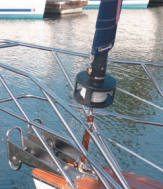
A hazardous task for anyone, particularly the solo sailor, is working on the foredeck in bad conditions. Lowering or changing a headsail on a slippery foredeck has little appeal, even when you do not have to balance on a “widowmaker bowsprit.” Fortunately, the abundance of high-quality roller furlers available make most foredeck expeditions largely unnecessary. My formerly Luddite notion, that on a boat only toilet paper is rolled up, I have discarded as nonsensical.
I remain opposed to roller furlers for the staysail and mainsail. The reason for not having a furling staysail is to retain the option of hanking on a storm jib. (Of course, there are systems available that allow raising a storm jib over a rolled-up sail.) The reasons for not installing a mast- or boom-furling main is sail performance, cost, and simplicity.
3. Other sail control aids
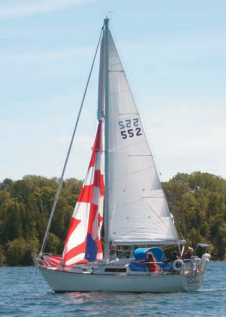
Because the winds are often light on the open ocean, having at least a light-air headsail is a must when long-distance voyaging. It is raised independently from the headsail furler. Often these sails, so docile in light breezes, become tigers when the wind pipes up. The single-handed sailor must have a way to lower a light-air sail safely. Purchase a sock-like dowsing device that will ride above the head of the sail when sailing and gather it in when lowered.
Since sail changes can pose a challenge for the solo sailor, reefing and furling the mainsail becomes simpler and safer with lazy-jacks. These you can purchase or fabricate yourself with a length of line, nylon thimbles, pad-eyes, and two small blocks (see Good Old Boat article on making your own lazy-jacks, July 2001).
A storm trysail is not a must in my experience. I faithfully carried one for decades but never deployed it. Instead, I have triple-reefed the main. Have at least two reef points in the main. A proper storm jib — which is not just any small sail — is an important asset. Roller-furling headsails with a proper luff can be reduced by partial furling, but they quickly lose efficiency if rolled up more than 15 to 20 percent. Another problem of reducing a jib by partly rolling it up in bad weather is that it will sit too high above the deck. Better to hank on a storm jib, which on a cutter can be on the staysail stay. This keeps the storm-wind forces close to the mast and low.
4. The GPS chart plotter
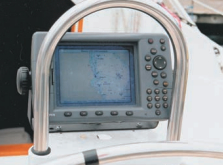
One of the greatest dangers facing the solo sailor in coastal waters has always been the difficulty of plotting and navigating in rough conditions. In heavy weather on the coast I often found it impossible to perform essential navigation tasks, particularly when in traffic. The arrival of Loran and GPS brought a marked improvement. The GPS chart plotter resolved that problem altogether.
The plotter tells me everything I previously had to gather quickly and painfully on a rolling and pitching vessel while bent over charts and away from the helm. It tells me where I am and am headed, optimal and actual courses, bearings, speed, distances, and all the information that at times can be as crucial as world peace.
Install the GPS plotter so it can be read from the cockpit — perhaps by mounting it on a swinging arm — while remaining protected from rain and spray. Laptop computers are not my choice for this use. Even a fairly inexpensive black-and-white plotter will do just fine. Be aware that the cost of chart chips can be considerable.
5. Radar
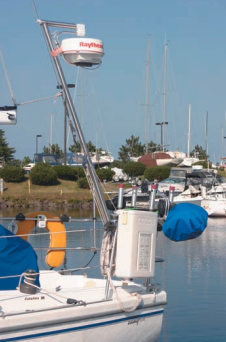
Having radar is far less crucial than most sailors assume. Radar is a great navigation aid, although it takes second place to the GPS chart plotter. Where radar is of great importance is as a lookout, especially in dense fog, at night, and in other conditions of poor visibility. It can give the solo sailor a badly needed margin of safety while he is belowdecks or occupied with other tasks. Purchase a radar that gives an audio alarm when targets show up in a designated area. In combination with an alarm or collision avoidance device that alerts to incoming radar signals, much of the risk of not maintaining a proper 24/7 lookout can be eliminated. Unfortunately, on smaller vessels the radar and collision avoidance device cannot be operated simultaneously since the radar signal will be read by the detector as a very strong signal very close — so close that it seems to come from all directions. I have the CARD radar detector. It will not break down if I leave it on when using the radar, but it will only detect my own radar. When operating the radar, I generally leave it on with the audio alarm turned off.
Mount a radar monitor on a heavy-duty bracket that allows it to swing out into the companionway so it can be observed from inside the cabin as well as from the helm.
6. A remotely controlled VHF radio
Occasionally a sailor must communicate by VHF radio with vessels or harbors. A handheld VHF used in the cockpit may suffice, but it is far better if the main VHF with its masthead antenna and greater range can be operated from the cockpit. Installing the primary VHF in the cockpit invites damage and theft; running back and forth between the helm and a radio is impractical. Mount a VHF radio with remote access microphone (RAM) capability inside the cabin. Install the RAM in the cockpit. That allows control of all the functions of the radio from the cockpit while the RAM serves as a remote speaker.
7. A dodger
Fatigue from handling a multitude of tasks, lack of rest, or poor nutrition is a very real hazard and tends to become more of a threat as the solo sailor ages or is physically less fit. Being cold or exposed to the elements contributes heavily to fatigue. A dodger is a must for the solo sailor. Dressed in warm and dry clothes and comfortably sheltered by a dodger, the sailor will remain fitter and more alert.
A dodger also increases the useful space on a boat. It allows better use of the space near the companionway, protecting sensitive gear there, such as GPS plotters, laptops, and radars.
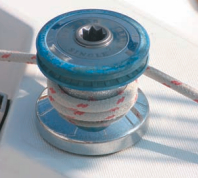
8. Self-tailing winches
Self-tailing winches are more than a mere convenience for the solo sailor, but if the boat does not have them, contrary to what some believe, the rubber Wincher Self-Tailers that fit over top of non-self-tailing winches will work well. They require that the line be wrapped around the drum a sufficient number of turns to get the needed friction, which is what many critics overlook. I have used them on sheet and halyard winches and found that, even in gale-force winds, they can hold a sheet until there is an opportunity to cleat it.
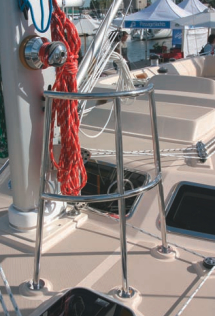
9. Sissy bars or mast pulpits
Often boats are advertised as equipped for singlehanded sailing, which usually means that halyards and other lines are led through blocks to rope clutches near the cockpit. Sometimes the arrangement works, but often when it’s most needed it fails. A kinked line or similar problem will force the sailor out of the safety of the cockpit onto the deck.
I prefer not to lead halyards and reefing lines to the cockpit. Certain tasks remain best handled at the mast, but working there should be safe. A pair of mast pulpits and uncluttered space for safe footing will greatly increase safety.
10. Additional compasses
It is often important to keep a close eye on the course, even when down below or on a bunk. Installing a compass belowdecks at the chart table and another one above the bunk makes life easier and safer. In the cockpit you may wish to install an extra compass that can be observed from under the dodger without moving to the binnacle compass.
11. Night-vision lights
When sailing at night, it is important to have adequate red light that does not destroy night vision but permits reading charts, making coffee and other tasks. Small red LED lights can light up spaces belowdecks without affecting night vision. Because their power consumption is minimal, they can be left on all night. Because of their low purchase price, you may wish to install them throughout the boat. At a very minimum, you must have one red light in the cabin, even if it’s only a red bulb in a light fixture.
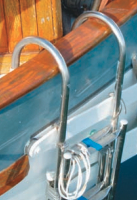
12. Boarding ladder
The great fear of many singlehanded sailors is falling overboard and seeing the vessel disappear over the horizon. You can take all sorts of measures to prevent falling overboard, but the danger remains. Some who fell overboard have made it back to the boat. With crew, getting back on board is usually not that difficult in moderate conditions. For the solo sailor the crucial question is if there is any way at all of getting back on board. Try it at anchor sometime, and you will likely find it very difficult or impossible, even under ideal conditions.
Very recently an acquaintance slipped overboard within sight of his home port in San Francisco Bay. His efforts to get back on board with the help of a jib sheet and in other ways all failed. With hypothermia and exhaustion setting in, he abandoned his efforts and began to swim to the shore. He would have drowned if another sailboat had not spotted him. It is safe to say that if the solo sailor does not manage to get back on board quickly, he may never.
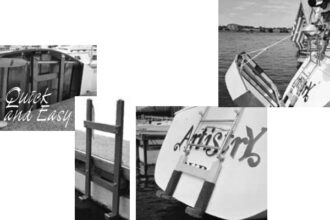
Some skippers install a rope ladder that can be reached from the water and pulled down, but these are difficult to climb in the best of circumstances. I resorted to permanently mounting a stainless steel folding ladder at the stern. It may look ungainly, but that is not as appalling as clinging to the boat with- out a means of getting back onboard.
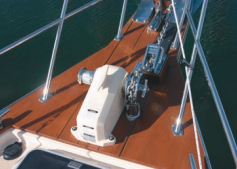
13. Anchoring aids
A reliable anchoring system is an absolute must. Except on very small and light boats, heavy ground tackle is a necessity. The opportunity to get a good night’s sleep in a less-than-optimal anchorage is priceless or at least demands as price a fairly heavy anchor and lots of chain. Defining what is a good anchor is like defining what is a good boat. The best way to arrive at your own preference is to try different anchors in poor conditions and with different types of bottom materials.
Not all anchors are equal. A Danforth-type anchor may work well with many bottom conditions but tends to kite over bottoms with lots of sea grass or weeds. This is particularly true for the lightweight Fortress. My preferred anchor is the Bruce, which has proved itself to me in many conditions and all kinds of bottoms: mud, sand, gravel, coral, and rocks. It sets quickly, can be broken out by positioning the boat above it, requires less scope than most, and has tremendous holding power. But if a rock of very specific dimensions lodges in the claw between the flukes, not even a Bruce can dig in. This never happened in the 25 years that I have relied on Bruce anchors.
The Delta and Spade are other fine anchors. When anchoring in soft mud, drop these hooks from a stopped boat and allow them to sink into the mud for a few moments prior to backing up or exerting much pull. The CQR plow anchor remains popular, but it has a design flaw that could prove disastrous in certain conditions. If a sudden wind change causes the boat’s heading to change quickly, the anchor will break loose if the rode is jerked from an angle greater than an angle in which the shank can be turned. Then the rotating movement and the great weight of the joint between shank and crown can flip the anchor over and cause it to be pulled upside down over the bottom. This flaw very nearly cost a friend his boat at Smugglers Cove on Santa Cruz Island.
In selecting an anchor, be cautious with imitations. An anchor may look like a Bruce or CQR, but was it manufactured under the same high standards? Particularly with these latter two anchors, I have seen knockoffs that I would never buy. A fairly small savings in purchasing anchors may cost you dearly.
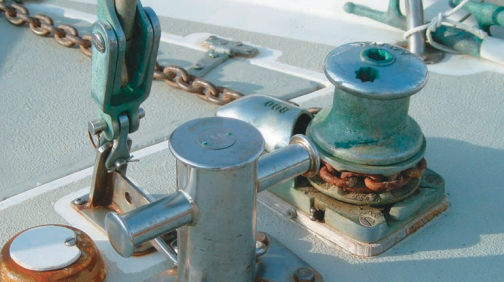
A heavy anchor and chain demand the use of a manual or electric windlass. My preference is for an electric windlass that permits manual operation. That is not essential since winches can substitute if the electrical windlass malfunctions.
If the windlass is electric, the solo sailor should be able to control it not just from the foredeck but also from behind the wheel. In a crowded or small anchorage it may be necessary to remain at the helm and engine controls when dropping or weighing anchor. One way to achieve that additional control is to connect a three-position toggle-switch with a three-wire extension cord to the switching terminals of the windlass motor.
14. Stern anchor rode
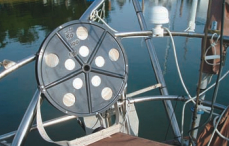
In minuscule or crowded anchorages or harbors where a stern anchor must sometimes be quickly set because of limited swinging room, it is a challenge for the solo sailor to do this while simultaneously setting the bow anchor or moving to a quay. The stern anchor will usually have a chain and nylon rode that must run out while the boat moves forward. It may kink or tangle at the most inconvenient moment possible, necessitating a series of dramatic maneuvers to avoid disaster and ridicule. To avoid that irritation, some skippers install a reel for the rode at the stern, but that tends to be bulky and inconvenient. I purchased a reel with 185 feet of webbing and mounted it to a stern stanchion. This Ankarolina product is made in Sweden and is sold in the United States. It comes in three versions: a 17-inch reel with 185 feet of webbing in breaking strengths of 5,500 and 8,000 pounds and a 19-inch reel with 230 feet of webbing at a breaking strength of 8,000 pounds.
Once I drop the stern anchor with its short length of chain from the stern, the webbing runs out smoothly from the reel. Webbing has less elasticity than a nylon rode but is strong and easier to handle. When weighing anchor, once the webbing is slack, it rolls up quickly and effortlessly on the reel, which has a detachable handle for that purpose.
15. Docking aids
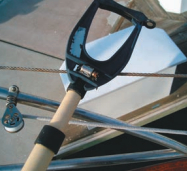
Docking or tying up to a mooring buoy — when limited room, unfavorable currents or wind, and amused onlookers affect the operation — are to many singlehanded sailors the most feared challenges. At those times even an incompetent crewmember would be worth his weight in lead, if not gold. Fortunately, a number of gadgets are available that make these tasks simpler for the solo sailor. A Happy Hooker or similar device at the end of a long, preferably telescoping, pole will make it possible to get a line through an eye or shackle on a buoy without masterful helmsmanship. Similarly, a grappling hook and line thrown over a dock may get a line temporarily secured to the dock. In controlling docking and undocking maneuvers the availability of a midships-mounted cleat and the use of spring lines can remove the need for help of crew or bystanders.
The cost
Assuming that a boat has none of the above-discussed pieces of equipment, an investment of $12,000 to $18,000 will buy it all. That’s a considerable expenditure, sometimes approaching the purchase price of an older boat, but it will pay off royally in safety and convenience.
If the budget is too tight and the choice lies between purchasing an older well-equipped boat with a good sail inventory or a newer, but minimally equipped vessel, safety considerations should steer the buyer toward the older well-equipped boat.
Thank you to Sailrite Enterprises, Inc., for providing free access to back issues of Good Old Boat through intellectual property rights. Sailrite.com