How a world voyager improved light-air performance

Issue 48 : May/Jun 2006
If you wonder how much drag and hinderance a 2-, 3-, or 4-bladed propeller puts on a sailboat, I suggest you toss a large metal bucket over the transom and hang on to it with a stout lanyard. Wait! Don’t heave the bucket over the side and try to hold it by hand. Take a round turn around a mooring cleat or a winch beforehand. I can tell you that if you’re going, say, 5 knots, the drag of the bucket may yank you over the lifelines and into the water.
Consider, then, the drag of a stationary propeller and how it slows a yacht at low sailing speeds. This is why there’s been a long-standing effort to perfect folding and feathering propellers.
Margaret and I sailed Whisper, our Spencer 35, to many places and, like all sailing nuts, we wanted to go faster with less effort and fuss. I had increased the sail area slightly, bought better sails, reduced weight aloft, stored heavy things amidships and low, and worked hard at filling and smoothing the bottom during haulouts.
Once, when we were hauled out in a boatyard in Puerto Rico, a fellow rubbed his hand along the copper paint and said: “Whisper’s bottom is better than most people’s topsides.”
I was flattered. However, I know that any increase in sailing performance because of a super-smooth bottom is only one step on a whole staircase of points leading to better performance.
Two areas
It seems to me that good light-air performance depends on attention to two general areas:
- The hull design, its proper lofting and construction, and the design and fairing of the rudder and keel. You may think your hull is perfectly fair, but if you and a friend take a 6-foot flexible batten and start going around a hull, you may be astonished at how unfair the hulls of many boats actually are, even those from famous builders. Try doing this in a boatyard. You’ll be amazed. If there are any people around, they’ll soon be watching to see what you’re doing. And they’ll be amazed too.
- The drag from protruding through-hull fittings, poorly fitting centerboards, rough bottoms, exposed engine shafts, struts and, most of all, propellers, is significant. All this is relevant, particularly in light air when the vessel is sailing slowly. Lots of wind forces the yacht through the water, regardless of bottom drag. In my years at sea, however, I have found that 50 percent of the time the wind is 15 knots or less — even out in the middle of an ocean. Anything that helps light-air performance gives you a real advantage.
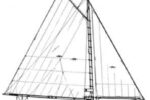
A Spencer 35 has a mid-1960s CCA-type hull with gentle overhangs, a cutaway forefoot, and an 8-foot-long keel (see Good Old Boat, September 2004). The rudder is hung on the angled sternpost at the back of the hull on three cast bronze gudgeons. Each is bolted to a solid glass layup at the sternpost with 6 1⁄4-inch bronze bolts. A 2-bladed propeller is (or was) set in an aperture.
Turned vertically
Normally when sailing, I turned the propeller vertically to fit within the aperture to reduce drag and locked the propeller in place by putting the engine gearbox lever in reverse position. I used a painted mark on the propeller shaft (viewed from inside the boat) to line up the propeller. This kept the propeller blades from sticking out to pick up lines and supposedly reduced the drag of the blades by hiding them within the aperture. Of course, this was all fairly standard stuff.
My naval architect friends told me the flow through the aperture from the high-to the low-pressure side of the hull was significant and that the drag of the propeller blades was disastrous for good sailing performance. I envisioned various schemes to get rid of the terrible aperture and propeller blades, but I didn’t know how to do it. I sighed and resigned myself to the restrictions inherent in the basic design of the yacht.
In 1980, just before Margaret and I set off on a sailing trip around the world, I decided to install a new engine.
Since my weight-reduction program (for the yacht, not the captain) was continuing, I chose a 1-cylinder 11-hp Farymann diesel that weighed 245 pounds instead of the 485 pounds of 23-hp Volvo MD2B that we had used previously.
I wondered if I could install the new engine on mounts so the engine shaft would be horizontal rather than inclined 15 degrees downward as the old Volvo was. If I did this, maybe I could run the shaft and propeller out behind the rudder (but still well below the waterline). To solve the resulting conflict between the new shaft and the rudder, perhaps I could lower the area of the rudder slightly. This would place the propeller above and behind the rudder. This step would necessitate a change in the shape of the rudder, but the naval architects told me that the shape of the old rudder was obsolete.
“Make a new rudder with straight lines like a 12-Meter,” Germán Frers Sr. had advised me when we were hauled out in Buenos Aires on an earlier voyage.
“I’m sure the yacht will steer better with more rudder area down lower,” counseled the late John Brandlmayr, Whisper’s designer, when we were in British Columbia.
Who was I to argue with experts?
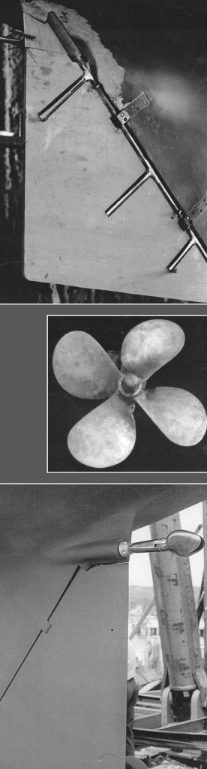
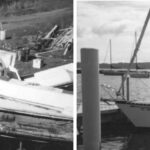
The culprit, at center: the blades of a fixed propeller will ruin any reasonable slow-speed sailing performance.
A view of the new rudder and propeller arrangement, at bottom, from the port side showing the Martec folding propeller, the shaft and propeller zinc, and how the new rudder has been carefully faired into the hull.
Shaft problem
I still had the problem of how to get the propeller shaft past the rudder shaft. Certainly I couldn’t run the propeller shaft through the rudder stock. In an old book by Eric Hiscock I saw a photograph of a yacht with an offset propeller. Why couldn’t I move the new shaft to one side or the other to miss the rudder stock? The torque of the small diesel was modest. A 5-degree shaft offset was trifling. I decided to chance it and go ahead with the project.
It was a frosty autumn day when we took the boat out of the water and put her in a shed at Southwest Boat Corp. in Southwest Harbor, Maine. I hired an assistant, George, and we quickly removed the old Volvo and ripped out the engine mounts. In a few days George and I had new mounts made from two big slabs of mahogany and glassed them into position. It was easy to install the new German diesel because it was small and light. Now we turned our attention to the rudder.
Our boat was already 14 years old. Margaret and I were about to head out toward great unknown places where a rudder failure was unthinkable. What was the condition of the rudder shaft and the rudder tube? Were the metal pieces still good, or had they been eaten up by electrolysis and galvanic action? Would the rudder fail at some crucial moment? Since I planned to build a new rudder, I decided to replace all the metal parts. I would need a rudder shaft with three brazed or welded metal fingers that would be built into the new rudder. In addition, the new engine would require a longer shaft and a new shaft log. Six new pieces in all, seven if I replaced the heavy-walled rudder tube.

Expensive Monel
“By all means use Monel for your rudder parts,” advised an engineer friend. “You can weld it, and nothing is stronger and more corrosion-resistant.”
I telephoned a metal salesman in Massachusetts. “Only $2,200 for the seven pieces,” said the man. I almost dropped the telephone. (A quote in 2005 was $3,647.)
That afternoon a man in the boatyard showed me a Monel shaft that was half eaten away by corrosion, probably from an electrical leak. Since Whisper had had bronze before, I decided to continue with the same metal. However, there were half a dozen varieties of so-called “bronze,” some with up to 37-percent zinc. I telephoned an engineer at ASARCO in New Jersey.
“Why didn’t you call before?” he counseled. “I’m here to help people like you. Of course you don’t want high zinc content around salt water. I think you need bearing bronze, which has only a trace of zinc.” He suggested a stainless-steel propeller shaft of AQ-22 and advised hanging a few sacrificial zincs on the metalwork. The seven new pieces cost $301. (A quote in 2005 was $1,348.)
It was a big job to remove Whisper’s rudder. Because of the long rudder shaft that extended up into the cockpit, the standard techniques are either to dig a deep hole in the floor of the boat shed or raise the vessel in order to slip the rudder and shaft out from the hull. Since the boat shed had a floor of reinforced concrete, we had no choice. We began a series of jacking and blocking moves while constantly adjusting the shores to keep the yacht from falling over.
With a small hydraulic jack, large wooden blocks, and patience we managed to get the bottom of Whisper’s keel 3 or 4 feet above the concrete floor, high enough to drop the rudder and its long shaft.
Shaft hole
With the old rudder out of the way, we cut a hole for the engine shaft and fitted and began to align the 30-inch stern tube. We now had to deal with bearings for the propeller shaft inside the stern tube. At the after end of the stern tube I gently tapped a rubber Cutless bearing into place. To support the forward end of the shaft I had a machinist press in a small bronze bearing about 3 inches from the forward end of the stern tube. We tapped the stern tube at this point for a small copper line that would lead upward for a couple of feet to a convenient screw-down grease fitting. (Today I would make the bearing of Delrin plastic, fit it at the forward end of the stern tube, skip the grease fitting, and figure on sea water to lubricate the plastic.) The stern tube jutted forward into the bilge for about 3 inches to leave room to slide on the stuffing box hose and two Grade 316 stainless-steel hose clamps.
Since I am the world’s greatest fusspot, I was concerned about the bond between the stern tube and the hull, so I had the machinist knurl the thick-walled bronze pipe. I reasoned that glass and resin would stick better to a roughed up metal pipe than a smooth one.
George and I then wiped off everything with acetone, coated the surfaces with epoxy, and slipped the stern tube into place. We fitted a small rectangular bronze plate (about 3 inches x 5 inches) over the stern tube to secure its forward end. We sank four 3⁄8-inch lag screws into the glass layup (with Marine-Tex epoxy) to hold the plate. The whole assembly would never leak.
Wouldn’t budge
Now I was free to turn my attention to the new rudder. Since I had decided to replace the rudder tube I had to remove the old one. I hammered and pushed and pried and swore, but the old tube wouldn’t budge. Even a small hydraulic jack did nothing. I finally discovered that the Spencer Boat Co., the builder, had brazed a flange on the rudder tube and then had glassed the flange in place inside a hull stringer, a fiendishly clever (and strong) installation but one calculated to drive future mechanics to despair. After removing the old rudder tube (and half-destroying it in the process) I concluded that the metal was in perfect condition. Still, I was pleased to have removed and replaced the metal pipe to ease my nagging doubts about its condition.
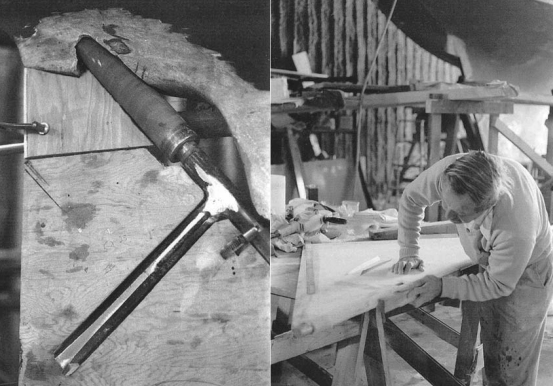
An expert welder carefully brazed the bronze fingers to the new rudder stock. I made a plywood core and laid up laminations of glass and resin around the stock and over the plywood. The scheme was labor-intensive and slow, but I gradually built up a strong assembly. With carefully scribed centerlines, a long straightedge, a red grease pencil, a grinder, and patience I began to get a streamlined fin. To fill in the hollows and to achieve a feather edge on the aft and bottom edges, I used micro-balloons and epoxy, a superior and easily sanded compound. When I was through I put one layer of glass cloth and epoxy over the fairing to tie everything together.
Over time, I have learned that the best grinding scheme for me is to lay a 3-foot metal ruler over an area to be smoothed and to mark the high areas (mountains) with a red grease pencil. Then I hit the red marks with the big grinder (or sander), taking care to keep the machine level. Depressions (valleys) need to be brought up with filler. If it’s a structural area I add layers of fiberglass mat and epoxy or Marine-Tex epoxy by itself; if it’s merely cosmetic, I use lighter fillers.
Morning person
I’m best in the morning when I’m rested and have steady arms and hands. By grinding a little and then re-marking with the ruler and red grease pencil, it’s astonishing what I was able to accomplish. I find that if I get tired and my hands and arms tremble, my work suffers.
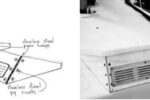
I fitted the new 48-inch rudder tube (also knurled) and glassed it into place, both inside and outside the hull. Next, I filled in the old propeller aperture and shaft log hole, and put a piece of plywood above the new rudder to serve as a base for building up the hull, which now came down a bit lower (see photo above). Little by little, everything went together. I faired-in the gudgeons after I hung the new rudder.
With the new appendage in place, George and I lowered Whisper from her tippy perch. Now I could easily reach the new shaft to install the Martec folding propeller and zincs. One day we called in the yard gang and dragged Whisper to the dock crane and lowered her into the water.
“What about the performance?” I can hear you say. “Did the scheme work out, or was it all a waste of time?”
The little 11-hp Farymann worked to perfection and drove Whisper about 5 1⁄2 knots in smooth water, almost the speed that the old Volvo produced, with half the weight. Under power, she tracked almost straight ahead. I believe the reason for the improved performance was because the propeller operated in clear water and was unencumbered by the restrictions of the old propeller aperture. Another factor could be that the propeller diameter, pitch, and design combination was better suited to the yacht and her weight. When I spoke with the Martec people, they asked me for a dozen numbers, which they put into their computer before recommending a propeller diameter and pitch. Of course the first question I always heard was “What happened in reverse? Did you hit the dock or did the propeller actually pull you astern when you put the engine in reverse?”
Worked well
I can say honestly — I paid cash for the propeller, a 16-inch diameter, 14-inch pitch model — that the Martec prop worked well in all conditions, both ahead and astern. However, I don’t approach docks at 5 knots because I think such maneuvering is ill-advised. I come in at 2 or 3 knots and, when I put the engine in reverse and speed it up, the boat stops smartly. In truth, I really don’t have much to do with docks and marinas because I prefer to anchor out somewhere. But that’s another story.
Much of my sailing pleasure comes from sailing in and out of complicated harbors and anchorages. However, I’m the first to admit that the occasional use of a little engine is handy, especially if you have to shift your anchorage in a crowded harbor at night. And for generating a little electricity.
With regard to sailing performance with Whisper’s folding propeller, no aperture, and streamlined rudder, I can tell you that she sailed very much better at low speeds. At 2 to 4 knots the little boat definitely glided along easier and was more maneuverable. With stronger winds and higher speeds, I don’t think the propeller made any difference because the increased drive (horsepower) available from the wind and the gain from the rudder and propeller improvements was a less meaningful fraction of the total drive equation. Or you can change the words and say that at low speeds the improvements from the lessened propeller and aperture drag mean more.
Of course, with such an arrangement we had no worries about picking up lines from lobster pots or fishing traps because the hull was as smooth as a dolphin, with no propeller blades sticking out to snare things. I suppose that I’m prejudiced and really have no way of measuring these changes quantitatively, except that when we sailed along with other yachts in light air we generally slipped past the yachts dragging fixed propellers. At sea in very light going, when every advantage is a big step, I think we were way ahead.
Thank you to Sailrite Enterprises, Inc., for providing free access to back issues of Good Old Boat through intellectual property rights. Sailrite.com