Lose yourself in the mystery of the universe
Issue 48 : May/Jun 2006
We hardly get to see the sky at night anymore; electric light has all but banished it. Anywhere near a city, the atmosphere reflects the glare of our street-lights, causing even the clearest sky to glow dimly and obscure all but the brightest stars. Even away from town — in the country or near the water — there seems to be a bright light nearby to ruin our night vision and distract us from the heavens above. It wasn’t always this way.
Before artificial lighting, even city dwellers were familiar with the stars and the constellations, the motions of the Moon, Sun, and planets, and how it all relates to time, tides, seasons, direction, and location. In ancient times, people may have been ignorant of the true nature of the universe and Earth’s place in it, but at least they were able to experience it directly. Now, even those who work outdoors after dark — policemen, farmers, and mariners — rarely look up at a clear, moonless sky and just wonder.
In order to see the stars as our ancestors did, professional astronomers retreat to remote mountaintop observatories and amateur stargazers drive for hours or contemplate buying retirement homes in wilderness communities. Sadly, most of our children have never really seen the sky at all.
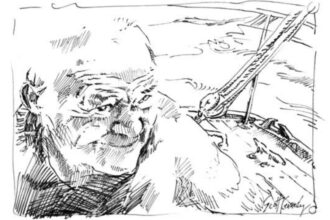
Fortunately, people with boats have access to the heavens, and not just for navigation but as a profound experience in its own right. On a long passage or at anchor in some remote lagoon, a starry night is an invitation to stretch out on deck and just look up. At times like this we can all see the sky as our most distant ancestors did.
Forget what you’ve learned . . . no telescopes, textbook diagrams, Carl Sagan, or Astronomy 101. This isn’t about what the sky is or how it works, it’s about experiencing it directly, on an emotional and spiritual level. See it the same way the Polynesians did from their ocean-going canoes and the way Odysseus did on the way home from Troy. Learn the sky by actually looking at it, the way you learned the sea and the weather. You may be surprised by how little you really know and how much those ancient mariners understood that you don’t.
Lie on deck
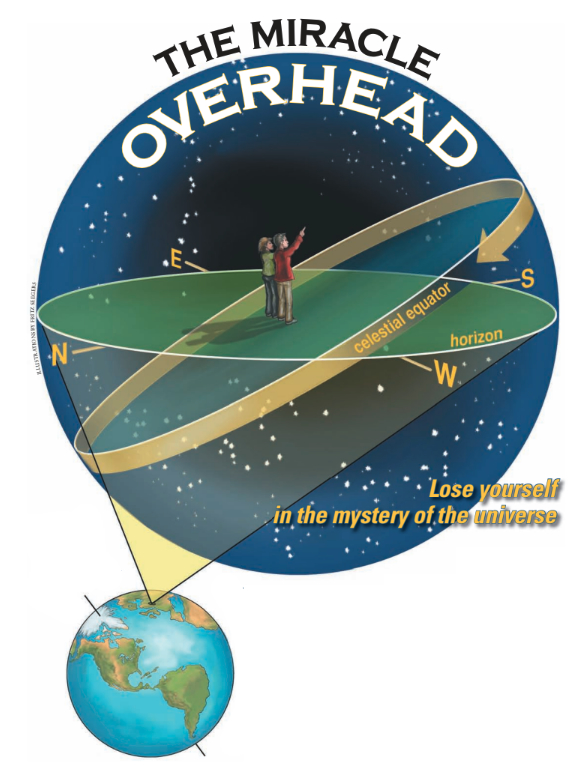
Choose a clear dark night with no moon. Lie down on deck. Look up and memorize a few of the brighter stars and constellation patterns. The first thing you’ll notice is that they move. They don’t move among themselves, but the sky itself moves, as a unit, slowly, at half the speed of the hour hand of a clock. It’s as if the sky is a huge black sphere completely surrounding the Earth and the stars are glowing dots painted on the inside of it. Actually, this is what everyone believed until after the Renaissance. It’s the celestial sphere, or the firmament, as the translators of the King James Version of the Bible called it.
Although we know today that we’re really not in a big black sphere, it is still a useful metaphor to help understand what we see above us. The old-timers were able to navigate ships and predict eclipses with this concept, so it’s nothing to be scoffed at. As the celestial sphere slowly rotates about the Earth, the stars are dragged along with it since they remain rigidly attached to the inside. This is why they are called the fixed stars.
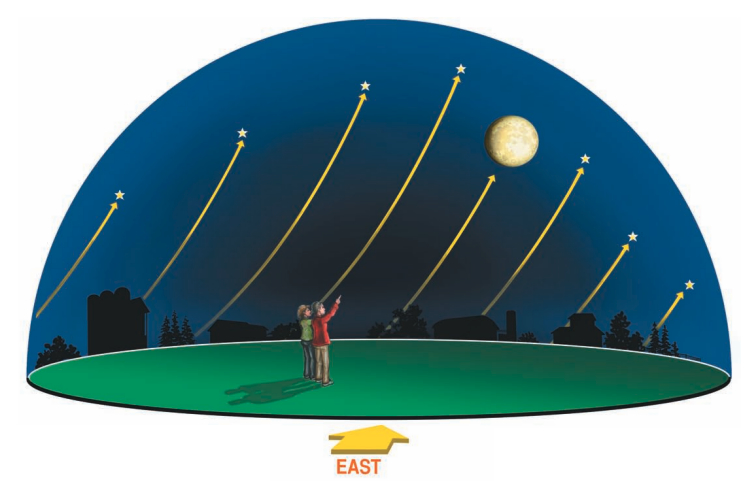
It takes the sphere about 24 hours to rotate around the Earth. The stars become visible as they come out of the sea in the east. They then travel slowly around the sky to set eventually in the west. The Sun is attached to the inside of the sphere, too, and it will eventually rise out of the sea in the morning and follow the stars around the sky until sunset. The fixed stars will still be there, but they won’t be visible because of the glare. The ancients called the amount of time it took the celestial sphere to go once around the Earth a sidereal day. We know it today as the amount of time it takes the Earth to spin once around its axis, relative to the distant, fixed stars.
But we set our clocks by the Sun, not by the stars, and if we go out the following evening at the exact same time (one solar day later) we will notice that the stars will be just a little bit ahead (west) of where they were the previous night. In fact, every one of the fixed stars rises about four minutes earlier than it did the night before.
Quite noticeable
This isn’t immediately obvious from day to day, but over the course of a few months it becomes quite noticeable. Stars that were just starting to rise around sunset are now quite high in the sky when it gets dark, while stars setting shortly after sunset will now be too close to the Sun to be visible at dusk. In this way, the stars that are lost in the Sun’s glare during the day gradually change places with those on the night side, so that half a year later the daytime stars are visible at night, and the nighttime stars of six months earlier are invisible in the daytime. For this reason, we have spring, summer, fall, and winter stars and constellations.
The reason for this is that the Sun is not a fixed star. It is free to move on the celestial sphere, creeping among the fixed stars from west to east in the opposite direction of the sphere’s turning, like an ant walking around on the surface of a spinning basketball. It takes the Sun a full year to travel all the way around the celestial sphere. Of course, we know now that the Earth rotates on its axis every 24 hours and revolves around the Sun once a year.
As the Earth spins out one sidereal day, it has also moved along its orbit about a degree, so it has to turn for four minutes more before the Sun returns to its original position (one solar day). But the old-timers saw the celestial sphere turning at a constant daily rate with the Sun slowly moving along it on its own yearly path through the fixed stars, the ecliptic. The 12 constellations along the ecliptic they named the “zodiac.” It is a testament to the failure of our educational system that most people today know the meaning of the latter term, but not that of the former.
The ecliptic
It takes the Sun an entire year to travel around the celestial sphere. The Moon, on the other hand, makes the trip in about a month. If you watch it for several hours during the night, you can actually see the Moon moving very slowly among the fixed stars from west to east, in the direction opposite to which the sphere is turning. The Moon’s path on the sphere is close to, but not the same as, the ecliptic, which means the two intersect at two places. This is where lunar and solar eclipses can take place.
The Moon revolves about the Earth, but the planets revolve about the Sun so their paths on the celestial sphere are quite bizarre, although they, too, are close to the ecliptic. The inner planets, those closer to the Sun than Earth, are always near the Sun on the sphere and can usually be seen only shortly after sunset or before sunrise. The quaint term is “evening star” or “morning star.”
The outer planets, which circle the Sun further out than the Earth does, can be found anywhere along the ecliptic; their positions, brightness, and speeds vary enormously depending on the relative positions to us, their positions on their orbits, and Earth’s position on its orbit. The planets will move among the fixed stars, but their motion is slower, not noticeable over just one night. Confusing? You bet. That’s why it took mankind 5,000 years to figure it out.
Still, once you learn the brighter stars and constellations along the ecliptic, you’ll quickly be able to pick out the planets as the ones that don’t belong there. But don’t worry about the wanderers yet. Focus your attention, for the time being, on the celestial sphere itself and the stars fixed on it.
Angled paths
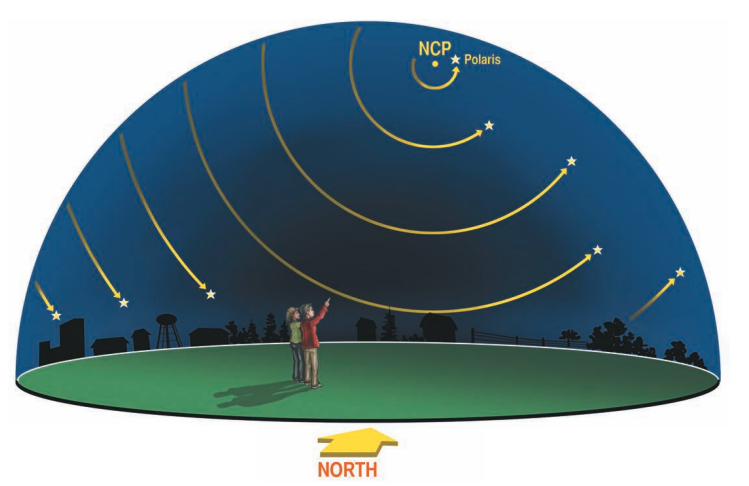
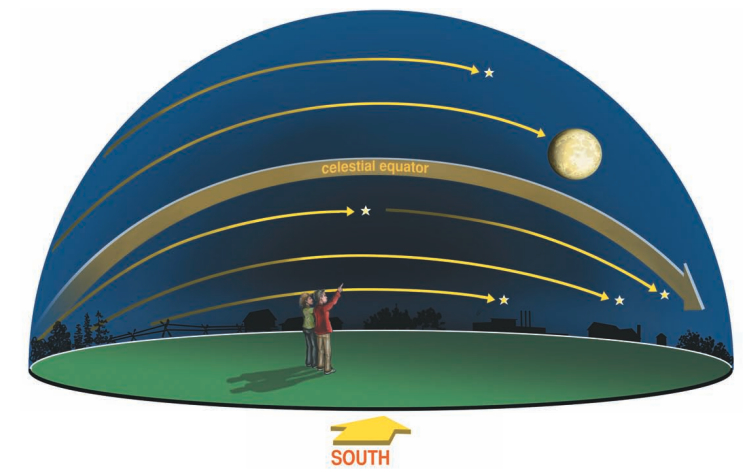
The second thing you’ll notice about objects on the sphere is that they don’t rise straight up out of the horizon; their path is at an angle to it. In other words, the stars and other celestial bodies’ paths are not perpendicular to the horizon when they rise or set. It’s as if the celestial sphere were tilted at an angle, or more precisely, its axis of rotation is tilted relative to the surface of the sea. Remember, the sphere completely surrounds the Earth, so there are spots on the sphere directly above each of the Earth’s poles, conveniently named the celestial poles; likewise, that part of the sphere over the equator is called the celestial equator, an imaginary line which divides the sphere into a northern and southern hemisphere, just like the Earth below it.
As the sphere rotates on the axis through its (and the Earth’s) poles during the course of a sidereal day, its appearance will depend on your latitude (how far north or south of the equator you happen to be). For example, if you are at either pole, the stars don’t rise and set at all. They travel around the sky on paths parallel to the horizon and the celestial equator coincides with your horizon. That’s how the midnight Sun works.
At the equator, the stars do rise straight up out of the horizon on a perpendicular course. And another thing, the celestial equator is directly overhead there, going from east to west with the two celestial poles precisely at the northern and southern horizons.
Equal to your latitude
At latitudes between the equator and poles, the spin axis of the sphere is at an angle, and that angle is equal to your latitude. So in my home in Florida, at latitude 26 degrees north, the north celestial pole is 26 degrees above the northern horizon. Fortunately, there is a fairly bright star, Polaris, very close to the pole so I can easily locate it (and the direction of true north) by just memorizing the star patterns around it. Furthermore, stars less than 26 degrees away from the pole never set for me, they just go around it in a big circle. They are called circumpolar stars. Using similar reasoning, it is easy to visualize where the southern celestial pole is, 26 degrees below my southern horizon. Of course, I can’t see it, the Earth is in the way. But south of the equator it is clearly visible and higher in the sky the farther south I travel.
Unfortunately, our friends Down Under don’t have a bright star to help them find it. They have to memorize the surrounding constellations to locate their south pole. Consequently, as sailors travel north or south on the sea, they can actually see the angle of the sphere’s axis change, the whole bowl of the sky will shift, exactly one degree for every 60 nautical miles they travel north or south.
Congratulations
You now know all the astronomy you need to do celestial navigation. From the geometry described so far, it should be clear that unless you are precisely at the equator, there are parts of the celestial sphere that you will never see, since the body of the Earth will be in your way. At the poles you can see only one hemisphere of the celestial sphere and at points nearer the equator, as you leave the poles, you get a chance to peek further down into the other hemisphere, but never all the way. Even at my southerly location in Fort Lauderdale, I can’t see any star located less than 26 degrees from the south celestial pole. They will never rise above my southern horizon.
By now you may be wondering, “Why is the ecliptic, the solar path among the fixed stars, not the same as the equator?” To put it another way, why is the ecliptic tilted with respect to the equator (about 23 1⁄2 degrees) so that the Sun spends six months north of the equator and six months south of it? The short answer is that the Earth’s axis of rotation is not perpendicular to the plane of revolution of its orbit around the Sun. The Earth leans over 23 1⁄2 degrees, its axis pointing at the north celestial pole, locked into place by the powerful gyroscopic force of a planet spinning over 1,000 miles an hour at the equator.
Incidentally, this means that the Sun can never be directly above you unless you are within 23 1⁄2 degrees of the equator. This is why the Tropics of Cancer and Capricorn, two parallels of latitude 23 1⁄2 degrees north and south, respectively, are defined on maps. They mark the extreme limits of the Sun’s path through the celestial sphere, or the summer and winter solstices.
The equinoxes
The points where the Sun crosses the equator on its yearly journey around the sphere are the spring and fall equinoxes. When the Sun is at the solstices, any observer less than 23 1⁄2 degrees from the appropriate pole can see it all day long; it will not set. At the opposite pole, the long polar night will reign, and the Sun will not rise. The parallels that mark these limits, the Arctic and Antarctic Circles, are located 23 1⁄2 degrees from the Earth’s north and south poles, respectively.
The motions and geometry of the night sky can best be appreciated by going through the cycle for several years, watching the daily repetition of rising and setting, the monthly cycle of the Moon, the yearly path of the Sun, and the gradual rolling of the bowl of night as your ship crosses, at a human pace, a substantial portion of the planet you live on.
The planets also impose their own complex rhythms, each one changing wildly as they race each other around the great circular tracks of their orbits, passing and overtaking, falling behind and ducking into the blue glare of daylight, their complex motions being a projection onto two dimensions of the simple and elegant three-dimensional architecture of the solar system.
Just a little knowledge will go a long way to attuning you to these rhythms and cycles. Like the old Babylonians, you will come to accept the night as not just undifferentiated chaos, but a functioning clockwork, the mechanism of the universe beautifully explained and even more magnificent in its grandeur and majesty than when it was clouded in mystery and ignorance. What’s more, your appreciation of these simple geometric relationships of time and geography will allow you to look beyond to other levels and deeper into the sky itself.
The Milky Way
Also attached to the celestial sphere is the Milky Way, a cloud-like glowing band of starlight that completely circles the sphere, cutting across the celestial equator at an angle of about 60 degrees. With even the slightest optical aid, such as your binoculars, it resolves into a mist of stars, untold millions of them, stretching off into infinity. To the naked eye it is a mysterious object, very like a cloud, although it is clearly fixed to the celestial sphere and shares its motion. The unaided eye reveals knots and clusters, bright and dark nebula, sudden brightenings and clumpings of starlight. The slightest light pollution, even the natural kind from our Moon, will cause it to disappear, but on a dark clear night its icy-pale glow and the belt of bright stars that accompanies it is one of the most breathtaking sights nature has to offer.
The Milky Way used to be available to everyone; now most people have never seen it, and those who have been lucky rarely saw it under ideal conditions. It is absolutely staggering, particularly near the bright central bulge, most easily visible from the tropics and farther south. The Milky Way is our home galaxy, seen edge on, the only way we can see it because we are embedded in it.
Our Sun is just one of billions of stars in the galaxy and everything we see with our naked eye at night is part of that great round and flat stellar system. Our Sun is about halfway out from the center, and when we look about the celestial sphere we only see the thin mist of Milky Way stars between us and the cold and dark of extragalactic space. But when you look at the Milky Way you are staring into the disk along a hundred thousand light years and a hundred billion stars.
Fear not that a little knowledge of astronomy will destroy the beauty and wonder of the night sky. The more you know, the better it gets.
Thank you to Sailrite Enterprises, Inc., for providing free access to back issues of Good Old Boat through intellectual property rights. Sailrite.com