How to lessen the danger of cooking with propane
Issue 49 : Jul/Aug 2006
We know that 90 percent of people who sail do their cooking with liquefied petroleum gas (LPG) because modern propane stoves are quick, clean, and convenient. As long as propane (or butane) is kept under control and handled properly, it’s a miraculous fuel.
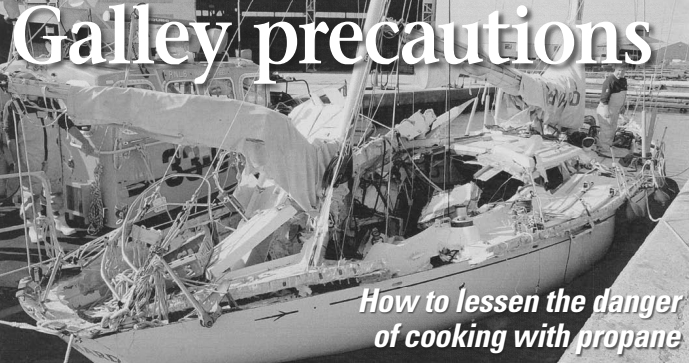
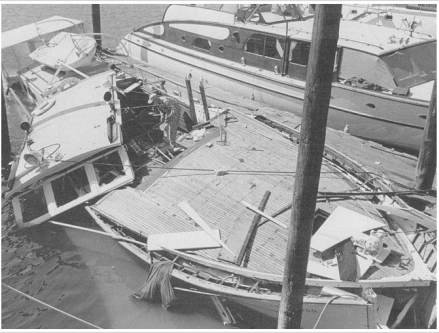
Unfortunately, LPG is heavier than air. If it accidentally leaks inside a boat from one of the small metal tanks where it’s kept under pressure, or from any parts of the stove plumbing, the gas will silently settle into the lower areas of the interior and bilges. Then if ignited, perhaps by a spark from a motor, it can blow a vessel apart with force comparable to exploding dynamite or TNT.
I’ve seen and heard this happen to two yachts that were near mine. Believe me, it’s a horrifying experience that I’ll never forget.
To utilize the advantages of gas, but to minimize the danger of accidental explosion, sailors and engineers have worked out a series of safe practices. You can be sure that each detail is important and has been added to the list only after tragic experiences. Some of these points may seem niggling, but each is significant.
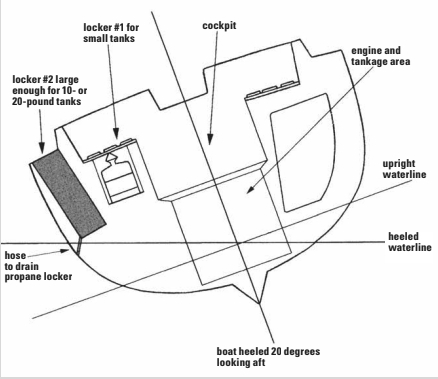
1. The gas bottle or bottles should be kept in a gas-tight deck locker or box with an over-the-side drain from the bottom of the container. Or the gas bottle can be simply mounted on deck or on the coachroof. Then if there are any leaks in the bottles, regulators, shut-off valves, or plumbing, the heavier-than-air gas will drain overboard and dissipate.
2. In practice, the gas-bottle locker is often a small fiberglass compartment with a tight-fitting lid. To prevent gas from leaking into the interior of the yacht, it’s important to seal the small opening through which the gas pipe or tubing is led from the box. This can be done with a generous slug of bedding compound, inside and out, or preferably with a special threaded, vapor-tight, nylon-and-rubber seal made especially for this purpose.
The overboard drain for the locker should be half-inch inside-diameter heavy-walled rubber or reinforced-plastic tubing. The drain should be plumbed so that it gently curves to a small through-hull opening well above the waterline (see drawing on Page 25). If the drain line is too long, it may curve below the hull opening on the inside of the hull. The resulting half-loop or kink can form a water trap and stop any leaking gas from draining overboard. This may sound like an over-fussy detail, but it’s not.
To test the drainage, pour a little water into the box and watch the through-hull on the outside. You may be surprised.
In some yachts, particularly smaller boats under 35 feet, it’s a problem to find sufficient vertical room for a locker to take the bottles that is still high enough above the waterline for the locker to drain when the vessel is heeled. Let’s not forget that people eat and use cooking stoves when yachts are heeled. If the gas-bottle locker-drain exit is under water, the whole point of the locker is invalidated. Or said another way: in their quest for lines smooth to the eye and a wish to keep such mundane things as gas bottles out of the way, architects may locate the gas bottle locker too low for it to drain properly in all conditions of usage. I believe this is a reasonable argument for keeping gas bottles on the coachroof or in a deck locker.
3. The copper (recently annealed) or special rubber line (a better choice) that runs from the gas bottle locker to the stove should be of the highest quality. The usual LPG hose is designed for use at 350 pounds per square inch of pressure (psi), while the actual gas pressure (after going through the regulator) is only 0.5 psi. This means the hose is actually using only 1⁄700 of its normal pressure capability. This line should be one continuous piece, carefully sited, and fastened so it doesn’t chafe on anything. When you measure the length, add a couple of feet to your figure; it’s easier to cut off a little than to be short.
Some people go to the trouble of routing the propane hose inside lengths of PVC pipe, but that may be overkill and it makes it harder to inspect the hose. The flexible hose needs a little slack here and there and protection where it goes around corners. Small PVC pipe hangers or pieces of split garden hose glued to the inside of the top areas of lockers may help in running the hose. It’s best if you can route it out of the way so you’re not tempted to grab it accidentally when you open a locker or are working on the engine. When the line is connected to the stove (either with a special threaded fitting or two hose clamps), the joint should be tested under pressure with a soap solution. When you’re fitting this line, allow enough slack so a gimbaled stove can swing easily between its extreme movement limits.
The electric wires for the on-off solenoid in the propane locker need to be properly bedded or run through a special seal where they go through the wall of the gas bottle locker.
4. All the pipe fittings inside the gas locker (regulator, pressure gauge, solenoid control valve, pigtails, adapter fittings) should be connected to one another with Tefl on tape or special thread compound and carefully tested — under pressure — with soap solution. The sole function of the pressure gauge is to spot leaks in the system.
The pressure gauge has nothing to do with the amount of gas in a cylinder. This is determined by weighing the gas bottle.
5. The electric solenoid inside the gas-tight locker is a small shut-off valve that turns the gas flow on or off. The switch for this valve should be located in the galley and usually includes a prominent red light placed at eye level. When you’re ready to use the stove, you start the gas flow by flipping the switch to “on,” which also turns on the red warning bulb. You light the stove and proceed with cooking.
When finished with the stove, but while a burner is still alight, you turn off the switch, which closes the solenoid in the gas-tight locker or wherever the gas bottle is located. The flame in the burner continues until it uses all the gas in the line from the propane tank. When the flame goes out, you turn off the burner valve and you’re done. The stove is out and the gas has been shut off. Everything is safe.
Note that the gas has been shut off at the bottle inside the gas-tight locker or wherever the gas bottle is located. Additionally, the solenoid is constructed so that, in case of a general electrical failure, the valve will close. Some people take the additional step of going to the propane tank and physically turning off the gas valve at the bottle.
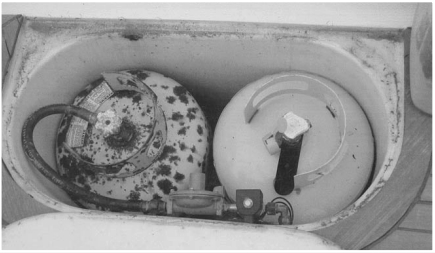
6. If there are two gas bottles in the gas-tight locker and one becomes empty, the gas flow stops. You have to go to the locker and either turn a valve to connect the other bottle, presumably full, or physically disconnect the empty bottle and connect the other. Note that the tank and mating pigtail gas line have left-hand threads, which means that you turn the wrench in the opposite direction. (Leave a wrench for this job permanently in the locker so you don’t have to fumble when you change bottles in the middle of cooking. Wrap the wrench in a rag to stop mysterious noises.)
When you change bottles is the moment to pay attention to the pressure gauge that’s generally part of the regulator. When you hook up a full cylinder, check that you have the solenoid closed (red light off). Then do the following:
- Open the main valve on the new gas cylinder to charge the lines, regulator, and pressure valve inside the gas- tight locker with gas under pressure.
- Close the main valve on the gas cylinder.
- Note the pressure gauge reading, which should not change during a three-minute period. If it changes, something is leaking.
7. In addition to the six considerations listed above, a propane gas detector can be installed in the bilge of the boat. In the unlikely event of gas leaking into the interior of the vessel, the detector will give a visual and audible alarm.
8. As I mentioned earlier, you can make a strong argument for mounting a gas bottle out in the open on the deck or on the coachroof, particularly on smaller yachts. Then if the LPG bottle or plumbing leaks, the explosive gas will flow harmlessly overboard. You turn the gas on and off at the tank itself. Depending on where the tank is mounted, this means reaching out through an opening hatch or portlight or climbing on deck. This is a safer arrangement than using a locker whose drain line can be blocked, either by poor design, by improper fabrication, or by a quarter wave when the yacht is heeled and sailing fast.
Additionally, a manual shut-off valve is simpler and more positive than an electric solenoid. But you have to remember to go out and shut off the valve.
Of course, a gas bottle mounted above the galley on the coachroof next to the boom gallows or aft of the cockpit is much less attractive than if it’s tucked away inside a hidden locker. The bottle — perhaps a tall, small-diameter aluminum cylinder mounted on its side — can be disguised by covering it with a plastic storage box. A milk box or its equivalent with open mesh or slat construction held down with a couple of pieces of shock cord works well, is simple and quick, and looks surprisingly functional.
Often, exterior bottles are mounted on deck behind the cockpit, with the bottle in use on one side and the spare on the other. Such bottles need stout wooden or metal mounts and sometimes line guards to keep main and mizzen sheets away.
Added stink
In its natural state, propane is odorless. However, to help detect leaks and alert people to the danger of an explosive gas, a chemical (ethyl mercaptan) is usually added to give the gas a pungent and distinctive smell. This odor is often described as similar to overripe chopped cabbage, rotten eggs, or decayed food. If you detect anything like this, shut off the gas, stop all forms of spark or fire emission, and start testing the fittings with a soap solution.
About 25 years ago, compressed natural gas (CNG) was introduced to the boating market in the United States. CNG is lighter than air, which means that it dissipates upward and will not flow into the bilges of boats if there is a gas leak. Everyone thought that CNG (with a specific gravity of 0.67, a bit more than half the weight of air) had a great future because it was so much safer. Certainly, it would eclipse the bottled-gas market. Regrettably, CNG, in spite of its inherent advantage, failed to catch on and, like the Edsel car and the smokeless cigarette, has faded from the scene.
How much propane should a person take along? A rule of thumb is that one person will use 1 pound of gas to cook meals for one week. According to this, a 10-pound gas cylinder will supply cooking for two people for five weeks, three people for 3.3 weeks, and so on. For additional people, however, the amount of gas needed grows proportionally less since one cooking of spaghetti (or whatever), even with more in the pot, will do for the whole crew. Many cruising yachts carry two 20-pound bottles.
Using more fuel
When a sailboat goes to the high latitudes, the people on board invariably use more cooking fuel because all hands want bigger and heartier meals. Everyone eats more in Alaska than in Guatemala. Friends who have sailed to the high latitudes have reported running out of cooking gas and having only one hot meal a day, a dreary prospect.
I have asked my sailing friends about propane consumption, but the answers have been so varied and vague that I hesitate to give any hard numbers. I suggest that you keep a written record in the log or the ship’s book each time you change and fill the gas bottles. Or if this is too much trouble, take a red grease pencil and write on the gas bottle the date you begin drawing from it. Then when it’s empty you will know how many days it lasted. This will help you evaluate your system and your cooking habits.
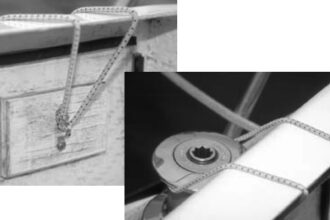
Try to use the best components and take care with the installation of your propane system. Once in place and working, it will function properly for years. Don’t forget to check the connections occasionally with a soap solution. And watch out for chafe on the propane hose in the stove area. Sometimes a piece of weak shock cord or a short piece of small stuff dangling from a screw eye will keep the hose out of trouble as the stove swings back and forth.
Thank you to Sailrite Enterprises, Inc., for providing free access to back issues of Good Old Boat through intellectual property rights. Sailrite.com