Fiberglass boats begin their next half decade
Issue 50 : Sept/Oct 2006
This year marks the 50th anniversary of the birth of the type of boats featured in this magazine. It was 1956 when Aeromarine, née Coleman Plastics, launched the first series-produced fiberglass auxiliary sailing yacht. The boat was the Phil Rhodes-designed Bounty II, a full-keel wineglass 41-footer with a sheerline like a lover’s sigh. One could hardly conceive a better first good old boat than the Bounty II. It is eye-pleasing, seaworthy, and, it turns out, deceptively fast.
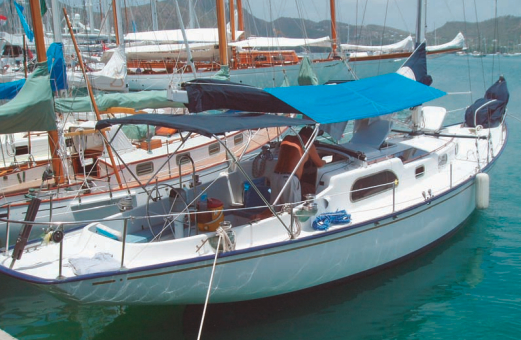
As I write this in April, a Bounty II cruising in the eastern Caribbean (shown in photo) showed her transom to boats 10 feet longer and 30 years more modern in the Antigua Classic Yacht Regatta. Not only did Sunshine win her class on corrected time, she also arrived at the finish line first. The same boat had just come from posting a clean sweep in the St. Maarten Heineken Regatta, beating a pair of Beneteau 38s, a fin-keel Cal 40, and half dozen other challengers. I normally don’t take much interest in sailboat racing, but when the class winner is a 48-year-old cruising boat sailing with a blade jib — no spinnaker, no genoa — it surely makes the case that the qualities of a well-executed sailboat are not diminished by age.
In a case of Jupiter aligning with Mars, this is also the 50th issue of Good Old Boat, a milestone worthy of note. The concept of this magazine is that the considerable pleasures of sailboat ownership need not be an onerous financial burden. This should not be a revolutionary idea. After all, the original impetus for constructing boats from fiberglass was to reduce the cost of ownership. That laudable objective seems to have faded in the ensuing years, with today’s “Best Boats” lists in mainstream sailing magazines regularly praising boats costing $400,000 or more as a good value. Really? What does that say about a boat of equal capability priced at $40,000?
Here is the reality. New boats cost what they cost because oil is expensive, labor is expensive, plant space is expensive, and product liability insurance is expensive. Boat manufacturers are not villainous. To the contrary, we owe them a huge debt of gratitude for the inventory of praiseworthy vessels they create, and we should not be- grudge them any profits they squeeze out of the sale of new boats. However, the remarkable longevity of fiberglass boats makes old sailboats one of the best bargains on the planet.
If you dream of catching the trade winds in your sails and you don’t have a half million bucks moldering under your mattress, you have come to the right place. Boats capable of fulfilling such dreams have been launched continuously for the last 50 years. And for the last 100 months there has also been a publication committed solely to showing the way to match boat and dream. So if you harbor the dream and don’t have a boat, buy one. Whether you will give it a new life or it will give you one is hard to predict. If you have the dream and the boat, make the leap. Dreams are less durable than boats. So is flesh. Don’t wait too long.
Don Casey wrote the first editorial in Good Old Boat’s first issue, June 1998. We thought it fitting to have him back as a guest editor once more as we publish our 50th issue.
Thank you to Sailrite Enterprises, Inc., for providing free access to back issues of Good Old Boat through intellectual property rights. Sailrite.com