A new concept for “sail training”
Issue 51 : Nov/Dec 2006
Our 20-foot Flying Scot had a longer boom than does our C&C 30. With such a short boom, our high-aspect mainsail can’t get into very much trouble when we drop it. It’s not control that we need, it’s order.
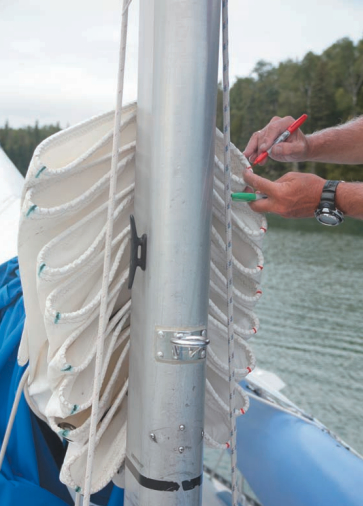
We want the main to flake neatly over the boom. A neat flake has alternating panels to port and starboard. Some years ago, when the sail was new, we made a very neat flake in calm conditions and then marked the luff of the main with red and green permanent markers to show which side of the boom the sail should fall on at that point on the luff. We did the same for the roach. These marks fade over the years and must be renewed from time to time.
Now, when we lower the mainsail, the person at the halyard at the base of the mast pushes the panels to port and starboard as they fall. Depending upon the size of the crew, the roach can be made neat at the same time by another person or later by the same person. The point is that once the luff is laid down correctly the roach can be made to follow with minimal effort. The main soon was so well trained that it almost always fell correctly with no interference (a new concept for the term “sail training,” perhaps?). Once flaked, we tie the sail with the tail of the sail’s reef lines, working forward, and the Cunningham, working aft. This works so well that no extra gear is necessary to control the main.
We use the same markings on our jibs to help us get them flaked prior to rolling and bagging.
Thank you to Sailrite Enterprises, Inc., for providing free access to back issues of Good Old Boat through intellectual property rights. Sailrite.com