Curing the clamminess under your cushions
Issue 53 : Mar/Apr 2007
My wife and I live aboard our 40-foot ketch in San Francisco Bay. The weather is relatively cool, and often foggy, for much of the year. These are ideal conditions for condensation and dampness. At laundry time, stripping the bed would often reveal a soaking-wet mattress sitting in a puddle of water. It was wet so often that the fiberglass under the mattress was blistering. Hauling the mattress on deck to dry out became part of our laundry day ritual. Fortunately, those days are over. We are happy to report that this problem, which affects almost every liveaboard vessel at one time or another, can be solved simply, cheaply, and permanently.
Where does all that water come from? I sweat. You sweat. Everybody does. Even though we may feel cool and dry, our skin is still evaporating water all the time. Usually the sweat doesn’t collect and drip off our skin; it evaporates into water vapor before we notice it’s there. This is the way things are and should not be considered a problem.
Problems start when that water vapor encounters a cool surface and returns to a liquid state. This is often in a place where we do not want it, such as inside our foul weather gear or under our bunk. While we sleep, the water vapor that has evaporated from our skin dissipates upward through our sheets and blankets, but it also moves down into the porous foam of the mattress. When that water vapor reaches the cool surface under the mattress, it returns to a liquid state in a location where evaporation is difficult or impossible. There it collects and soaks the mattress, grows mold and mildew, damages wood, and generally makes a smelly mess of things.
New solutions
Every other year there is a new vendor at the boat shows loudly proclaiming that his or her product has solved this problem. Traditional solutions approach this problem from under the mattress, since that is where the water is found. You can buy pads to place under the mattress to soak up the water, but they must be regularly removed and aired in order to eliminate the water they collect. Rigid porous mats can hold the mattress up off the surface and perhaps allow the water that accumulates every night to evaporate during the day. These products help, but none is a perfect cure. Fortunately, there is a better way.
As with most problems, it is better to target the cause than the symptom. As we have learned, the excess moisture doesn’t start out under the mattress. The dampness begins to accumulate where you sleep, on top of the mattress. There is no way to stop our bodies from sweating, but we can stop the water vapor from moving down through the mattress to the cold surface below. We accomplished this by putting a moisture barrier between the sheets and the mattress. Basically, the principle is similar to using a vapor barrier in home construction to prevent water from soaking building insulation.
There are several approaches, but let’s start with the case of a dedicated sleeping berth on a larger cruising or live-aboard boat. A berth like this is typically treated as a traditional bed and is covered with sheets that stay in place during the day.
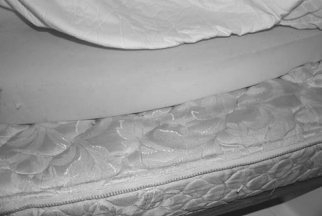
Go to the local linen store and buy a mattress pad that includes a waterproof vinyl layer. Get one large enough to cover the mattress. Don’t get a “breathable” cover. That won’t work in this case. If you don’t have a standard-sized mattress, it might take some sewing to make it fi t well.
Same temperature
You may be thinking, “A vinyl cover? I’ll be sleeping in a puddle of water.” Not true. Since the vinyl layer is on top of the mattress, it is at the same temperature as your body and the water vapor will not condense on it. The water vapor that previously went down into the mattress will evaporate and rise through the blankets. (You don’t use plastic blankets, do you?) Because the vinyl layer is under a thin quilted pad, you don’t even know it is there. If you are skeptical, try it out before you spend the time modifying the pad to a custom fit. Purchasing the cover is a very small investment. If fabricating a custom cover will exceed your sewing skills, you can simply use a spray adhesive to permanently attach the vinyl to the top of the mattress.
If your berth is needed as a settee during the day or covered with a heavy fabric, there is another possible approach.
Go to the linen store and get a vinyl mattress cover without the quilted pad. With the heavy upholstery fabric normally used on boat cushions, a pad is not necessary to keep the vinyl from feeling “crinkly.” Trim the vinyl slightly larger than the top of the cushion and slip it inside the cover on top of the foam. A couple of stitches or spray adhesive can be used to hold it in place if you have trouble with it sliding or bunching. Your condensation problems will be solved. If you are making new berth cushions, you might want to put the vinyl layer on top of the foam but under the batting.
Let it evaporate
It’s best not to cover the bottom. Just cover the top and, optionally, the sides. If any moisture were to fi nd its way into the cushion, it should be able to evaporate.
There are other benefits to having an impervious layer on top of foam cushions and mattresses, obvious to anyone who has ever had rain or (horrors!) salt water soak their mattress through an open hatch. The vinyl will keep most of the water off the mattress. It is much easier to deal with wet sheets than a soaking wet mattress.
If you still have water problems after taking these steps, look for other sources. Is condensation running down the hull and collecting under your berth? Adding insulation and a vapor barrier should help here. Are you sure that condensation is the source of the water? Could you have a leak?
People we tell about our great discovery often think this solution will be cold and clammy or wet and uncomfortable. However, if you have condensation problems under your berth, give it a try. Life aboard will be much more comfortable.
Don’t you just love boat projects that are capable of solving difficult problems with a minimum of cost and effort?
Thank you to Sailrite Enterprises, Inc., for providing free access to back issues of Good Old Boat through intellectual property rights. Sailrite.com