Renovation proceeds despite critics and admirers
Issue 53 : Mar/Apr 2007
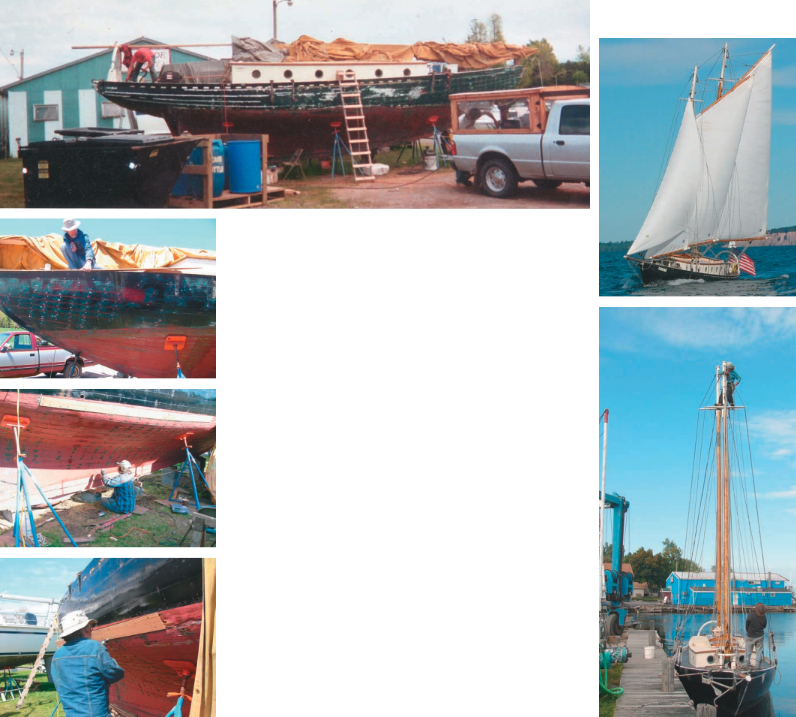
Ice still covered the silent white bay and snow lay knee-deep in the boatyard when we began renovating our “new” old yacht. In March, only the quiet hum of the dock bubblers sounded, though the strengthening sun had already begun to melt the snow atop the canvas cover. With a mixture of hope and dread, we eyed the 38-foot, 12-ton hulk before us. Would we really be able to revive her? This boat was huge.
She had entered our lives after a fateful foray onto eBay the previous fall. The 50-year-old woodie had arrived at the marina a few days before Thanksgiving aboard a transport rig and was promptly unloaded and covered up for the winter. Now it was time to begin the real work.
That March weekend, my husband and I removed the rudder, coming back the next day to find only our two sets of tracks in the unmarked spring snow. Over the next four months the ice melted, vast flocks of geese flew over, heading north, and the boatyard barn swallows returned in time for the lake’s annual spring midge hatch. The other land-bound yachts were launched one by one while we toiled on in the lengthening daylight, returning every weekend to perform another set of tasks associated with Sara B’s revival.
I cannot call what we did to our old schooner a restoration — rather, it was a phased renovation process. We had both seen full professional restorations of similar, somewhat larger, boats — one 49-footer at a cost of more than $200,000 and another 60-footer on the far side of a million plus. No, we were just fixing her up in the time-honored budget-limited tradition of amateur yachties who were also amateur woodworkers.
Neither of us had attempted a previous project of such magnitude. My husband had restored a 26-foot fiberglass boat purchased for $500 about 10 years ago. And I had kept a 1938 homebuilt 23-footer operational for 17 years. But this was well beyond what either of us had experienced in the way of boat fixing. And neither of us had ever worked so long and hard on a boat in public.
Bleed unseen
I had replaced plank butts, bottom fasteners, a chine log, deck canvas, a transom knee, and various other wooden boat parts in the relative seclusion of my yard at home in the city. Chris had patched holes and renewed keel bolts and interior rotted bulkheads in his rural driveway. In such a setting, one can stand and stare at the boat or sit in her cockpit and dream in complete privacy. When frustrated by a tough task, the rebuilder can go pull weeds or mow the lawn for a while as well as curse, weep, and occasionally bleed unseen.
But as March advanced into April, the boatyard came to life. The hum of sanders and waxers, the cheerful banter of weekend sailors, and the racket of hungry baby starlings tucked away in our neighbor’s aluminum mast butt accompanied warmer longer days. We toiled on, cutting, sawing, pounding, scraping, grinding, and sanding under the watchful eyes of the marina staff and customers.
Several people stopped by to share memories of their younger days when they, too, had owned wooden boats. One old salt eyeing a pile of fresh planer shavings said, “I like to see fresh sawdust in a boatyard.” One day we came down to uncover Sara B and found that someone had arranged some of the splinters and bits left on the ground beside her, after we’d removed a rotten board, in a curious pattern vaguely resembling the skeletal keel and ribs of a boat. Clearly this was a message of some sort. Give up? Persevere? Or just idle whimsy? Several times our next-door neighbor spoke of visitors coming to inspect her after we had left.
Because we were located next to the dumpster, sooner or later nearly every boatowner in the yard paused to watch and then said, “You’ve got quite a project there.” None suggested that our boat belonged in the dumpster . . . at least not to our faces. Twice we were presented with books. One gray-haired gent laid a copy of Simplified Boat Building on the afterdeck while I was hard at work stripping out old caulk. “I’ve had this in my library for 30 years, but you need this more than I ever will,” he said. Another marina customer loaned us a copy of Wayne O’Leary’s Tancook Schooners to educate us as to Sara B’s Nova Scotian heritage. And nearly everyone who spoke to us during their dumpster runs parted with the words, “Good Luck.”
Pulling for us
Clearly, at least a sizeable percentage of the marina population was pulling for our old boat. They wanted to see her afloat again. As we labored, we got ample amounts of advice and more than one effort was made to lift our spirits. Don’t give up — she’ll be beautiful when she’s in the water . . . or words to that effect. A couple of friends even stopped in and worked at tedious tasks for several hours to help out.
I must admit there were times, as I examined my savings account’s dwindling balance, when I wondered, “Why are we doing this? Why spend hundreds of hours and thousands of dollars on acquiring and then renovating Sara B?”
I’m not sure I have a short answer but, whatever our motivation, I think some of the anglers, sailors, houseboat skippers, and powerboaters of the marina sensed something of her presence as I did then and still do now. We all wanted this wooden survivor from a rocky northern coast to live on for a few more years, to age gracefully upon the inland waters of a Great Lake.
Thank you to Sailrite Enterprises, Inc., for providing free access to back issues of Good Old Boat through intellectual property rights. Sailrite.com