A one-design racer with surprising cruising capability
Issue 53 : Mar/Apr 2007
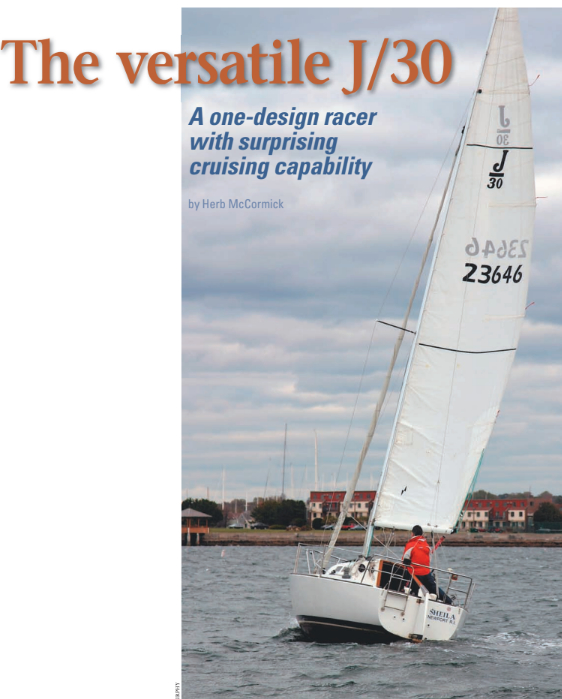
In 1975, brothers Rod and Bob Johnstone shocked the world with a one-design keelboat that gave racing sailors a satisfying alternative to the irritations of rating rules. That boat was the J/24. Since its introduction 30 years ago, more than 5,300 have been sold.
That’s a tough act to follow. Their second boat, the J/30, went into production in 1979. It didn’t come close to matching the critical or commercial success of its little sister. But that’s not to say it wasn’t an interesting and popular boat in its own right, with 575 units built in a production run that ended in 1987. And in today’s used-boat market, with its attractive price tag, roomy and functional interior layout, and the dynamic sailing prowess that’s a signature of the entire J/Boat line, it’s a versatile 30-footer that still has the capability to fulfill many sailors’ dreams.
Performance
One purchases a J/Boat with certain expectations, the leading one being performance under sail. So let’s begin there. Though I’d owned a J/24 and raced it, I harbored no delusions of racing grandeur when I later bought a J/30. Instead, I was looking for a boat that sailed well and had good accommodations for coastal cruising and summer- time living aboard. Between the Js I owned a 1975 C&C 33 that could really get up and go, so my benchmark was high. I also wanted something I could sail easily by myself. Racing the boat was never a part of my equation.
Without putting too fine a point on it, the J/30 delivered in spades. Its 3⁄4 fractional rig, with an emphasis on a big mainsail and relatively small foretriangle, is highly conducive to shorthanded sailing. In fact, I’ve never driven a boat that sailed so well under mainsail alone. The J/30 is tiller-steered and, to my mind, a tiller extension is absolutely mandatory. With it, you can perch up on the cockpit coaming with the helm in one hand and the mainsheet in the other and have full control of the boat. It’s a great setup for solo harbor tours or for taking friends or kids for a sail, during which their only duty is enjoying themselves or passing out snacks.
I loved my C&C, don’t get me wrong, but with its high-aspect rig that put the emphasis on the genoa for driving power (so popular in the 1970s due to the quirkiness of racing rules), mainsail-only sailing was impossible in anything less than 20 knots of wind. The J/30 will make way in a zephyr with just the main and will attain speeds of 5 to 7 knots on any point of sail once the breeze pipes up into the mid-teens or more.
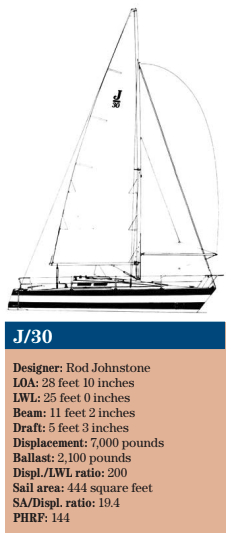
The J/30’s PHRF rating in most fleets is 144, slower than the newer J/29 at 117 (fractional rig), which just goes to show that boats continue to get lighter and faster. A Beneteau 305 rates 165 and a C&C 30 rates 162, so there’s no mistaking that the J/30, despite growing dated, was and remains a fast boat.
Fun meter rises
Obviously, once you press on a bit of headsail, the fun meter rises accordingly. In one-design racing, in almost all conditions (save for a heavy blow), the J/30 is sailed with an overlapping headsail of up to 163 percent with a crew of five or six stationed on the rail to keep things level when hard on the breeze. For daysailing and cruising with a couple or family, however, a 100 percent blade jib works fine in light to medium air and is very easily tacked (frankly, grinding in the big headsail can be a bit of a chore, especially when heeled). Once the breeze comes on, there are two quick, easy options: douse the jib entirely and carry on under main or tuck the first reef into the mainsail via the simple slab reefing system and carry on accordingly. The boat balances nicely in both modes.
Either way, it’s important to note, maintaining a balanced sail plan is very important on the J/30. The boat has a vertical, transom-hung rudder that lets you know, in no uncertain manner, when you’re pressing too much sail. If it’s moderately over-canvassed, you’ll experience an immediate case of weather helm. There are three ways to address the situation: drop the traveler, ease the mainsheet, or add a bit of backstay tension to flatten the main via the block-and-tackle backstay adjuster. In more extreme situations, the helm will load up and the rudder may stall, causing the boat to round up. That’s the time when shortening sail is overdue.
For some sailors, this may sound a bit hairy. It’s not meant to. The bottom line is that the J/30 is a very responsive sailboat that teaches one a lot about balancing sail plans. As long as one stays a step ahead of things on windy days, it’s a very invigorating and satisfying boat to sail.
Deck layout
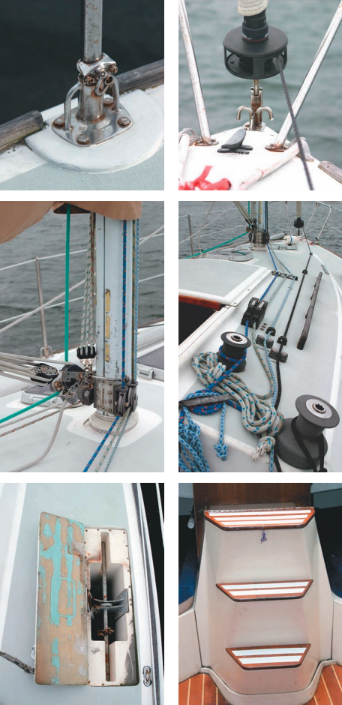
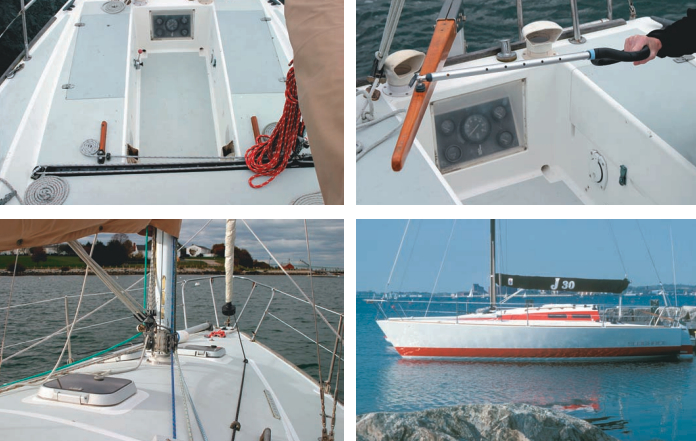
The J/30 was designed as a racer/cruiser, a fact that’s abundantly visible in its deck layout and hardware. The original headstay foil has twin grooves for sail changes, though for simplicity’s sake, many sailors instead opt for a roller-furling setup. I retrofitted my boat with a Harken unit that did the job very well.
To keep the bow light and buoyant, the J/30’s anchor is stored in a clever vertical locker about 10 feet aft of the bow to starboard. It’s clever, but it’s a bit of a compromise for cruising, especially if you need to haul the attendant rode forward from a cockpit locker every time you anchor. For this reason, many owners add a hawsepipe and cap just forward of the bow cleat to at least deal with the rode. Down below, there’s a good-sized locker just forward of the V-berth that can easily handle 200 feet of line.
The sidedecks are clear and expansive, as is the foredeck. For racing, the boat flies a standard, symmetrical spinnaker, the pole for which is stored in chocks to port. The original specs called for a standard boom topping lift, though many racers have switched over to solid vangs like the Boomkicker or Hall’s QuikVang, which control the boom well and eliminate the need for another line aloft. All reefing lines, spinnaker controls, and halyards are led aft to five rope clutches on the coachroof to either side of the companionway hatch (three to port, two to starboard). These, in turn, are serviced by a pair of Barient 27 winches. There’s also a set of Barient 10s nearby for spinnaker trimming.
The Barient theme continues in the cockpit, with two 27STs as the primary winches. There are two distinct cockpit layouts, depending on the year the boat was built. Prior to 1984, the cockpit had a bridge deck on which the Schaefer traveler was located and two good-sized seat lockers to port and starboard. After 1984, the bridge deck was eliminated and the traveler re-positioned, which opened up the footwell considerably. New coamings were added also, improving comfort. Finally, one of the quarter berths below was removed in favor of a larger sail locker in the cockpit.
Engine controls and gauges are placed at the foot of the helmsman in the aft part of the cockpit, where the operating handle for the standard manual bilge pump also resides. A fold-down swim ladder, hung off the transom, completes the no-nonsense layout.
Accommodations
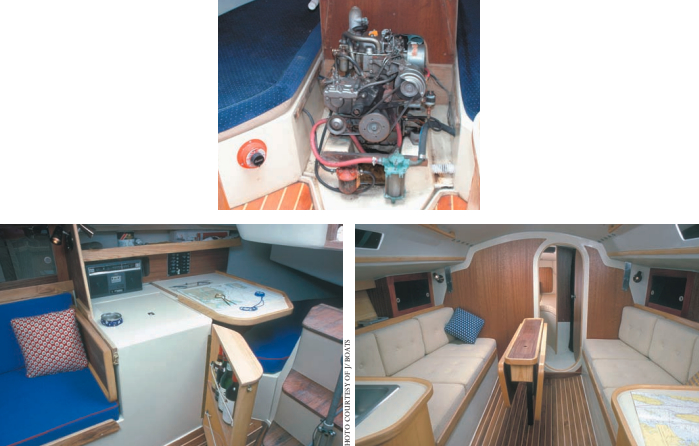
Here’s where the J/30 surprises a lot of sailors who, at first glance, might mistake it for something a little larger. But the boat’s 11-foot 2-inch beam gave designer Rod Johnstone a considerable bit of interior volume to work with and, for the most part, he made solid decisions with the way he allocated space below.
For its size, the J/30 has an absolutely cavernous forward cabin, with a V-berth measuring 7 feet long by 6 feet 3 inches at the head and 2 feet 4 inches at the foot. There’s a semi-enclosed head just aft that opposes a nice hanging locker that, on my boat, also was home for the CNG-tank that serviced the two-burner stove (later boats were available with optional propane stoves and ovens).
The main cabin features a pair of 6-foot 2-inch settees and a removable dining table that will sit six for dinner. I stashed the dining table in my cellar. This really opened up the interior and had the added benefit of giving me a place for the huge, three-step fiberglass molding that does double duty as the companionway and the single access point for the 15-hp Yanmar diesel. Once that molding is out of the way, engine access is excellent, but with the dining table in place it’s hard to find a spot to put the bloody thing.
To port of the companionway is a functional, if tight, galley with a double sink. To starboard is a large ice chest. A table on top of this slides aft on its own track to access the chest and serves as the stand-up nav station when underway. Older boats had a pair of 6-foot 2-inch quarter berths aft, which did double duty for storage. In 1984, the company added a bigger, more functional galley to port and, as mentioned, did away with one of the quarter berths, which enabled them to make further changes on deck. The interior has a nice wood finish. Headroom is just shy of 6 feet at the companionway and tapers down to about 5 feet 9 inches moving forward. For coastal cruising, the package does its job well.
The J/30’s relatively simple DC electrical system begins with a pair of batteries beneath the aft starboard quarter berth. There are circuits for most, if not all, of the basic equipment required for racing and coastal sailing. One oversight is the lack of an AC system and shorepower. Otherwise, it’s hard to find fault with the standard equipment list.
Construction
Like the J/24, the J/30 was built of composite construction in the hull and deck, using Baltek’s Contourkore end-grain balsa in a sandwich of hand-laid E-glass and vinylester resin. The main bulkhead is glassed to the hull and deck and serves as the anchor for the through-bolted stainless-steel chainplates. The hull-to-deck joint is bonded and bolted, then bolted a second time to fasten the teak toerail to the boat. How well the boats have held up over the years is a testament to the skill of the craftsmen at Tillotson-Pearson Industries in Warren, Rhode Island. Compared to my older C&C, my J/30 had practically no superficial cracking or crazing in the gelcoat.
The keel is lead and is bolted through a solid fiberglass sump. At the top of the lead and bottom of the sump there’s an indent, around which a few layers of glass are applied to hide the joint.
There are, however, a few trouble areas that should be closely examined before buying a J/30. Many boats in the second or third year of the run suffered from gelcoat blisters. The balsa-cored decks, particularly around the often-times highly stressed stanchions, have become soft and spongy on many boats and will require attention.
Likewise, water leaking into the boat via the chainplates may have caused dampness or weakness in the structural bulkhead. And finally, there’ve been reports of spreader failures on the Kenyon aluminum spars when the rivets that attach the brackets to the spars begin to work or loosen after years of use. When considering a J/30, be sure to point out these potential problem areas to the previous owner or, better yet, to a marine surveyor. Be sure you’re satisfied with their answers before moving forward with an offer.
Summing up
The J/30 was a strong boat from the outset; not one but two early Js survived the horrible 1979 Fastnet storm that took the lives of many sailors. I wouldn’t recommend the J/30 for any kind of extensive offshore work without a serious refit and a vastly experienced crew, but it’s nice to know the original platform has been tested hard and came through relatively unscathed.
Another of the nice things about the J/30 is that several always seem to be on the market at any time and all at decent prices. A scan of Yachtworld.com in late December 2006 showed 16 J/30s available at prices ranging from $14,900 to $34,000, with an average asking price of $22,000. To my way of thinking, that’s a lot of boat for the buck. And there were models virtually everywhere from New England and the Chesapeake to Texas, the Pacific Northwest, and Hawaii.
The J/30 is probably not for everyone. Unless you find beauty in utility, she’s not the prettiest of the similarly sized peers of her era. Nonetheless, when you’re at the helm driving her to weather and your immediate view is of the boats you’re leaving by the wayside, she looks pretty darned good. Don’t be misled by the racing pedigree of J/Boats. There are lots of old racers out there ready to retire to the ranks of very useful cruisers. And the J/30 is at the top of that list.
Thank you to Sailrite Enterprises, Inc., for providing free access to back issues of Good Old Boat through intellectual property rights. Sailrite.com