A better idea for a singlehander’s ladder
Issue 57 : Nov/Dec 2007
One afternoon, contemplating the fate of the solo sailor who winds up in the near-freezing waters of Puget Sound, I took Hervey Garrett Smith’s excellent book, The Marlinspike Sailor, off the shelf and made a rope ladder. I slung it over a stern cleat where it swung under the canted transom and proved extremely difficult to use. I considered fixed or folding steps on the outboard rudder of our Ericson Cruising 31, but I didn’t like the idea of drilling holes in the sandwich construction and the possibility of leaks. An ideal solution was elusive and, trusting to fate, I kept putting it off.
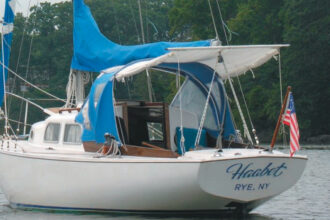
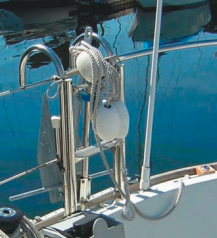
Then it occurred to me that I could improvise a solution with the over-the-gunwale stainless-steel boarding ladder that we use mainly for boarding the tender. It has J-shaped arms that loop over the gunwale and attach to deck-mounted brackets. All well and good, but the Cruising 31’s gunwale curves up and over the rounded stern, posing a problem in mounting.
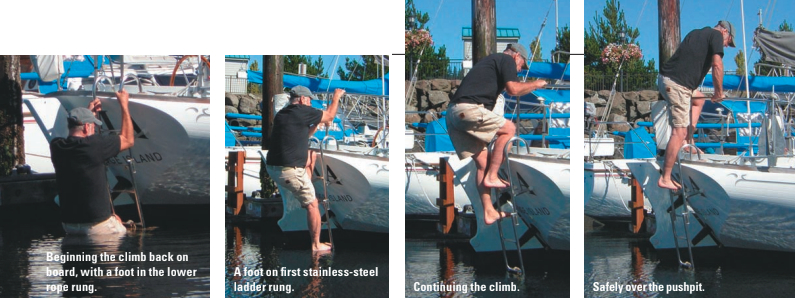
By a trial-and-error method of positioning the J ends in just the right place, I made chocks for the mounting brackets so the ladder is nearly vertical when the tubular, rubber-footed standoffs touch the transom. The critical thing is getting the geometry right — the firm attachment of the J ends to the mounting brackets and the vertical arrangement of steps. It will be seen from the photographs that, ideally, the standoffs should be lengthened slightly to bring the ladder to a more nearly vertical position.
Not deep enough
The lower part of the ladder folds up against the upper part while underway. When let down, the lowermost rung is just under water, not deep enough for a scared and tired swimmer to start the long haul from the water to the cockpit.
My solution was to make a short, Hervey Garrett Smith-style, two-step rope ladder and lash it to the lower rung with about a 3-inch swath of 1⁄8-inch Dacron. When the ladder is ready for cruising, the rope rungs hang down to the waterline. The folded-up bottom part is tied to the top part by a strand of waxed sail twine. The person overboard pulls on the rope, breaking the twine, which brings the ladder down for boarding. The two rope steps sink below the waterline, easing the climb up.
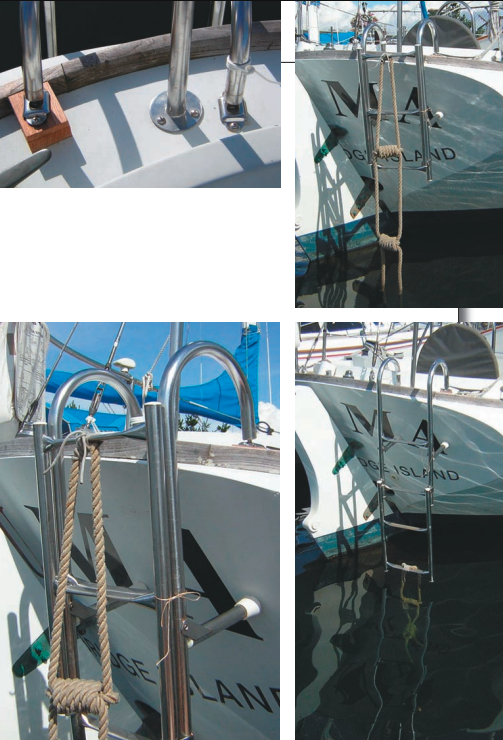
Well, that’s the idea. Now, when I go off on my own, I move the ladder to the stern and lash on the rope rungs. I’ve yet to use the ladder in anger and hope I never will, but at the very least, I feel a little better knowing I have a fighting chance of clambering back on board.
Richard Smith is a contributing editor with Good Old Boat. He has owned and built several boats, including an Atkin Red Onion sloop, a 30-foot Alan Pape steel cutter outfitted from a bare hull, an Atalanta 26, five dinghies, and an Ericson Cruising 31.
Thank you to Sailrite Enterprises, Inc., for providing free access to back issues of Good Old Boat through intellectual property rights. Sailrite.com