Remove old finishes an easier way
Issue 57 : Nov/Dec 2007
I made a conscious decision when we purchased our good old boat: it would have the minimum of wood trim on the exterior. Maybe it was too many spring weekends working on the brightwork of my father’s boats when I was of an impressionable age, but I now admire a great varnish finish from afar . . . as far as possible.
Still, no boat is without some wood, be it a tiller or winch pad, or maybe even just a cup holder. And there comes a time when this requires a bit of attention, usually in the form of a fresh coating of your favorite finish. Before you can apply this fresh coat, you need to prepare the surface and, to most people, this means sanding.
Sanding is convenient, even though it may be tiresome. One problem with sanding is that it can also remove a lot of wood that you would rather leave attached to your boat. The good news is that there is a better way to remove old finish with a tool that has been used for centuries by fine woodworkers: a scraper.
A scraper is a thin metal rectangle that is set with a fine burr along the edge. If you push or drag the edge across the surface of a piece of wood, you are able to remove fine shavings. It is easy to control so that you can carefully remove just the finish and leave the wood. As a bonus, you get a smooth finish on the wood when you’re done, finer than just about anything you can achieve by using multiple grades of sandpaper. You can buy scrapers for less than $5 apiece from woodworking tool suppliers, such as Lee Valley Tools http://www.leevalley.com.
Create your own
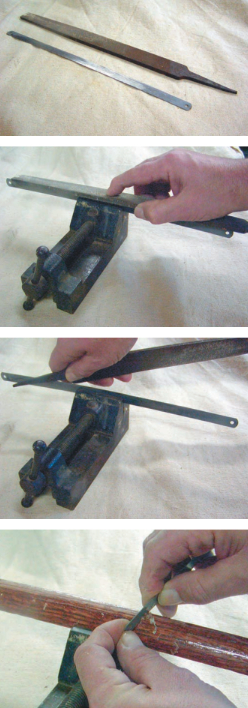
But what happens when you arrive at the boatyard and the weather turns out to be much better than forecast and you don’t have a scraper in your toolkit? You can create a serviceable scraper from any worn-out hacksaw blade, which is an item that tends to be in ready supply in most boats’ toolkits. All you need is a good flat file to turn it into a handy scraper.
Start by cutting or breaking the blade into a handy length. Most people find that 6 inches is a useful size, but I like to use the whole blade because the extra length means that I don’t have to resharpen it as often.
To sharpen the blade, start by dressing the top of the blade — the edge opposite the teeth — to make it smooth and square with its sides. Once the top is prepared, take the tang of the file — the handle end — and rub it firmly along the edge of the top. Woodworkers will debate the correct angle for this burnishing step, but I find that holding the tang at about 30 degrees works pretty well. Run the tang along both edges of the top of the blade to create fine burrs. You can test the burr by dragging it lightly across the back of a fingernail.
To use the scraper, some like to push and others prefer to pull. In either case, bend it slightly and then hold it at a slight angle leaning toward the direction of movement. Apply gentle pressure while moving the scraper over the surface. You should be rewarded with a thin, wispy shaving using a minimum of effort. A very few passes will quickly remove many layers of old finish and weathered wood, leaving you with a smooth surface that is clean and ready to accept a coat of your favorite finish.
Alfred Poor grew up sailing on the Chesapeake Bay on his father’s boats and shares ownership of his second good old boat, Jambalaya, a 1973 Tartan 34C, which he sails out of the Bohemia River at the head of the Chesapeake.
Thank you to Sailrite Enterprises, Inc., for providing free access to back issues of Good Old Boat through intellectual property rights. Sailrite.com