Two efforts to save old boats from our landfills
Issue 57 : Nov/Dec 2007
This is the first of a two-part series about sailors who fall in love with old boats, particularly those made of wood, and are compelled to restore and sail them. Part 1 reports on two men who are passionate about finding and salvaging boatyard rejects through their roles as “matchmakers.” Part 2 will focus on two people who are pouring their love into the restoration of one of these boats . . . a reject no longer.
We’ve all seen them. Neglected unwanted old boats shoved off into the back corners of marinas, boatyards, and backyards are a common sight. Sometimes they’re mildewed, grimy, fiberglass boats with clouded windows, crazed and cracked gelcoat, or graffiti-sprayed hulls. Sometimes paint peels from weathered gray planking or a dark stain of rot grows from the corner of a varnished transom.
These boatyard waifs, particularly the perishable wooden ones, face a bleak future. But thanks to the Internet and some dedicated (crazy?) individuals, a few of these once-proud and beautiful yachts are being rescued from the chain saw and landfill. Bone Yard Boats, founded in 1996 by a woman who grew up around old boats in her father’s boatyard, and a more recent startup, the Wooden Boat Rescue Foundation, whose mission statement reads “placement, saving, locating, researching, wishing, learning, and dreaming of wooden boats,” are recycling and restoring the unloved, one hull at a time.
The Bone Yard Boats’ recycling effort has been highlighted for years on Good Old Boat’s webpage listing free and inexpensive sailboats. Bone Yard Boats began as a hard-copy newsletter listing the old and unwanted for sale or adoption. Ginger Marshall Martus started publishing it in 1996 after watching the destruction of several old unwanted, but still salvageable, boats. Soon she was getting the word out across the United States and Canada through her subscription-supported quarterly newsletters. Additional revenue for printing and mailing came from a fl at charge when a boat sold, that amount being equal to the last two digits of the boat’s building date.
New skipper
Two years ago, Ginger turned her newsletter over to a new skipper, David Irving. As he tells it, he spotted a notice in Soundings about her desire for a change of watch. “I have a bachelor’s degree in English, love to write, and have a background in information publishing,” David says. “I put the issue of Soundings down and thought, ‘I should give that lady a call.’ ” A month after discovering the article, he finally called. “We hit it off right away. She said she had several parties interested and was not going to give up her ‘baby’ without a personal interview.” David made arrangements to meet with Ginger and spent a morning exchanging sea stories and boat anecdotes with her. “After a few hours, I said to Ginger ‘Well, what do you think? Am I the right person?’ She put her two thumbs in the air, and the deal was struck.”
Like Ginger, David, now based in Marblehead, Massachusetts, is a long-time boater and admirer of “old things.” (He and his wife, Nan, and two children took on the restoration of a fixer-upper home not long ago.) Unlike Ginger, who had been putting her newsletter together with a typewriter and a “database” of index cards, David was familiar with computers and their capacity for organizing and disseminating information. Before long, Bone Yard Boats had gone digital. Here, David posts listings, rescue and restoration stories, and other information, while he continues to produce the hard-copy newsletter for subscribers. He charges readers $19.95 to subscribe to the Bone Yard Boats newsletter. As subscribers, they are able to list boats for free.
Bone Yard Boats seeks new homes for all types of boats (power and sail) built of wood and fiberglass. At the
time of this writing, Bone Yard Boats had several wooden and fiberglass sailboats up for “adoption,” along with a selection of powerboats. Not all the yachts listed are free, but they are generally too cheap and rundown to sell through traditional brokerage services and often are too tired to pass a survey for financing or insurance. Every now and then, though, a diamond in the rough comes along that simply needs a little polishing. A recent example was a 1948 Herreshoff H-28 ketch listed as free to a good home. This 28-footer had been saved from the chain saw several years ago, and her owner kept her active and afloat as a daysailer. She was professionally built by the Truscott Boat Works in Michigan. The newsletter ad read: “Now it’s time for someone to come along and give this boat a good home and lots of elbow grease.”
An unnecessary death
When I interviewed David, he had recently seen another salvageable boat die an unnecessary death. It was a 65-foot wooden motoryacht, afloat at a Maryland marina. The owner had vanished, and the yard needed the space for paying customers. A marine surveyor familiar with wooden boats heard of the still structurally sound and very restorable old timer’s impending death sentence and alerted David. He promptly called . . . only to learn that the marina had just paid $7,000 to demolish the yacht and haul the remains to the local landfill. David recalls, “When the marina manager heard of the newsletter, he said, ‘I wish I knew about you before.’ He just kept repeating that.”
But Bone Yard Boats also has happier outcomes to its credit. Last year a piece of maritime history, the 58-foot skipjack, Ethel Lewis, built as a working oysterman in 1906, was transported from a Brooklyn boatyard to a museum in Virginia, where she will be stabilized and placed on display. Other fortunate foundlings include a catboat that was purchased, completely restored, and listed for sale in a recent Bone Yard Boats newsletter.
New orphans continue to land on David’s doorstep. In the winter 2006 issue, he featured the Big T, a hapless 51-foot steel ketch that sank at her mooring on the Ashley River near Charleston, South Carolina, in 30 feet of water in 2004. After nine months on the bottom she was “adopted” and refloated, though not before a local news weekly voted her Best Shipwreck honors. As of this writing she was on the comeback trail. Another listing during the spring of 2006 was for a 40-footer, believed to be a Hinckley, built around 1960, also free to a good home.
Since its start 10 years ago, Bone Yard Boats has been written up in Classic Boat, Soundings, Wooden- Boat, and other regional and national publications. But the 65-foot motor-yacht destroyed in Maryland has made David more determined than ever to get the word out. He is planning more upgrades and enhancements to the website and to the printed newsletter. Already the website and email updates and alerts have become the basis of a growing online “community” of old-boat rescuers. And, as the project’s founder, Ginger Martus continues to lend a hand with publicity, articles for the newsletter, and boat placements.
Connecting people
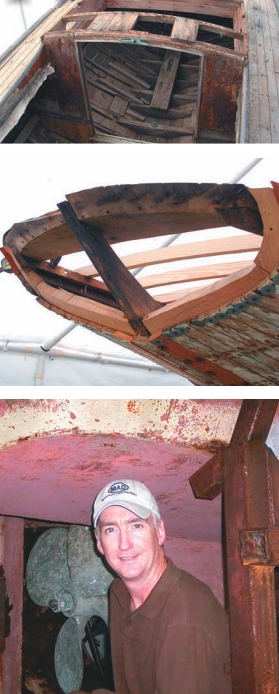
Another recent old-boat rescue effort created through the Internet’s ability to connect people is Bruce Elfstrom’s Wooden Boat Rescue Foundation. A boat named Masuyo started it all for Bruce. He simply couldn’t stop thinking about her. The Masuyo was a Scottish-built double-ender lying in a boatyard in New Jersey. Bruce got word of her as a possible parts source for the 1927 cutter he was restoring. But when he saw the hull, he thought, “I can’t cut this boat up for hardware. She’s way too good.” As he studied his find, he also had a vague and nagging sense that he somehow knew the boat from somewhere.
He drove back to his home in Connecticut thinking, “What can we do to keep this boat from being cut up?” And he continued to wonder what it was that seemed so familiar about her. Four days later, he remembered where he’d seen Masuyo before. “It was in a little book I had, Maynard Bray’s field guide to wooden boats. I found the book, and there she was — same big old iron windlass, double-ender, and built in Scotland.” Bruce “Googled” the name of the owner as given in the book, tracked him down, and called him up. “I said, ‘Hey, I think I found your old boat.’ The guy flipped. He said, ‘Where is it? I want her!’ ”
The Masuyo ultimately ended up in Maine where her former owner eventually passed her on to another wooden boat devotee, who is now completing a successful restoration. As Bruce recalls, “This started the idea that I can find homes for these old boats.”
Bruce grew up around boats. “I’ve sailed since I was tiny,” he says with a laugh, when asked how he started sailing. “I used to sail up in Maine for three months in the summer. I sailed on a Drascombe Lugger, a Contessa, and a Bristol Channel Cutter. The funny thing is we never had many wooden sailboats — just one or two dories.”
Still educates
After a spell in graduate school in New Mexico and some years of college classroom teaching, Bruce landed back in New England where he and his wife now live with their two daughters. He is still an educator but in a somewhat unorthodox way these days. He runs a business called Overland Experts to teach people how to use their four-wheel-drive vehicles in the best and most ethical fashion. Film crews, military personnel, foreign-aid workers, and weekend warriors learn to “drive well” and “go further,” as his website, puts it.
The Elfstrom family resumed sailing because, as he explains it, “When I turned my hobby into a business, I needed another hobby.” And somewhere along the way Bruce got hooked on wooden boats.
The appeal of the biodegradable boat is undeniable. Even people who are unwilling or unable to tackle a restoration or lack the discipline required for such a project look upon old boats as something special. “And,” says Bruce, “now that there aren’t very many of them left, people are starting to want them. I’ve seen a revival of interest in wooden boats.”
A few months after the Masuyo incident, Bruce, again prowling the boatyards, found another unwanted boat waif. This was a Swedish-built sloop, a Koster class, clinker-planked, 26 feet long, and in need of a home. His first thought (perhaps predictably) was, “I gotta have that.” But then reality set in. As he puts it, “You know, you can have too many boats.” Faced with this highly irregular jolt of common sense, he thought, “OK, I’ll find a home for her.” But when he started trying to give the boat away, he found no easy method for doing so. The free boat/free ad space that WoodenBoat magazine makes available was limited and, at that time, had a four-month waiting list.
Created website
“So in one day I made the website and posted a notice on the WoodenBoat forum, and the first week we got 5,000 hits,” he remembers. The Koster sloop soon had a new owner who began fixing her up.
Bruce created the Wooden Boat Rescue Foundation website database so people seeking or finding boats could post their own wants and requests. He was, he explains, far too busy with other projects (such as his business, his family, and the restoration of his 34-foot Katarina) to spend a lot of time being a webmaster. And it has worked. More than 50 boats have already found homes through the website. Bruce still prowls the boatyards in search of the unwanted and unloved wooden boat. But now other people are also out there playing matchmaker too.
Bruce takes pains to point out that he has no economic or personal involvement with the boats on his website. He doesn’t own them or store them, and he has no involvement if money changes hands for them. Sometimes he never sees the boats listed. He does occasionally provide some guidance to those who are interested in an “adoption” to be sure they understand fully what they’re getting into. And he accepts cash donations for ads or moving costs involved in the boat-rescue efforts.
Total amateur
People occasionally contact Bruce for advice on restoring their old boats. He is quick to tell them he is not an expert woodworker: “I am a total amateur!” However, he isn’t afraid to wade into a big project. This is clear in the restoration log for Katarina (posted under the articles section of his website). While Bruce says wooden boat repair isn’t brain surgery, he did decide to seek out advice and guidance from an expert shipwright at Mystic Seaport who offers boatbuilding classes. This was prudent, for more than one “rescuer” has torn open a wooden boat with no overall plan for its restoration and then never managed to put it back together again.
“People think there’s a sort of mystical aura about working on a wooden boat,” Bruce comments. To help counter that and the fear of undertaking a major repair job, he initiated another effort to save old boats: he organized a weekend boat-restoration seminar to be done under the guidance of a skilled shipwright. Recently, with the support of a waterfront landowner, he also established a “grass-roots wooden boatyard,” as he calls it, where people can keep and work on their wooden boats and obtain occasional advice and instruction from professionals.
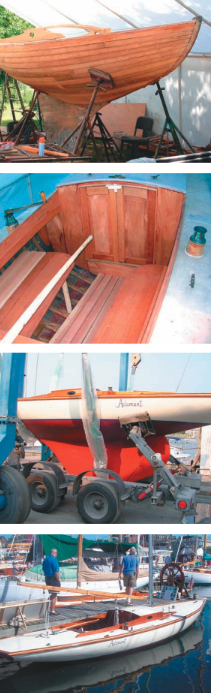
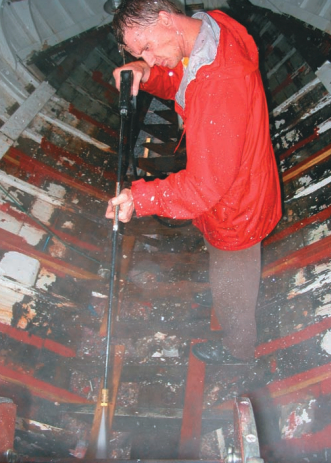
Bruce also suggests that the restoration logs on his website can provide guidance and inspiration to those tackling a big project. These, he notes, aren’t $300,000 restorations being done by a yard. These are real projects done by real people on real budgets. One notable example of a successful (and speedy) restoration is that of Don Salisbury’s Adamant, an Interclub one-design built in 1937. Don, an experienced carpenter who had restored several other boats previously, got the Adamant in early 2005. By June he had replaced all 72 frames and 19 floors, and by early August he had her afloat in time for a local Rhode Island wooden boat show.
Since its modest start, the foundation, like Bone Yard Boats before it, has attracted national notice. Bruce mentioned that several people interested in saving old boats in other regions had told him they wanted websites similar to his site. (Both the Wooden Boat Rescue Foundation and Bone Yard Boats are East Coast-based efforts.)
History and craftsmanship
I asked Bruce and David about the appeal of old boats. David, who says he loves history and craftsmanship, finds both in old yachts. “There are some pretty nice boats being built today, but so many lack the element of nautical charm.” Bruce agrees, saying that those who are willing to fix up a wooden boat seem to place a high value on aesthetics. Bruce, like many owners of older boats, also thinks that an old boat somehow absorbs a “soul factor” from past human associations as she is used (and worked on) through the decades. Perhaps a boat takes up that “soul,” along with some of the blood, sweat, and occasional tears of frustration expended in keeping an old-timer functional.
Undertaking a major restoration of a boat, whatever her hull material, is an act of faith and hope. It also takes a certain amount of trust to take on an orphan that can’t pass a survey. There are no guarantees out there in this weary old world. You do the best you can, and in the end, when you’re out there miles from land, you have to know you did, and believe in it.
Susan Peterson Gateley has written three books that feature her association with a vintage 23-foot woodie and her good old plastic 32-footer. For updates on her refit of a 47-foot Tancook Schooner, Sara B, visit http://www.sarab.brownroad.com
Thank you to Sailrite Enterprises, Inc., for providing free access to back issues of Good Old Boat through intellectual property rights. Sailrite.com