Updating skills learned in childhood
Issue 57 : Nov/Dec 2007
Until recently the majority of my sailing experience took place between the ages of nine and 16 aboard my father’s 17-foot Siren, Running Free. Our family of five, plus our 35-pound terrier-mix, spent many wonderful afternoons aboard that boat sailing the small lakes of central Minnesota.
Once we children started heading off to college, Running Free’s trips to the lake became fewer and fewer. Sailing was something we remembered fondly in passing as we hurried between work and school. In the blink of an eye, I saw seven years pass without setting foot aboard a sailboat.
Three years ago, I broke that dry streak. I was at a camping party at a friend’s remote lake cabin. Someone had brought a broad-bottomed 15- footer along and had it moored to the dock. When I saw it sitting there, the memories of the feel, the rush of sailing came flooding back. I got permission to take the boat out. I recruited a friend who had never set foot aboard a sailboat and the two of us somewhat awkwardly got under way.
My friend, a tenacious scrap of a girl, was soon howling right along with me as we heeled that little boat as far over as we could. The energy of the wind flowing through the sails, to the rigging, to my fingertips . . . it was intoxicating. We had hardly set foot ashore when I was already hungry for another trip out.
The following year found me newly married, the proud owner of a new home, and the co-founder of a custom woodworking business. All of these major life changes took place over the short Minnesota summer. The year after that, my father and I promised each other that we would get Running Free out . . . no matter what. After all, I had been hired by Good Old Boat as an editorial assistant and web designer. Now I had another reason why I needed to spend some time on the water.
Brooding sky
Ultimately, we did take her out under a low, brooding sky with winds that were right at the threshold of our comfort zone. My dad tested me to see if I knew enough to captain the boat on my own. It was a big moment for me. Sure, he’d let me hold the rudder as a child or let me call a tack, but this was more than that. It was left to me to make the choices. He didn’t say a word as I sheeted her in tight and tested the theory that she couldn’t be capsized.
But the remainder of the summer ran away from us. I suppose it doesn’t help that the home renovation business is seasonal. My husband, Chris, who had dutifully participated in the annual Father’s Day scrub down of Running Free, still had never been sailing.
This past winter, we discovered the solution to that problem: the key to getting Chris aboard a sailboat is to schedule his trip several months in advance. At the Strictly Sail show in Chicago, Good Old Boat editors Karen and Jerry signed both of us up for sailing lessons through Sailboats Inc.
Sailboats Inc. is based in Superior, Wisconsin, and offers lessons in Superior, Bayfield, and Manitowoc, Wisconsin; Chicago, Illinois; and Lake City, Minnesota. Since we also were looking at our trip as the opportunity for a romantic getaway, we chose Bayfield, a quaint little town at the heart of the Apostle Islands National Lakeshore. The course lasted three days and was a combination of classroom and on-the-water lessons. The first thing I did when I got home from the boat show was block those dates off on our shared calendar. We both counted off the days with anticipation.
Course materials
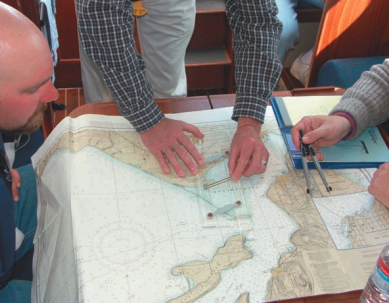
A few weeks after we signed up, our course materials arrived in the mail. Included were a three-ring binder containing notes corresponding with the online instructional video, a sailing overview DVD, a length of rope, a book (The Complete Sailor, by David Seidman), and pamphlets about Bayfield.
Chris, who has a remarkable photographic memory, immediately absorbed the materials and proceeded to walk around sounding as if he had been born with salt on his shoes. I had the advantage of having sailed before, so I could recall how certain maneuvers looked and felt. However, I also had to replace my nine-year-old notions with actual facts and real terms. The Complete Sailor is an excellent book for the inexperienced or rusty sailor. It is easy to read and is filled with clear illustrations.
The only hitch we encountered with the course materials was the online instructional video. We procrastinated on this part because we wanted to watch it together. By the time we discovered that the video isn’t compatible with our Macs, it was the eve of our departure. Later we learned that there is a DVD version of the video that can substitute if the online presentation is incompatible for any reason.
Chris and I were both a little nervous about what we might be tested on, but our concerns were unfounded. When we arrived for our morning classroom instruction, we were greeted by our instructor, Jim Scannell (Captain Jim to us), and introduced to two fellow students who would be joining us: Tim Hansen and John Flack. The first piece of business was learning how to use navigation charts.
Plotting courses
Navigating by chart is something I had always wanted to learn to do, but I had never had the opportunity. I could have plotted courses all day. . . It was a lot easier to pick up than I had ever imagined it would be.
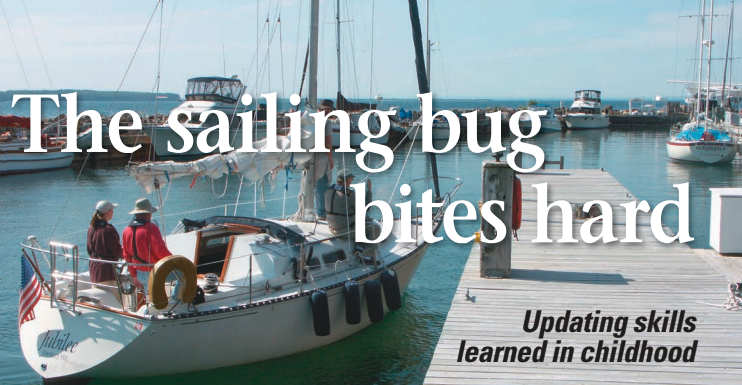
After spending the morning working on the navigation exercises, we headed to the marina to familiarize ourselves with the boat and then to work on docking maneuvers. The boat was a C&C 29 named Jubilee. It was certainly larger than any boat I had sailed before. This would be my first time steering with a wheel, rather than a tiller. I wasn’t sure how well I’d do, but I figured time would tell, as it would with everything yet to come.
I found out much sooner than I had anticipated. As we prepared to leave the dock, Captain Jim called out, “Theresa, why don’t you back us out?” This was, without a doubt, the most intimidating part of the entire course. Here I was, a 20-something female on a boat with three older, experienced sailing men and my husband, and I was to be the first to pull the boat out of the slip. I’d never steered a boat under power before, let alone in a space that seemed impossibly small. Jim, however, did an outstanding job instructing me. He calmly told me step-by-step what to do. His confidence in me inspired my own confidence in myself, and before I knew it, I’d backed the boat out of the slip and had her moving toward the open water within the marina.
For the majority of that afternoon, we did touch-and-go docking maneuvers. Each time I got behind the wheel, I felt more at ease. Jim would let us know when we made a mistake and, most importantly, how to correct it. He explained the physics of the movement of the boat in the water in a way that made sense and helped us anticipate how the boat would respond to our turns of the wheel and movement of the throttle.
Mixed feelings
The day ended with an excursion out into the open water of Lake Superior. This was the moment I had been anticipating with mixed feelings. Chris suffers from motion sickness, and at the time I was newly pregnant, complete with morning sickness (which I now know without a doubt is a misnomer — nausea can strike any time of the day). I was hoping that Chris’ first chance to experience movement under sail power was going to be a good one, not one spent bent over the rail. And I had my own concerns: I didn’t want to throw up in front of a bunch of strangers.
Fortunately, the motion of the sailboat was kind to both of us. I watched Chris closely as we cut the engine and raised the sails. The wind caught hold, propelling us forward with greater and greater speed. His look wasn’t one of abandon or wild joy; instead, he looked a bit shocked at first. When he finally spoke, his expression made sense: “I can’t believe how quiet it is!” Later he explained that he was simply amazed at the speed and the power of the wind pushing us along with seemingly little effort. Having grown up on powerboats and jet skis, this was an entirely new experience for him.
Our first trip out onto the lake was a pleasurable one, though we were eventually spurred inland by a burst of rain. Fortunately, we’d all come prepared with foul weather gear (not to mention shorts, T-shirts, long pants, sweaters, long underwear, gloves, hats, and sunscreen — as Minnesotans, we knew that early June on Lake Superior could encompass all seasons within a single day). We docked the boat and went our separate ways for the evening, excited about the next day’s lessons.
Docking exercises
The second day’s course began with more docking exercises. (By this time I felt much more at ease behind the wheel, though I maintained a healthy fear of crashing the boat.) I was intrigued by how intuitive getting the boat up to the dock seemed to me. I tried to figure out why it should feel like such a natural thing to do, and my best guess was that years of ice skating had taught me how to intuitively figure speed, mass, and stopping distance.
From docking exercises, we moved to anchoring. This was a valuable lesson, since I had never really learned the theory of anchoring (as would be evident if you had ever seen me out fishing from my rowboat, drifting horribly and wondering why the anchor wouldn’t set). I was shocked at first by the formula for how much rode to let out. In our case, it seemed like an awful lot of rode for such shallow water. With that one little formula, I suddenly found myself in possession of a bit of knowledge that would vastly improve my boating experiences for years to come.
As much as we were benefiting from the docking and anchoring exercises, we were all chomping at the bit to get back out on the lake. That afternoon, we were able to go out again. We all had a turn at the helm during our open-water lessons. We learned the man-overboard maneuver, practiced tacking and jibing, and experimented a bit with the various points of sail. Chris was even more astonished at how quiet a downwind run is.
The maneuver I thought was the most interesting was heaving to. I don’t recall ever doing anything quite like this aboard my dad’s boat as a child (at least not on purpose). It really impressed us to learn that it was possible to bring the boat nearly to a standstill. I realize how odd it might sound that the two lessons that impressed me the most were lessons on how to stop the boat, but as any pilot will tell you, stopping is the hardest and most important lesson to learn.
Clumsy moments
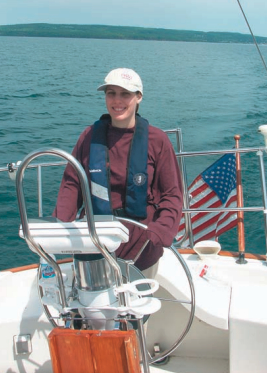
The rest of the afternoon we sailed around under a clear blue sky. We had our clumsy moments as a crew, but with each tack we improved our efficiency. Jim was a hands-off instructor during this time, letting us choose our course and assign who would be working which station. He only stepped in to offer a kind critique of our progress when he saw room for improvement.
By the end of our second day, we’d covered the majority of the lessons necessary for charter certification. The third day promised to be a “free day,” taking turns playing captain and cruising the waters near Bayfield.
This day dawned bright and sunny with a perfect breeze. We met at Jubilee and agreed that we’d like to plot a course and follow it. The chart came out and, between the four of us, we managed to get the course set. After we each took a final turn at docking the boat, we sailed out onto the lake.
This final outing was a lot of fun. We took turns at the wheel, though I admit that I spent more time with my face in the wind trying not to break my “haven’t thrown up on the boat” streak. We played with the GPS equipment and practiced looking for landmarks based on the information from the chart. After more or less reaching our destination, we hove to and had lunch. While we ate, the weather that had been forecast for the afternoon started to move in, and we decided to cut our trip short in order to reach the marina before the rain broke.
Torrential downpour
We made it back about 10 minutes before a torrential downpour began. Jubilee was docked, cleaned, and ready for the next class to take her out. We gathered our belongings and then met on the dock to receive our certificates proclaiming that we had successfully completed the Sailboats Inc. Charter Certification Course. Chris and I grinned at each other as we clutched our certificates. I practically had to drag him away from the marina office where they had a list of yachts for sale, reminding him that we had a perfectly good boat that we could use at our whim as well as a baby on the way. (It’s never fun to be the practical one, and I freely admit that I eyed several of those yachts with longing.)
As we drove the four hours back home the next day, we talked nonstop of all our plans — to take my dad’s Siren out, to find a way to charter a boat with friends, and to someday try our hands at building our own boat. It’s safe to say that the sailing bug has firmly burrowed its way into our hearts.
Theresa Meis recently joined the Good Old Boat staff as an editorial assistant, web designer, and audio manager. She has sailed a small Siren for years but now she’s gaining that all-important good-old-cruising-boat experience also.
Thank you to Sailrite Enterprises, Inc., for providing free access to back issues of Good Old Boat through intellectual property rights. Sailrite.com