Make sure they stretch and absorb shocks
Issue 57 : Nov/Dec 2007
The majority of sailboats see more time at the docks than actively sailing. This makes the selection of docklines especially important. Nylon (rather than polyester) is the material of choice for docklines, since it provides strength and enough stretch to absorb shocks and sudden strains. The rule of thumb is that a good-quality nylon line will stretch 25 percent of its length at 50 percent of its breaking strength. At a mere 200 pounds of tension, a 1⁄4-inch line 20 feet long can stretch 4 feet or more. Under the same tension, a 1⁄2-inch line 20 feet long will stretch about 1 foot. This stretch helps prevent a dockline from breaking and from putting sudden strains on dock and deck cleats.
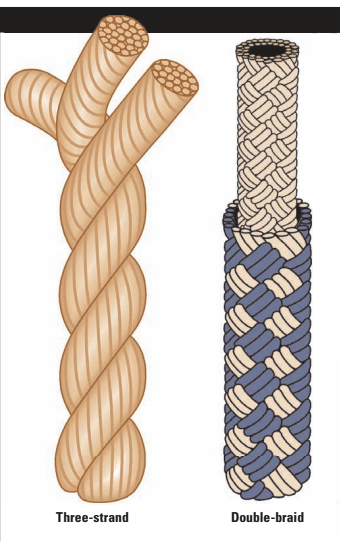
Nylon docklines can be either three-stranded or braided. Although double-braided nylon line is 15 percent stronger than three-strand, it stretches less. The advantages of braided line are that it comes in attractive colors, rarely kinks, is easier to coil, and is easy on the hands. The downsides are that it tends to chafe more easily than three-strand, is more expensive, and is difficult to splice. Most chandleries sell braided docklines with eye-splices that have been done by professionals.
Storm conditions
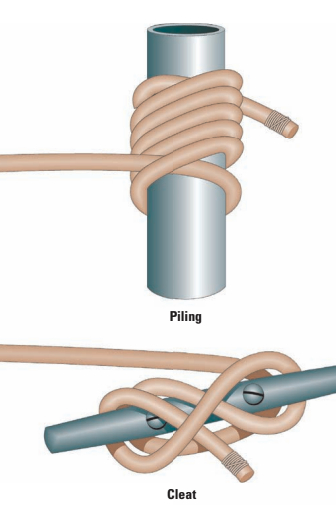
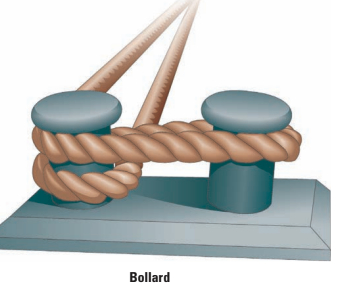
Docklines terminate in cleats on deck and are connected to pilings, cleats, or bollards on the dock. If possible, in storm conditions, your docklines should be around “permanent” pilings, with the added caveat that these lines should have some method of preventing them from coming off the top of these pilings in a high storm surge. In storm conditions it’s a good idea to lead additional docklines around the deck cleat and then fasten them to a keel-stepped mast (if your boat is so equipped), so that if the deck cleat is torn loose, the lines will remain attached to the boat.
Use large-diameter lines when a big blow is moving your way, either in place of or in addition to your normal lines. But remember, larger diameter offers less stretch. Double the diameter and you cut the stretch by a fourth. (The stretch is inversely proportional to the square of the diameter.) When you are setting up storm lines, you can take advantage of this lower stretch so wind and wave forces won’t allow the boat to pound the dock, the pilings, or an adjoining boat. Larger diameter lines are also less likely to fail from chafing.
Chafe prevention
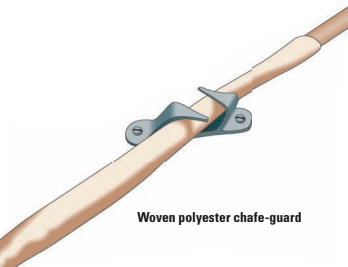
An unexpected finding by the Massachusetts Institute of Technology (MIT) after Hurricane Gloria, which plagued the East Coast in 1985, showed that many nylon lines angled across a chock failed internally when they melted from the friction created by the repeated stretch cycles. Most high-quality nylon lines are treated with a lubricant to reduce this type of failure, but this lubricant dissipates with age. So it’s important that, whenever a nylon line is angled through a fixed object, the line be protected from chafe. As a chafe-preventer, leather, neoprene garden hose, heavy canvas, ballistic nylon (Cordura) tubing, or commercial chafe-protectors are often recommended.
Some suppliers who sell docklines with eye-splices already made offer the option of urethane dips for the eye-splices or on the section of line that will be passing through a chock. Although chafing gear is necessary whenever a dockline goes through a chock, the possibility of melting the nylon through the constant stretching cycles can be increased when some types of chafing gear are used, since they can trap the heat being created and prevent the cooling rain or spray from reaching this critical point. Abrasion-resistant woven polyester sleeves are available from most marine chandleries. These allow the heat to dissipate and let water in to cool the line.
Characteristics of nylon line
A little-known characteristic of nylon line is that it loses about 15 percent of its strength when wet. The strength returns when the line has dried out. Since we are most concerned with strength during storm conditions — when the line is wet — factor this into the equation when buying larger lines for use in storms. Colored line has slightly less strength than natural, so factor that characteristic in as well.
One last consideration is the question of quality of nylon lines. A wide range of nylon lines is available, with the cheaper nylon stretching more and having considerably less abrasion-resistance and internal lubrication, so don’t skimp. Insurance companies estimate that up to half of the boat damage due to Hurricane Andrew, which hit Florida in August 1992, could have been prevented with adequate docklines. It’s much cheaper to buy high-quality line than to buy a new boat.
Don Launer is a contributing editor with Good Old Boat magazine.
Thank you to Sailrite Enterprises, Inc., for providing free access to back issues of Good Old Boat through intellectual property rights. Sailrite.com