A classic plastic shows us how to age with dignity
Issue 57 : Nov/Dec 2007
The first fiberglass sailboats appeared in the late 1940s, right after World War II, but it wasn’t until the late 1950s that the first auxiliaries appeared, notably the Rhodes Bounty 40, New Horizons 25, and Chinook 34. In the 1960s, the number of boatbuilders working in fiberglass exploded. Southern California, particularly Costa Mesa, was a hotbed of activity. Among the new generation of builders was a young engineer named Jack Jensen. Though boats built in the 1960s are admittedly growing a little long in the tooth, those that have been well cared for are still serviceable.
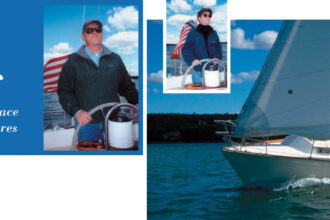
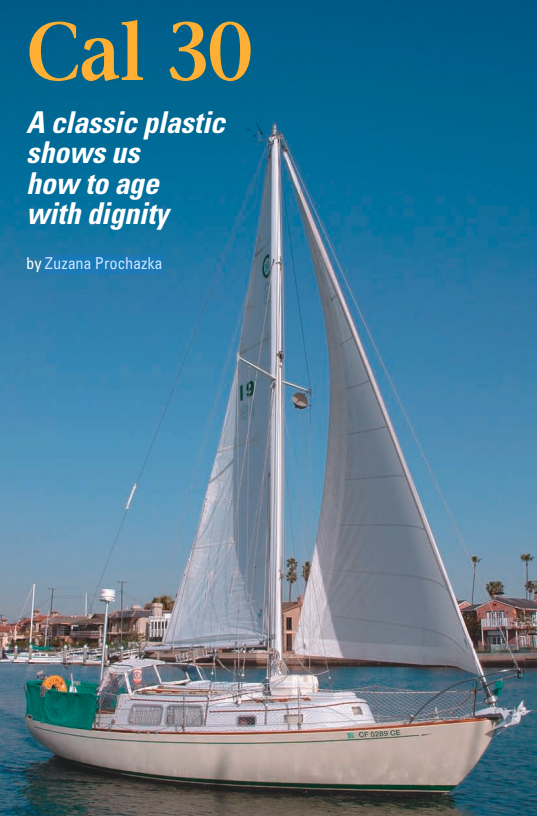
One such classic plastic in great shape is the Cal 30 owned by Holly Scott, a singlehander who has had a 23-year love affair with Catspaw, hull #19, launched in 1964 and our review boat.
History
In 1956 Jack Jensen founded Jensen Marine, which eventually became one of the most successful fiberglass boat manufacturing companies in California, if not the world. From the start he collaborated with Bill Lapworth, an up-and-coming designer who was way ahead of his time. The L-36, built in wood, was the largest one-design class of ocean racers in the world. Its enviable performance had earned Bill the reputation as a hotshot designer.
Bill’s first design for Jack was the Lapworth 24 (later renamed the California 24). It was a flat-bottomed centerboard design that blew the doors off its competition. Jack raced one himself; his name is first on the California 24 perpetual trophy. This is also the boat in which teenager Robin Lee Graham began his much-publicized circumnavigation, the subject of the book and movie, Dove.
The very successful Lapworth/Jensen combination introduced some of the first affordable fiberglass oceangoing boats that could do double-duty as racers and cruisers. Throughout the ’60s, ’70s, and into the ’80s, Jensen Marine was a leading builder with too many models to list here. They ranged from the still-popular Cal 20 and 25 to the groundbreaking Cal 40, notable for being one of the earliest production boats to separate the rudder from the keel. The 40 won three consecutive Transpac races from California to Hawaii (’65, ’66, ’67) and still has its own class in that event.
Jensen Marine also built several serious cruising designs, the largest of which was the Cal 46 that, like the Cal 30, later was updated as the 2-46 and 3-46. When Jack retired, he took off to the South Pacific on a 46. He died of cancer in Tahiti. Bill Lapworth died in 2006 and was buried at sea.
For a quarter century, Cals were among the most popular boats in America, even though the company was sold to Bangor Punta in 1965, was moved to Florida, and was relocated once more to Massachusetts and resold to Lear Siegler. The company went out of business in 1989. One-time head of O’Day and Cal, Jim Hunt, blamed a shrinking sailboat market. But the sheer numbers of Cals sold — thousands of units in at least 39 models — keep them visible on the water to this day.
Design
There were approximately 200 Cal 30s built between 1962 and 1967 before it morphed into the Cal 2-30 in 1968 and into the 3-30 in the 1970s. Satori was hull #1.She crossed her first starting line a week after being launched and won or placed in every one of the 20 races she entered in her first six months.
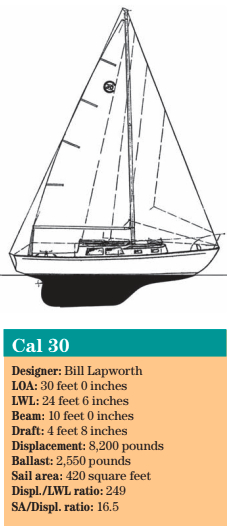
Billed in the original literature as a light-displacement boat, the Cal 30’s displacement/length ratio is 249, which today would be considered moderate. With 2,550 pounds of lead ballast, the ballast-to-displacement ratio is just 31 percent. To provide good form stability (also called initial stability), Bill Lapworth gave the boat a 10-foot beam, which was quite generous for the 1960s.
The underwater configuration is a full keel with sharply cutaway forefoot. The rudder is hung on the trailing edge of the keel. Soon afterward the Cal 2-30 and other Lapworth designs showed the shift to fin keels and spade rudders. The benefits of these changes are reduced wetted surface area and the ability to point higher. The downsides include poorer tracking (ability to hold a course) and a rudder more vulnerable to damage from flotsam and groundings.
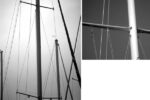
The Cal 30s came in short- and tall-rig versions. Catspaw has a short rig and has been re-rigged three times: to add a removable inner forestay; to beef up the wire, turnbuckles, and hardware; and to lead all lines aft to the cockpit.
Designed as a high-performance ocean racer, the Cal 30 has two unusual features for its time. First, four large fixed ports and four opening portlights make for a bright cabin; however, for offshore sailing, storm shutters are a good idea whenever a portlight is larger than a square foot.
The second unusual feature is the original size of the cockpit drains, which are unusually small. For an open-water boat, these small drains could be unsafe. To fix this in Catspaw, Holly installed new scuppers, which in her words are now “double oversized.”
The Cal 30 has a subtle and very pleasing spring in its sheer that is evident in some of Bill Lapworth’s later designs as well. The stepped coachroof is a bit dated and the high cabin trunk makes visibility forward from the cockpit a bit difficult.
Construction
The Cal 30 hull is handlaid solid glass that is 1 to 1 1⁄2 inches thick in places. The deck is one-piece molded glass with a marine plywood core. A through-bolted and glassed-over hull-to-deck joint holds it all together.
There have been some issues with hull blistering on the 30s; at one point Catspaw had 600 small blisters that were ground out and filled. She has received bottom barrier coat treatment twice in about 20 years. Overall, however, Cal 30 hulls have held up incredibly well.
Marine plywood on older boats has been a source of problems with water seeping in via deck penetrations at hardware attachment points. This usually requires grinding out the affected sections, filling with epoxy, and glassing over a new deck skin. Catspaw has experienced none of these problems.
The Cal 30 keel is encapsulated in fiberglass and the design also includes four keel bolts. The foam-fi lled rudder is built around a bronze post. Foam rudders are notorious for problems with water intrusion over time; nevertheless, Holly says she has had no issues with the rudder or keel bolts.
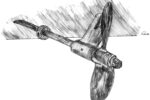
The propeller placement is unique in that it is above the rudder, rather than in an aperture. This arrangement eliminates prop walk and makes for much easier backing. The standard prop was feathering, additional proof that the Cal 30 really was conceived as a hotshot racer.
There are six through-hulls, originally fitted with gate valves. Many owners have replaced these with ball valves.
The Cal 30 has a keel-stepped, masthead rig with single lower shrouds. Since the standing and running rigging on saltwater boats should be replaced every 10 to 15 years, depending on local conditions and boat use, most Cal 30s will have been re-rigged at least once. If not, it’s something to consider when evaluating one for purchase. If nothing else, most owners have replaced the wire/rope halyards that were standard on most boats of this age with modern low-stretch cordage.
Belowdecks
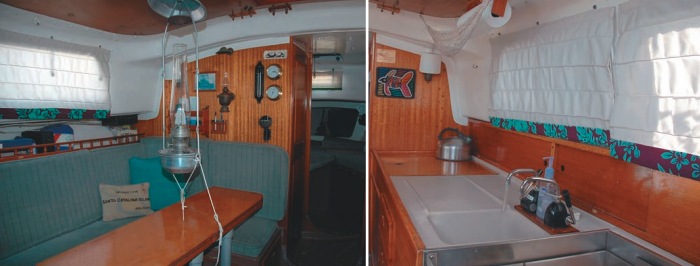
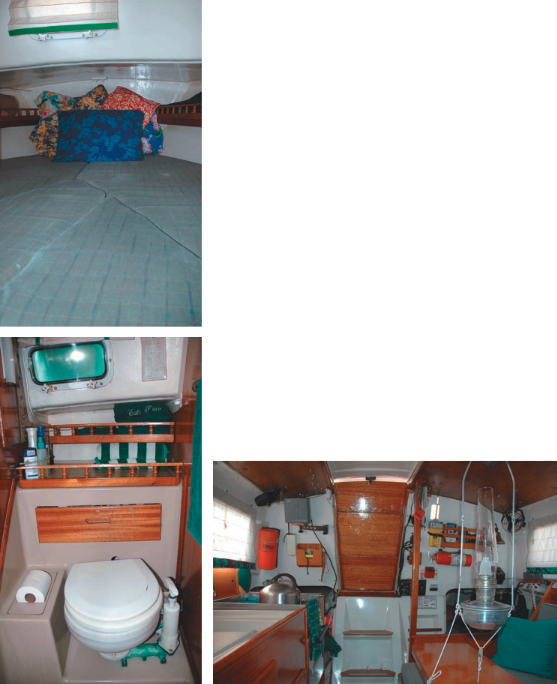
The Cal 30 layout was designed for a family of four to six to cruise comfortably. The accommodations begin with a sizable V-berth that is open to the anchor locker. Aft and to starboard is a hanging locker with drawers below. Across to port are an enclosed head with a sink, a convertible vanity seat, a hamper, and good stowage. There was no pressure-water option initially available, but some owners have made that upgrade.
The galley is in a straight line down the starboard side with an insulated icebox, a column of drawers, and a two-burner pressure alcohol stove. Many owners have since replaced that stove with a propane model with oven. On the Cal 2-30 and 3-30 models, which were completely new designs, the galley moved aft and to port and became L-shaped.
A convertible settee/dinette is to port. Originally, the Formica-covered table folded down to make a double bunk, but on Catspaw a larger teak table was added that no longer serves as a sleeping area. Two quarter berths, port and starboard, complete the arrangements. This layout doesn’t leave much room for a navigation station, so many Cal owners have opted to mount electronics on swing arms that can be viewed from the cockpit as well as from below.
The original Monel water tank held 25 gallons and was located under the hanging locker. There’s also a 25-gallon stainless-steel fuel tank under the port settee. Some owners have installed additional tanks and bladders to increase their cruising range.
Batteries are located under the settee aft of the saloon table; Catspaw has a total of 180 amp-hours, a 50-amp alternator, and a flexible solar panel to run all her toys, which include a VHF radio, radar, fathometer, GPS, and autopilot. Jensen Marine installed 30- amp alternators and a 12-volt electrical system in the original boats. There was no shorepower option.
On deck
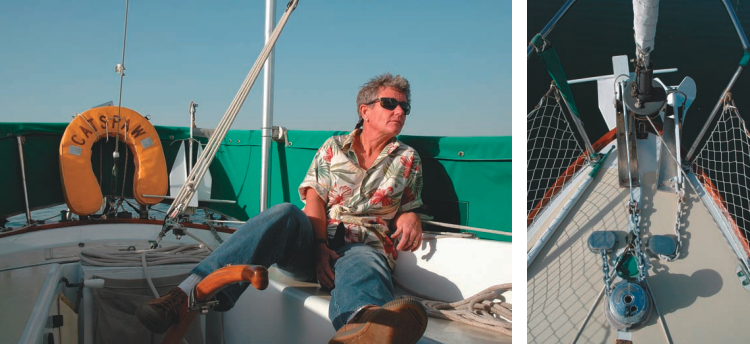
As noted, the Cal 30 was relatively beamy for its day, which not only makes for roomy cabins below but creates a large cockpit as well. Holly boasts that Catspaw has hosted 17 people in her cockpit . . . but six to seven would be more realistic.
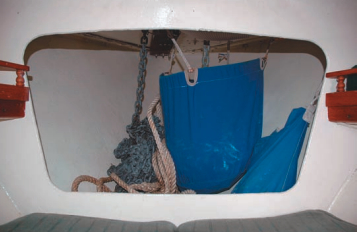
Despite the fact that Bill Lapworth didn’t like weight in the ends (to avoid hobbyhorsing), the Cal 30 has a sizable anchor locker forward that is accessed via the V-berth. There is also an aft lazarette. What’s more, there is space between the tiller and the lazarette for a propane box.
Low maintenance is a major appeal of fiberglass, and the Cal 30 advertising capitalized on that feature. Aside from a narrow cap-rail, an accent brow on the cabintop, and some handholds, the Cal 30 has a minimum of exposed teak to oil or varnish. Non-skid and gelcoat surfaces dominate the clean look, all of which came as a relief to those boatowners who were tired of maintaining wood. Jack Jensen and Bill Lapworth were some of the first to buck the idea that you had to have wood to be nautical and shippy. Besides adding to maintenance, excess wood trim adds weight, and they were looking for speed with this boat.
There are two sets of sailtracks, one on the caprail for the genoa sheets and one on the cabin. This second track was originally set up for a working jib but on Catspaw works nicely for the staysail. The bronze chainplates are set inboard on the cabin trunk to make for a clean deck.
Jensen Marine originally offered five sails as optional equipment: a main, working jib, lapper, genoa, and spinnaker. North Sails and Baxter & Cicero were the brands of choice, and none of the sails retailed for much over $300. Like the rigging, those old sails should have been replaced by now, and it’s likely they’ve been replaced more than once!
Bronze Merriman turnbuckles and toggles and bronze South Coast winches completed the original deck hardware. On Catspaw, a manual vertical Simpson Lawrence windlass retrieves the two bow anchors, and a Monitor windvane is a non-electric alternative to the autopilot.
Performance
“If you are not winning as many trophies as you should, try a Cal boat. It does make winning easier.” That is the copy from a 1966 Jensen Marine ad for the Cal 30 that pitches the boat as a low-maintenance racer and family cruiser. Ad hype? Perhaps, but it was a rocket in its time.
The Cal 30 is described by owners as a well-behaved vessel with good balance on all points of sail. It will do 6 to 7 knots in 12 to 15 knots of wind on a beam reach. It points well despite its full keel but experiences a little weather helm when the winds kick up. Sheeting angles are tight for good upwind performance.
The few Cal 30s still racing have PHRF ratings between 192 and 195 seconds per mile. Other similar-sized boats of its era include the Columbia 29, which pokes along with ratings around 216 to 219, and the Morgan 30, which rates an identical 192 to 195. Speed was important to Bill Lapworth and also to Charley Morgan.
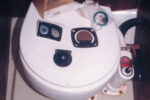
Under power the Cal 30 will make good about 6 knots. The first boats were offered with Onan 50-cubic-inch air-cooled engines, which had the reputation for lasting about two years. Jensen Marine soon replaced them with Atomic 4 gasoline engines. The ducting for the original air intake was molded right into the deck, and it makes for an interesting grate that continues to be visible in the cockpit.
To get away from the perceived risks associated with gas engines, many owners have repowered. Catspaw is on her third engine, a 4-cylinder Universal diesel. Unlike many Cals of other lengths, the 30s have a straight propeller shaft instead of a V-drive. Access to it and the engine are fairly good.
Conclusion
The 1962 brochure listed the base price as $13,500. Today, Cal 30s move in the $10,000 to $20,000 range, with some boats going for less and others selling as high as $30,000, depending on equipment and condition. That’s a great story of value for Bill Lapworth and Jensen Marine and not a bad return on a 40-year-old investment for an original Cal 30 owner.
Jensen Marine’s marketing copy pitched the Cal 30 as the boat for “the discriminating yachtsman who demands a high-performance ocean racer, the man who would rather sail than maintain a boat, and the sailing family which likes to cruise.” Forty-five years later, the number of Cal 30s still plying the water speaks to the enduring success of the design on all three of these levels.
Catspaw was outfitted for long-distance cruising and, like other Cal 30s that have crossed oceans and gone to far-off places like New Zealand, she is eager to head out. Perhaps she will get to do so with her new owner. After 23 years of ownership, Holly has moved on to a new project boat. No surprise, it’s another Cal, this time the famous Cal 40.
A boating writer and photographer, Zuzana Prochazka started boating as a kid with trailerboats and waterskiing weekends. For the past 12 years, she has been sailing the West Coast of the Pacific, South Pacific, and Caribbean. She is preparing to go cruising with her husband aboard their 48-foot ketch named Indigo. She holds a U.S. Coast Guard Master, 100-Tons License.
Thank you to Sailrite Enterprises, Inc., for providing free access to back issues of Good Old Boat through intellectual property rights. Sailrite.com