A cautionary tale from one who’s been there

Issue 59 : Mar/Apr 2008
The sirens call when least expected, their soft and gentle songs luring honest sailors away from much-loved boats, turning heads toward anything two feet longer — something with a shinier gelcoat, a new four-stroke outboard, roller furling, and radar. By the time the song is ended, and against all logic, previously happy owners see nothing but woe in the old boat. Moving up seems as inevitable as taxes, as natural as the wind.
I have owned a succession of good boats, 18- to 31-footers, each somewhat larger than its predecessor. I’ve sailed them, for the most part, in Puget Sound, the San Juan Islands, and the Canadian Gulf Islands. There are some frequently boisterous waters to be crossed in the straits of Juan de Fuca and Georgia, fast currents running through a large tidal range. There are sandy, mud-bottomed coves and supermarkets everywhere. It almost never rains in the summer, and the winds tend to be under 12 knots with some rather spectacular exceptions. These are almost ideal waters for small boats.
The little 18-foot centerboard sloop that I built and began cruising in some 30 years ago, took me to all the places that my current 31-foot keelboat does now — and a few more. I often wonder what life would have been like if I had kept that boat. Minka taught me much about these waters in all kinds of weather, summer and winter, weekends and Christmases. She taught me how to share happiness with a host of shipmates in countless secluded anchorages and city centers.
The sirens called
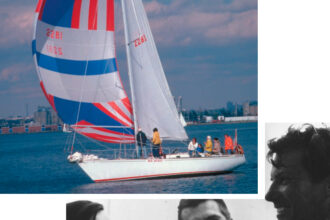
But the sirens turned my head toward a 26-foot Thunderbird, one of Ben Seaborn’s best. Haru Kaze was a good boat in all respects. She was faster than the barge-like Minka and more at home in the short and choppy seas that test a flat-bottomed and rather chubby centerboarder. The Thunderbird is a pretty boat and I fell for her good looks as much as her size and sprightly grace under sail.
But advantages were matched by disadvantages and I discovered the nature of compromise. There was more room in the 26-footer; but, as more roads beget more cars, Haru Kaze acquired more things. I learned that more space is easily trumped by carefully organized stowage and thoughtful usage.
The real problem with the Thunderbird was an apparent advantage: more headroom. Minka’s 4-foot cabin height required that one sat down immediately. The rule was: up in the cockpit, down in the cabin. The Thunderbird’s 5-foot headroom was a foot less than my height and, almost unconsciously, I adopted a gorilla-like gait. This led to serious lower back problems that eventually required surgery.
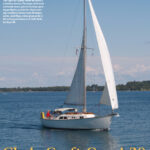
Enough room to stand up straight led me to an Ericson 27 — only a foot longer but a right proper yacht that had an inboard engine and five berths, an enclosed head, and teak all over. But it wasn’t long before I missed Minka’s 6-foot 6-inch ergonomically designed berths when trying to get four feet into the tiny wedge of space in the Ericson’s forepeak double.
Homicidal exhaust
The inboard gas engine was a boon in many ways — powerful and certainly quieter than the pinging and panging Seagull. It drove a prop that stayed well immersed in Puget Sound chop and the wakes of powerboats. When she was good, she was very good . . . but when an exhaust fitting cracked, my crew and I very nearly died of carbon monoxide poisoning one fine afternoon.
The costs, complications, and inherent dangers of inboard engines are not always fully appreciated when one decides to move up. And although the hazards of gasoline fumes in the bilges of sailboats are fast becoming a thing of the past, they’ve been replaced by an engine that requires more expensive repairs if things go wrong. And the smell of diesel fuel can permeate everything, making it more difficult to keep a small boat sweet.
I usually felt more confident in rough water in keelboats than I did in the unballasted Minka. Waiting out 20-knot days in a good anchorage, however, has its own pleasures. I learned to tell a western grebe from a black brant and admired the spread and drying wings of double-crested cormorants. I explored and fished over rock ledges just outside the mud bays that are good for anchoring but not so good for finding supper. I read a lot and just sat in the cockpit, carving jib cleats (Minka had no winches) and watching the world go by.

Wake-up surprise
One thing that I missed in most of my increasingly larger boats was the ability to take the ground and sit bolt upright. Minka looked almost surprised sitting there in the morning low surrounded by acres of clams. It’s not for everyone, this waking up high and dry, walking about your boat in the fog, scraping the odd barnacle, touching up some bottom paint, picnicking under the bowsprit . . . but I loved it.
The convenience of a smaller boat’s anchor tackle is not always fully appreciated as we contemplate the pleasures of owning a larger boat. A 22- or 35- pound Delta or Bruce can be a tussle to raise after an 8 1⁄2-pound Danforth. A windlass, probably electric and certainly expensive, is some insurance against back strain, but there is still an amount of lifting and tugging when breaking the anchor out after a windy night or two, lifting her over the roller and into secure mounts.
Concerns about wiring and electrical power can team up with the prospect of dragging into harm’s way. . . much more daunting in a $30,000 boat than in one costing less than a cheap used car.
I may be the exception, but piling on more and more years of cruising, I find more and more time for messing about with boats. My good wife, Beth, can find other things she’d rather do than head off for the islands one more time on a foggy October morning. Since I often sail singlehanded, this leads me to wonder if, all things considered, it wouldn’t make more sense to have a smaller boat.
Sailor talk
I often sail in tandem with my friend, Gary, who owns Imagine, a sister ship to Kuma, my Ericson Cruising 31. We often talk, as sailors do, of our most recent problems — my leaking take-off from the diesel tank, for instance, which I plugged badly when I traded the Webasto to Gary for a nifty little Dickinson bulkhead-mounted wood stove. It got back at me by delivering small quantities of diesel into the bilge for the past several months. I pump out the sump with a hand pump and cart the vile mixture of oil and water to a recycling center 20 miles away. It’s fixed now, but there is a lingering smell of diesel coming from a space between the tank and the fiberglass that holds it in place. There’s also fuel under the engine drip pan, but I’m working on it.
Gary can’t decide whether to fit a new manual or electric windlass. This leads to the seemingly never-ending anchor-sprit conundrum: wood or steel, one roller or two, what about the second anchor rode and its lead? Mooring cleat or Samson post? What’s the best anchor combination? What about making a proper bowsprit, increasing the J dimension, bobstays, and whisker stays?
All these problems, and the talk and lies that surround them, is satisfying in some peculiar way, but inevitably we seem to wind up reminiscing about our old and smaller sailboats. Gary argues for a 24- or 25-footer; I hold out for the pleasures of the 18- to 20-foot sailboat.
Inner-harbor advantage
Rafted up together in Blakely Harbor, having a coffee in Imagine’s cockpit, I point to the shore and tell my friend how it was to pass between those old bridge abutments over there and get into the inner harbor just before low tide . . . how I’d spend the night on the mud, away from all the proper yachts anchored outside in deep water, worrying about dragging together on a windy night. Gary thinks I must have taken leave of my senses to do a thing like that but we agree that, in one way or another, we had just as much fun — more even — in a smaller boat.
On the other hand, we believe the brain benefits from exercising on very difficult, often mysterious, problems that produce bad smells and uncomfortable nights, sore backs, and demands for lots of money. The brain, we think, may actually stagnate in the less challenging and healthier environment of a boat under 24-feet on deck.
Gary brings on stories of his old Trintella: how snug she was and cozy; how he’d keep warm with just old Pepper, that most wonderful and loyal seadog, and a flowerpot turned upside down on the cook stove. I try to top that with tales of Minka, her lack of demands and insatiable appetite for unannounced pleasure and how she asked for so little in return.
He tells me how it was that he could cross the straits in the Merit with all the security of a 30-footer and a good deal more excitement. I argue that if he wants excitement, he should try an 18- footer under the Narrows Bridge with wind and tide opposed.
Centerboard intimacy
I say that the berths on either side of Minka’s centerboard were longer than our 31-footer’s, wider and more comfortable. Nice in there, I’d say, holding hands over the top of that massive trunk with my first mate, hunkered down in mock intimacy.
But it’s not all about nostalgia, this talk about simpler times and less responsibility. It’s all relative anyway; I worried as much about Minka’s sudden loss of initial stability in a gust — her flirting with broaching — as with Kuma’s propensity to back down unpredictably in a narrow channel.
It’s about what’s essential to a good life with boats, about the time when sailing came first, the time before we heard the harpies sing and got caught up in wanting a bigger boat for the sake of having a bigger boat. Well, there’s always a bigger boat, always more things to attach, more things and more circuits. There are all sorts of ways to make a boat seem more like home — safer, more comfortable, more convenient.
And so we stroll down A Dock, my friend and I, admiring everything under 24-feet, rearranging deck hardware, getting Gary’s nesting dinghy on board that sweet little Catalina 22, fitting my old box compass and nav box to the cockpit of that Ranger 20. We’d change that nasty bit of graphics on the San Juan 24 over there and wonder if a little anchor ’sprit wouldn’t go rather nicely on that little Tanzer.
Maybe it’s just about starting all over again.
Richard Smith is a contributing editor with Good Old Boat. He has owned and built several boats, including an Atkin Red Onion sloop, a 30-foot Alan Pape steel cutter outfitted from a bare hull, an Atalanta 26, five dinghies, and an Ericson Cruising 31.
Thank you to Sailrite Enterprises, Inc., for providing free access to back issues of Good Old Boat through intellectual property rights. Sailrite.com