Cure “old boat smell” with aromatic wood
Issue 60 : May/Jun 2008
Each old boat has a comforting, mildly intoxicating, and unique smell: an indescribable combination of wood, salt air, and perhaps a bit of seawater. It may also have a hint of mildew, old canvas, paint or varnish, fiberglass resin, diesel fuel, transmission oil . . . all combined to make a good old boat smell like, well, an old boat.
There may also be odors that are less pleasurable: a nagging fuel leak, musty shower smells, or head odors.
Aboard Blessed, our 1979 Cheoy Lee Clipper 36 ketch, we’ve battled odors that may be related to her having been sunk years ago by Hurricane Andrew. Although she’s been completely rebuilt and restored nearly to her original glory, Blessie, as we fondly refer to her, has continued to offer up an array of very faint odors.
My solution was simple, decorative, functional, inexpensive, and it repelled insects. I purchased and installed strips of aromatic cedar throughout Blessie’s interior. Aromatic cedar stripping is available from most lumberyards and home-supply stores and provides a fresh, but not overpowering, scent of cedar. It is relatively inexpensive and comes in 1⁄8-inch-thick strips measuring 4 inches by 4 feet. These strips are milled with ship-lapped edges allowing them to overlap slightly when installed side-by-side or end-to-end. I purchased packages, marketed as closet liner material, from a nearby home-supply store for about $20. Each package contained enough stripping to cover approximately 15 square feet of surface area.
Trim board
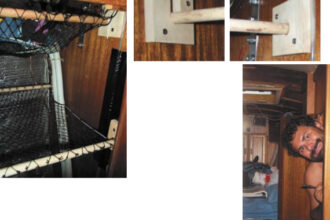
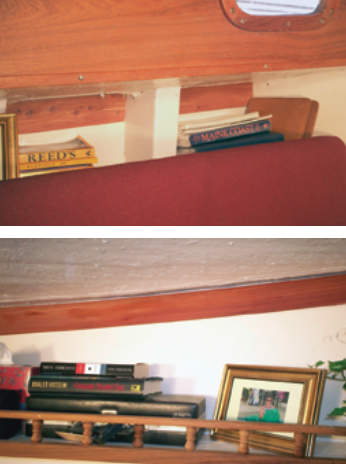
In the main saloon and forward cabin, I used cedar strips to create a 4-inch-wide trim board and applied it along the inside of the hull where it meets the underside of our decks. For these trim pieces, I ran the cedar strips through a table saw to remove the ship-lapped edge and produce a more finished appearance.
I applied the trim strips using a marine adhesive. I used wooden battens (that I could spring against the hull or cabinetry) to hold them in place while the adhesive set up — usually about 24 hours. Alternatively, you could affix strips to the hull or decking using very short stainless-steel or silicon bronze wood screws, provided you select a length that won’t go all the way through the hull or deck and if you don’t mind seeing the fasteners when the installation is completed.
While I was at it, I sheathed the entire interior of our hanging locker with aromatic cedar. Now the locker and its contents always smell fresh, since the locker has essentially been converted into a cedar chest. An added benefit is that aromatic cedar repels a variety of insects. I’ve never been particularly worried about moths aboard a boat, but we do seem to have fewer mosquitoes and flies aboard now.
I also installed trim strips inside many of our lockers and cabinets, especially those that tend to stay closed for long periods of time. The cedar strips don’t prevent mildew from growing in some of these poorly ventilated cabinets, but they do keep the cabinets fresh smelling.
New cedar grating
In the head, I removed the original teak grating that covered the shower sump and drain and replaced it with a grating made from cedar strips that I cut on a table saw into 1-inch-wide strips and screwed to a grid of supporting wooden frames, also made out of cedar. The result is a head that smells fresh and clean.
On a boat that I owned many years ago, I used aromatic cedar to fabricate a number of handy storage devices, such as spice racks, towel hangers, bookshelves, and binocular holders. The cedar has an attractive color and grain that complements the warm colors associated with other woods commonly used in boat interiors, such as teak and mahogany.
The cedar is always at work, imparting a subtle, clean aroma to the interior of the boat. Used sparingly, aromatic cedar can help keep the interior of any boat smelling fresh and clean, without creating an overpowering artificial smell such as you might encounter if you lived inside a cedar chest. Over time, aromatic cedar will lose some of its odor-imparting quality. As the aromatic quality declines, a simple light scrubbing of the surface of the cedar with 60- or 80-grit sandpaper or a plastic scrubbing pad will expose the natural oils in the wood once again.
Aromatic cedar was a natural choice to keep our good old boat smelling like a clean good old boat.
Ralph Pears began sailing in the early 1950s, at the age of 8, aboard Olympic-class Dragon boats. These were followed by an array of daysailers and cruising boats. He and his wife, Kathryn, cruise aboard Blessed, a 1979 Cheoy Lee Clipper 36 ketch, from Sebasco Estates, Maine.
Thank you to Sailrite Enterprises, Inc., for providing free access to back issues of Good Old Boat through intellectual property rights. Sailrite.com