How to check your rudder stops
Issue 60 : May/Jun 2008
This excerpt is from the revised and expanded third edition of Lin and Larry Pardey’s Storm Tactics Handbook. The book has 10 new chapters and has received an extensive update throughout.
Almost all of today’s sailors have grown up with automobiles. So it is no surprise that when the systems on their boat relate directly to those in a car, these same sailors expect equal reliability. Case in point? Steering.
When is the last time you heard of a car getting into trouble because its steering system failed? When is the last time you checked your car’s steering box or linkage? With millions of cars being produced each year, lots of money is available to test any new steering-gear ideas before they are used on the road. On the other hand, there are probably only a few hundred steering systems built for sailboats each year, so it is little wonder that problems do occur, far more often than they should.
Fortunately, when they do happen, sailors will rarely be moving at more than 6 or 8 knots, so the results are unlikely to be fatal. In most situations, steering failure will probably lead to some embarrassment or scuffed paint. But in a storm situation, steering failure can be the first link in the chain of events that build up until the crewmembers feel their lives are in jeopardy.
Fortunately, steering systems on almost every sailboat are relatively easy to inspect and maintain. There are also simple steps you can take to ensure a high degree of dependability.
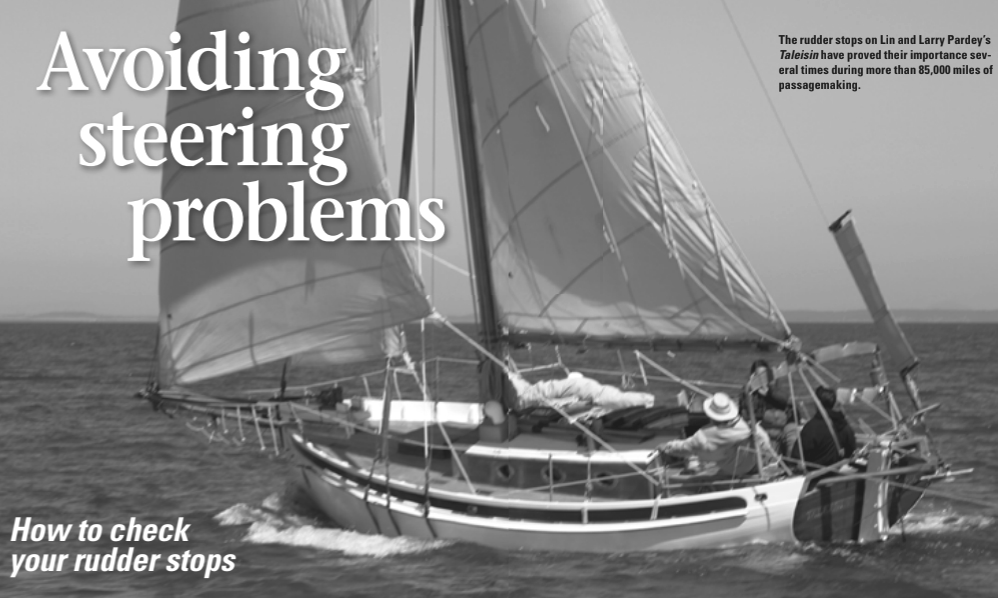
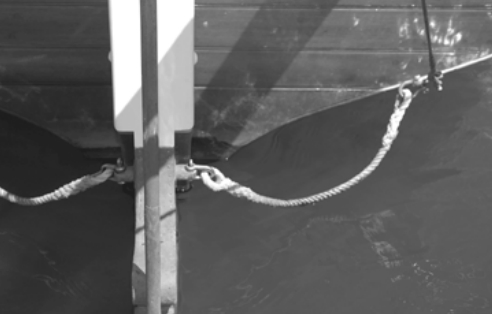
The simplest and easiest-to-maintain system for any boat is a tiller with a rudder hung on the transom or on the sternpost of a double-ender. Inspection is easy: check to see that the gudgeons and pintles are strongly attached, that there is no corrosion eating away at the metal of the fittings, and that there is a securing device to prevent the rudder from being lifted free of the gudgeons in a sloppy seaway. The tiller connection should be inspected on a regular basis and the tiller itself should be checked to be sure the wood is sound. For heavy weather, it is important to add rudder stops such as we use on Taleisin.
By limiting the travel of the rudder, these lines protect the gudgeons and pintles against sheer and shock loading. This loading happens when a boat is suddenly shoved astern by missing stays during a tack in heavy weather, or when the force of a wave crest carries the boat bodily astern if it is lying head-on to a sea anchor.
Rudder stops are just as important for boats with wheel steering and for those with spade-rudder configurations where the rudder shaft comes through the hull. Here they absorb shocks that could otherwise damage the steering quadrant or any of the components that make up the steering system. Also, should any component of the steering system break down, the rudder stops will keep the rudder from jamming hard over and stressing the rudderpost.
The rudder stops for wheel steering, and through-the-hull rudderstocks, have to be designed specifically for each individual boat and are usually belowdecks inside the hull. Since they are hidden from view and rarely come into play, some boats leave the factory without rudder stops. In other cases, people retrofit their tiller steering with a pedestal-and-wheel system. Since there is no simple, one-size-fits-all rudder-stop arrangement that can be sold with the retrofitting gear, the boat ends up unprotected.
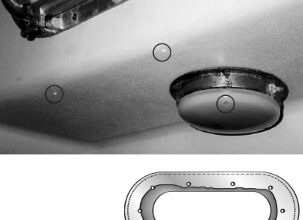
The drawings reproduced on Page 22 show several rudder-stop arrangements. Will Keene, of Edison International, which has been making steering systems for three generations, presented some simple suggestions that can definitely improve steering dependability, but he stressed that rudder stops are the starting point. The stops should allow the rudder to swing no more than 35 degrees either side of center. (Your rudder becomes ineffectual once it goes beyond 25 to 30 degrees.) Will recommends that high-density rubber be used at the strategic spot to increase shock absorption (act like a cushion.)
Once the rudder stops are in place, it is important to check the chain length on the main sprocket for the wheel. You do this by taking the compass off the top of the pedestal — so you can see the wheel sprocket — then turning the wheel until the rudder is hard over against the stops. The chain should extend at least two links beyond the sprocket teeth, both port and starboard. This guarantees that the wire steering cables cannot be drawn in and shredded by the teeth of the sprocket.
After checking the chain length, your next step is to make sure the steering cables are properly tensioned. The tension should be checked with the wheel amidships and with the wheel hard over against the stops — first to port and then to starboard. This will let you see whether there is too much slack on the lazy cable (the cable that is not under stress). A slack cable can fall free of its turning blocks.
Though the steering cables should be tensioned so they cannot be pulled free of the sheave grooves, it still is important to have sheave guards on each block. These work similarly to the cheeks on a block such as you use for jibsheets. Guards are not standard equipment; since they cost extra, they may not have been installed on your boat.
All parts of your system should be easy to inspect, and this inspection should be done on a regular basis. Larry and I noticed the steering beginning to feel sluggish on a 50-foot center-cockpit ketch we were delivering. When we began tracing the cables for this system, we realized we could not access the turning block that was causing the trouble. It lay behind the cabinetry in the main saloon. After we isolated the problem to this one block, we finally cut a hole through the cabinet (which, fortunately, was hidden by the cushions of the settee) and found that the bolts holding the block in place had sheared, the block was no longer properly aligned, and the cable had slipped off.
Chay Blyth, who built specialized boats for the fleet he organized to race around the world against the prevailing winds, had an excellent way to make sure the components of the steering system could be easily inspected and maintained. Instead of having the cables and quadrants hidden away belowdecks, he had them installed under easy-to-remove gratings in the cockpit.
Will Keene likes the idea of installing a tiller-like rudder stop above the quadrant. “If I had an autopilot system, I’d attach it to this rudder stop tiller. That way, if any part of the pedestal steering system failed, the cables, the gears, the chain, the autopilot would take over as an immediate, electrical emergency steering system,” Will explained.
Even with this backup, it is imperative that all wheel-steering systems have an arrangement that allows you to install a separate emergency tiller above decks (usually in the cockpit). If the emergency tiller can be attached easily, it can work to save wear and tear on your whole steering system as you heave-to in storm conditions. Install the tiller and secure heavy-duty shock cord from the tiller to a sheet winch on each side of the cockpit to hold the tiller slightly to leeward. Allow the wheel to turn freely. The stresses will then be absorbed by the shock cords.
Whatever type of steering system you use, wheel or tiller, in storm conditions these shock cords are important. They work to dampen the rudder movement and are the first line of defense in absorbing shock loading, which could damage your rudder, its connection to the rudder post, or the gudgeons and pintles. The rudder stops are your secondary line of defense. It is important to use bowlines to secure shock cord in these conditions, as most other knots will tend to slip or untie.
Lin and Larry Pardey are spending the Northern Hemisphere summers exploring Puget sound and the Gulf Islands on Taleisin. During the Southern Hemisphere summers they explore New Zealand waters on the 110-year-old sloop, Thelma.
Thank you to Sailrite Enterprises, Inc., for providing free access to back issues of Good Old Boat through intellectual property rights. Sailrite.com