How one cruiser learned to slow down and relax
Issue 62 : Sept/Oct 2008
Skills gained through hands-on accomplishments can help demystify problems and bolster our self-confidence to tackle more demanding challenges. But the wisdom of others offers a whole new perspective on a lifestyle choice.
It was an attention-grabbing experience for me to be awakened at first light by what sounded like a freight train speeding through our 1981 Bayfield 32, lying at anchor off Beausoleil Island, in Lake Huron’s Southern Georgian Bay. The V-berth, which had been motionless when we went to sleep, was now rocking back and forth like an out-of-control department store rocking horse.
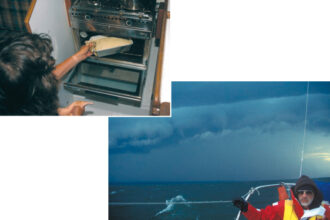
My first mate, Emily, was already awake and anxiously sitting in the main cabin. She confirmed my suspicions when I disbelievingly asked, “Is that the wind?” I was accustomed to hearing the wind howl through our rigging but I’d never heard it roar like it did that morning. We had to raise our voices within the cabin just to hear each other over the din outside. A near-gale-force wind had unexpectedly piped up, wreaking absolute havoc in our anchorage. It didn’t occur to me at the time to turn on our masthead instruments to check the wind speed, but it must have been well in excess of 30 knots.
An inspection on deck revealed that our anchor rode wasn’t chafing, but I let out a generous amount of additional rode as extra insurance. Fortunately, our anchor held, while many sailboats and powerboats around us, especially those that had been rafted together, dragged theirs. Within 20 minutes or so, the wind had subsided and calm was restored.
I thought little more of the high winds until the next day, when it was time to return to our marina and Emily offered to weigh the anchor manually. I motored forward to allow her to haul in the slack rode. When the rode became taut, try as she might, the anchor wouldn’t budge. It seemed that our 22-pound Bruce anchor had buried itself several feet into the mud during the high winds of the previous morning.
Breaking free
A previous back injury prevented me from being too much help — even together we weren’t able to break the anchor free. I cleated the anchor chain and unsuccessfully tried to motor forward and use the power of our diesel engine to break the anchor free. After struggling for half an hour and with mounting frustration, I finally managed to break the anchor free using this method.
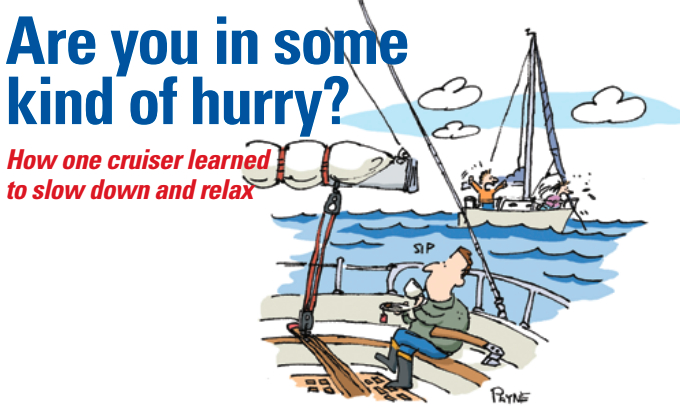
Weeks later, I was speaking to a long-time cruising couple we had met, and I brought up the incident of burying our anchor. The skipper replied that whenever he buried his anchor, he simply shortened the rode as much as possible and went back to the cockpit for a cup of tea.
By shortening the rode, he explained, the combined effect of wave action, the wake action of passing boats, and transferring the weight of the crew aft would cause the anchor to effortlessly work itself free. He then looked at me with that wisdom born of experience and slyly asked, “Were you in some kind of a hurry? You were on a sailboat, after all.”
His message wasn’t lost on me: if we were always meant to hurry through life, what were we doing on a sailboat in the first place? The reason we had selected a sailboat was to enjoy peace and quiet, with loss of speed being a welcome compromise.
Now, whenever things seem to go wrong or I fall into old habits of rushing through life, I try to remember that sage advice and ask myself, “Are you in some kind of hurry? You’re on a sailboat, you know.”
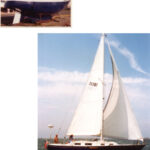
Bill Van Allen and wife, Emily, sail their 1981 Bayfield 32, Ocypete, out of Penetanguishene, Ontario, on Lake Huron’s Southern Georgian Bay.
Thank you to Sailrite Enterprises, Inc., for providing free access to back issues of Good Old Boat through intellectual property rights. Sailrite.com