This old Winslow yawl still stirs passions
Issue 64 : Jan/Feb 2009
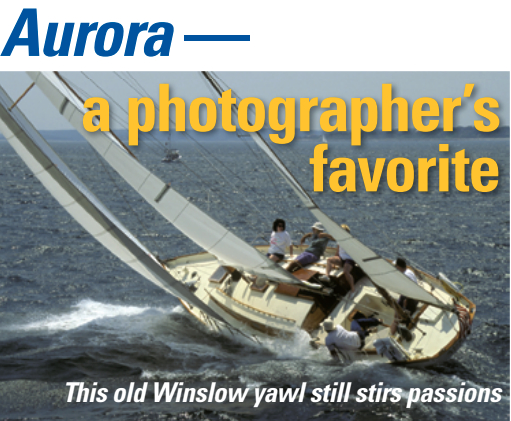
Most sailboats, when berthed or moored, look rather like birds with folded wings. As birds are meant to fly, windships are meant to sail. Under canvas they demonstrate and fulfill their true natures. So it is with Aurora, a 36-foot Winslow yawl. Under way she is a wonder — sheer poetry in the hands of a master mariner. Of all the boats in our homeport of Scituate, Massachusetts — and there are more than 650 — she is my favorite to photograph.
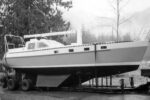
Aurora is no spring chicken. According to her present owners, Rick and Mary Williamson of Scituate, Rick’s father, an industrial arts teacher in a junior high school, began her construction in 1958. She was launched in 1962, her sails made by his mother with some advice and help from knowledgeable friends, and her name chosen by both of Rick’s parents. Newspaper articles at the time documented her building and launch.
Aurora was both nimble and staunch. Her hull was, and is, white with a blue sheer stripe and blue boot top. She is made of strip-plank construction, with 1 1⁄8-inch cedar planks on oak ribs. Her planks are edge-nailed into each other and screwed into the ribs. The masts are made of Sitka spruce, which is very light but strong. Her beam is 9 feet 6 inches; her draft, 5 feet 6 inches. Her original engine was a 45-hp 4-cylinder gas Lathrop engine. Rick removed that old tired engine in 2004 and repowered her with a 40-hp Volvo/Penta diesel, work done with the advice and assistance of a local diesel dealer. Nowadays, Aurora sleeps four, but in the 1960s she actually slept up to seven with pipe berths.
Out of the blue
After about five years into her sailing career, Aurora was sold by Rick’s parents to a couple who were going to relocate from a neighboring town to South Freeport, Maine. In 1986, Rick’s father received a call out of the blue from the wife of the couple who had purchased Aurora, informing him that her husband had been dead for three years and she was now trying to sell the boat. She was wondering if anybody in Rick’s family was interested. As luck would have it, Rick and his wife were headed to Portland, Maine, that next weekend to take the ferry to Nova Scotia. They left a bit early and detoured to South Freeport to look at the boat. Once they returned to Scituate, Rick drove his father back up to see it. After a few months of mulling it over, they decided to take the woman up on her offer to sell and bought the boat back, hiring a local transporter (whose father had helped and advised Rick’s father on the original construction of Aurora) to bring her home. She was re-launched in the spring of 1988.
Rick does all the work on the boat himself, brightwork included, and stores Aurora in his backyard.
But I don’t see her in these prosy moments. I see her out sailing and whenever the wind is high — no matter what other vessels are out there on the briny deep — we head for her in our Grand Banks 36-foot trawler, Sea Story II. I shoot her from every angle, and there isn’t an image of her that isn’t beautiful. She holds her own with every more “modern” windship I capture with my camera, whether she’s beating, reaching, or running — always, I might add, while being expertly helmed — proving the truth of Keats’ old adage that “A thing of beauty is a joy forever.”
Mary Jane Hayes and her husband, Warren, have been boating for more than 25 years. They sailed Serena, a Sabre 28, for seven years and now cruise the East Coast in a Grand Banks 36, Sea Story II. A freelance writer and photographer, Mary Jane has been widely published in boating magazines.
Thank you to Sailrite Enterprises, Inc., for providing free access to back issues of Good Old Boat through intellectual property rights. Sailrite.com