Once stranded and condemned, she’s now her salvor’s Ruby Deux
Issue 67: July/Aug 2009
In the tradition of all good seafaring stories, this one began on a night dark as pitch. The wind built from the southwest and white-capped waves roared up the channel across the moorings to explode in foam against the breakwater. A lone hanging lamp testified to the storm’s violence, casting animated shadows in the gusts and illuminating the sheets of rain blasting inland.
At the height of the gale, a gust laid the little boat over hard and she swung against the run of the current. As she snapped back, the cleat on the foredeck let go and she was briefly free to explore. The cadet on watch in the waterfront center saw a flash as her mast whipped in the waves. She ripped by his elevated position, headed into the cove, and ran up onto the rocky beach. With some quick thinking and even faster footwork, he managed to secure some lines aboard and lay them back to trees and a large rock.
The next day was bright and cold, as is normal for early December in New York. I was on my way to class at SUNY Maritime College and, as I drove past the Science and Engineering Building down to the water, I noticed a mast pointing off toward the Throgs Neck Bridge, rather than skyward, as would be normal in the moorings.
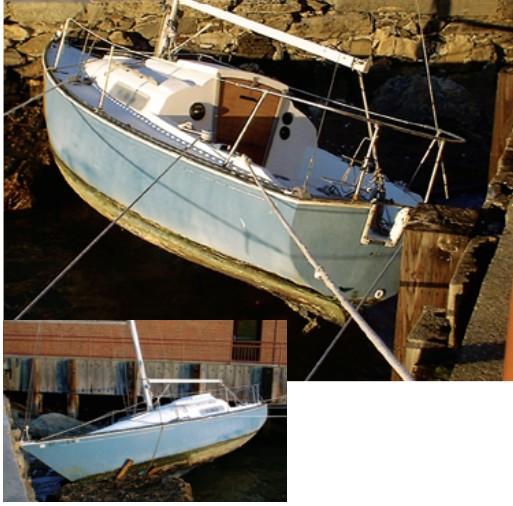
On walking down to the seawall through the flotsam thrown across the grass bank, I saw the little C&C 25 propped against the wall and almost standing on her keel, which had worked itself into the fi ne sand that filled the spaces around murderous boulders. Not thinking, I said out loud, “Someone has their work cut out for them with this one.” Little did I know that the boat gods were looking down at just that split second. They decided to have some fun.
Coming with chainsaws
A voice boomed from behind me: “Oh no, she’s got to be off the college property by the end of the week and I have a couple of guys with chainsaws coming to cut her down to more portable proportions.” It was the manager of the waterfront center.
“But what about the owner?” I asked.
“She was a donated boat, and a donation on the rocks is a pain. You move her, she’s yours.”
With 10 minutes before the start of my class, I looked over the hull and clambered aboard. There were only a few scratches on the hull as far as I could see and, although she had a grand collection of seaweed and shells tucked away in her cockpit, she looked pretty good. I stood on the foredeck looking at the four holes where once the vital cleat had been, my mind racing.
I can’t just let her be cut up . . . someone would knock great fun out of her . . . but how do I move her? . . . class time . . . nice sheer . . .
The basic problem of moving the boat was compounded by the fact that the previous night saw the highest spring tide there would be for a month. Even with another tide as big as that, the sea level would not get back up enough to refloat her without a gale piling New York Bay against the outgoing tide from Long Island Sound.
But the little boat and her guardian gods had their own ideas. When I sighted along the mast to see if the rig had been damaged, I noticed a mobile crane moving large concrete traffic barriers on the bridge above me.
They must weigh a couple of tons; I bet that crane could shift her.
A couple of minutes later, I was talking to the crane driver and a fee was agreed. He could come on Saturday morning and we would see what we could do.
While digging the sand away from the upper side of the keel, I found the rudder buried in the sand. “Good,” I thought, “At least this saves me the job of tracing shapes off other boats’ rudders in the boatyard.”
A gentle lift
Another bright and calm day dawned and the tide was as low as it gets. I pulled the strops under her hull and the crane took up the strain. “I don’t know how much I can do for you,” the crane driver said, as he realized that the keel was lead, and the strain gauge in the cab climbed to 4,000 pounds. But she shook herself free of the sand and, with the greatest of delicacy, she was placed in 2 inches of water alongside the pier to await the incoming tide.
The crane driver waved as he left and shouted, “I hope she floats after all that.”
“Or I will be in a world of trouble,” I replied under my breath.
Over the next five hours the tide filled, and finally, almost imperceptibly, she stood upright and floated free. Down below, her bilges were as dry as a bone and there still seemed to be something connected to the keel bolts. The next day, a launch from the waterfront center towed her to nearby Locust Point Marina and she was lifted for the winter.
And so the work began.
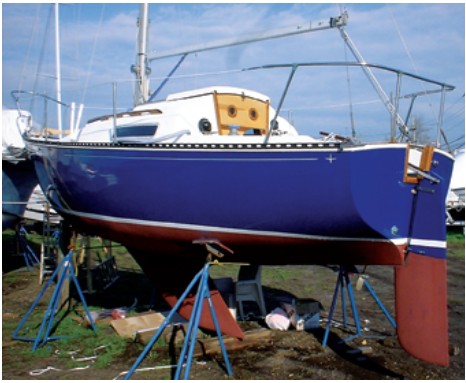
Although she was in reasonably sound condition, she was in bad need of a good overhaul. Even without the grounding, she would have needed a goodly amount of work. Having taken Don Casey’s advice about softly abrading the baby blue topsides and waxing them back to life, I found that after a week I was getting nowhere. A topside paint job was in order. I did this with a two-part Interlux paint over several coats of primer. After fully degreasing and filling the surfaces, I rolled the paint on and tipped it off with a fi ne-bristled brush. It was my first attempt at this painting technique and I heartily recommend it, with the caveat that the preparation work must be 100 percent or the topsides you have will look better than what you will get.
Toiling in the cold
For those who have not experienced a boatyard in winter in New York (and I don’t suggest anyone should go out of his way to do so), it is a right desolate place. Anybody with half a brain would stay at home reading boat mags and poring over the charts for next year’s adventures in the warm.
I worked after classes had finished and before they began, hence avoiding the killer heat and sunstroke associated with 30°F weather. The final straw came as I was sanding the topsides with wet-and-dry sandpaper and the water froze as I applied it to the surface. The boat gods had a chuckle that day.
Some jobs could be tackled even with the inclement weather. The motor, a Danish-built Vire 5-hp, single-cylinder, gasoline engine, which looked so good, simply would not fi re. I had come across these fi ne little motors in boats in Europe and knew they had a very good reputation. After a quick Google search, I had full diagrams of the motor’s carburetor and electrical system. I bought a new 12-volt battery and charged it at home. The next day, after crushing the ice in the yard’s water hose and connecting it to the water intake on the motor, I cranked the motor over and heard the faintest of kicks, then another, and away she went — not like a kitten; more like a cat coughing up a furball, but enough for me to know there was not much wrong with the motor.
A little homework
The tiny storeroom in our upstairs apartment in Hicksville became the workshop for the pulpit. I did not have any real tools of the sort I would have liked to do the job, but the $1,000 quoted to build a replacement pulpit for an “out of manufacture” boat was just too much to pay without at least giving it a go. I used standard angles, bases, and tees instead of welds to connect the parts. It was important to set all the locking screws and lock them in place with adhesive lock compound. After all, it might be me hanging off the bow screaming something about spinnakers and jibing.
The difficult part of the construction was bending the 1-inch stainless-steel tube. This I did using a length of 2-inch softwood with a 1-inch hole drilled in one end so the tube would slide through. As I bent the tube very slowly, using the wood as the lever and a door jamb as a brace, the correct shape began to appear. My wife-to-be watched, thinking, I am sure, second thoughts.
The portlights were hazed to the point I could see nothing through them, so I bought some 7-mm acrylic and very carefully marked the shapes of the old ones on it. Without removing the protective film from the new acrylic, I cut them with a fine-tooth fretsaw, cutting through a piece of quarter-inch ply at the same time to prevent the plastic from splintering. I then drilled the holes and replaced the portlights in their frames, bedding them in high-modulus silicone mastic. This was the first time I could see something for the work, and I was glad to see it.
The Christmas break gave me some time to clean out the bilges and lockers and start on the woodwork both down below and on the deck. The handrails could be unbolted by removing push caps in the headliner. Along with the tiller (also found in the sand weeks later) I took them home and varnished them in the storeroom, where my wife-to-be pitted her asthma against, “Just another two, or maybe three, coats. Come see, they’re looking great.”
A boatyard springs to life
Regardless of the official date, spring comes when we have the required 50°F to dry primer and paint. And then one day, the boatyard morgue, where all winter I’d stalked between boat bodies veiled in white plastic shrouds, exploded into life with the smell of thinners, the sound of power tools, and an ever-present patter of Bronx idioms: “Yeh-yeh-yeh, and your mudda.”
With the brighter evenings, work moved along at a good pace. The new pintles and transom capping went on, followed by the new stanchions and bootstripe. I removed all the old wiring to nowhere and replaced it with new wiring to somewhere. One evening, after I’d spent several hours sanding internal woodwork prior to varnishing, the VHF that I had written off crackled and then spoke. It was as if the old boat was feeling better and letting me know she was grateful.
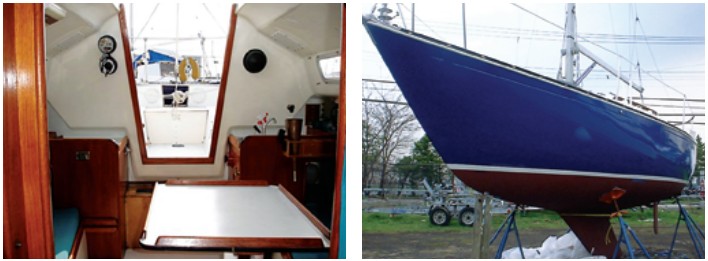
Just a year before, I was living aboard my 40-foot steel gaff cutter in the balmy south of Spain before beginning studies for a degree in naval architecture. My beautiful home afloat was called Rubicon, affectionately known as Ruby, so subliminally the new boat was being called Ruby also. When it came time to name her it seemed only right to call her Ruby Deux and so her transom was anointed with this name.
Registration frustration
A situation I had not foreseen was the boat’s registration status. Although she had been donated to the college, she did not carry papers. Either she had not been registered or someone had lost the papers. A two month-long back-and-forth with the previous owner finally yielded the necessary bill of sale and a very straightforward trip to the DMV.
“Just bring a rubbing of the HIN number from the transom, and a photograph of the boat, and the HIN number,” they said. We got away without having to bring the actual boat. This was a real request at one stage, I kid you not.
In hindsight, registering the boat should have been my very first job, as the previous owner would have been liable for the costs of removing her from the beach and would have been happy to sign her over at that stage — a lesson learned the hard way.
Having secured a mooring in the perfect harbor of Oyster Bay, and after making sure all the rigging was sound, it was time to see if Ruby Deux would swim. She sat happily with the slings of the travel lift under her as I checked the through-hull fittings for leaks. Then I started the engine. It revved and ran. Then, after a mighty whoosh of steam burst from the cockpit locker, I switched it off. The rubber tube between the raw-water pump and block decided to split and spray salt water over the exhaust, hence the steam. It took the rest of the day to replace it as it was (as is typical) almost completely inaccessible. Point noted, I thought.
The next day was a perfect early-summer day and Ruby Deux motored down the cut and out under the Throgs Neck Bridge. A light breeze wafted from the Connecticut shore and, as we made sail, there came that sublime moment when the sails start to pull and the motor falls silent. It felt like heaven. She was lighter than I had thought and she picked up speed well, even under her well-used canvas and her hand-me-down asymmetric cruising chute.
Since then, I have added an inner staysail stay 3 feet aft of the stemhead that allows me to set a smaller sail to balance the reefed main. My now wife (yes, even after all that) and I re-covered the cushions with Sunbrella material, which makes her interior feel much better. I constantly update the safety equipment and I even carry a parachute anchor because you just never know when the boat gods might decide to have a little fun.
Eric Holohan is a Westlawn graduate, naval architect, yacht designer, a Lloyds-accredited marine surveyor, and an ABYC master technician. You can contact him at www.holohanmarine.com.
Thank you to Sailrite Enterprises, Inc., for providing free access to back issues of Good Old Boat through intellectual property rights. Sailrite.com