Lessons learned by a would-be circumnavigator
Issue 66 : May/Jun 2009
Choosing and equipping your voyaging boat is all about compromise. Among other considerations, you have to balance initial costs, operating costs, weight, storage, and function (both for the boat itself and for each of its systems). Over the last several years, we have rehabbed our boat, planned a circumnavigation, and set out on the voyage. After a year under way and 10,000 miles under the keel (a mere beginning in the world of bluewater voyaging), I have a few comments about how some of those decisions worked out.
Five years ago I met an adventurous and salty lady. We put together a partnership, which flowered into a marriage. Over a period of three years, we got my boat ready and simplified our land lives and finances. We set out around the world: Cape Cod to North Carolina, Bermuda, Panama (a non-stop straight shot), Galapagos, French Polynesia from the Marquesas to the Societies, Rarotonga in the Cook Islands, Niue (the Rock), the Kingdom of Tonga, Fiji, and, finally, the Bay of Islands in northern New Zealand. All this in one year.
What a ride! None of the things that keep would-be cruisers up at night happened: no pirates, no rogue waves, no hurricanes, no freighter collisions, no heart attacks or broken legs, no shark attacks, and nobody fell overboard. The sailing was fun and the destinations were fantastic — all as advertised. The boat and equipment have performed more or less as we hoped and expected. But we have learned a few lessons along the way.
First decision: the boat
When we decided to circumnavigate, I already had a Whitby 42 ketch. Blue Stocking was built in 1982 and was showing her age. We wondered whether we should fix her up and sell her and then buy something more ideally suited, or whether we should simply fix her up for the journey. All boats, new or old, have disadvantages and problems. We decided, given the constraints of time and money, to stay with the familiar disadvantages and problems rather than buy a new set.
We hauled Blue Stocking out and began a two-year rehab. This involved, among many other things, removing the engine and rig for rebuilding; building a temporary shelter (two winters); rebuilding the engine; stripping and painting the masts and replacing the rigging wire and fittings; body work and painting the topsides, house, and deck; installation of new equipment; and putting it all back together, launching, and shaking down.
I’m not that worried about appearance or resale value — at her age she is not worth that much (in dollars) and, as a result, I have not put as much time into interior cosmetics as many boatowners do in reconditioning a boat for a voyage. I kept the focus as much as possible on function. During the coldest part of the two New England winters we worked indoors, mainly on building four new sails and a Jordan series drogue.
Living with limitations
We did successfully correct most of Blue Stocking’s problems in the rehab but, of course, the disadvantages of a particular design are hard to eliminate. The Whitby was built for comfort and capacity so BS (my nickname for the old girl) is not especially weatherly, and that didn’t change. She has a full keel with a cut-away forefoot and a keel-hung rudder with an aperture prop. I would happily trade a foot of draft for a balanced skeg-hung rudder: Blue Stocking often needs a lot of steering force under sail and she is absurdly unpredictable in reverse under power. I avoid marinas anyway, but I just about need tugboats for docking and maneuvering close in. This can be frustrating and embarrassing.
The ketch rig, at least on this boat, has never impressed me, although it was a big selling point when I bought her. I’d much prefer a cutter. About the only time I use the mizzen is upwind or on a reach in a lot of wind (over 25 knots, say). Then, I drop the main entirely and sail on jib and jigger. In most other circumstances, the mizzen seems mostly to add weather helm and heeling moment but not much effective velocity.
The mizzen mast is useful for a lot of things: radome, wind generator if we had one, mizzen staysail if we had one. But the extra rigging is a bit of a pain; the shrouds make moving about on the after part of the boat tricky.
In general, I have found it difficult to set up the sailplan to minimize weather helm, especially once she starts to round up due to wave action. We use a block and tackle from the boom to the side rail as a vang/preventer downwind. The tail of the tackle runs to the cockpit so the preventer can be eased in a controlled way during an intentional jibe or if we are taken aback. This has worked pretty well.
The Dutchman boom brake we installed was way too fussy and we gave up on it.
Abundant benefits
Overall, Blue Stocking’s advantages — comfort, seakindliness, and capacity — have greatly outweighed her limitations and rehabbing her was a good choice. Most boats do fine in the long downwind tradewind passages. But BS really showed her stuff on the long upwind slog from Fiji to New Zealand.We did that 1,200-mile run in eight-and-a-half days, with apparent winds over 30 knots at least a third of the time.
Taking everything apart and putting it all back together during the rehab was invaluable, both for developing knowledge and confidence for future repairs and modifications as well as for predicting what tools and parts would be especially helpful to have on board during the voyage.
Self-steering is key
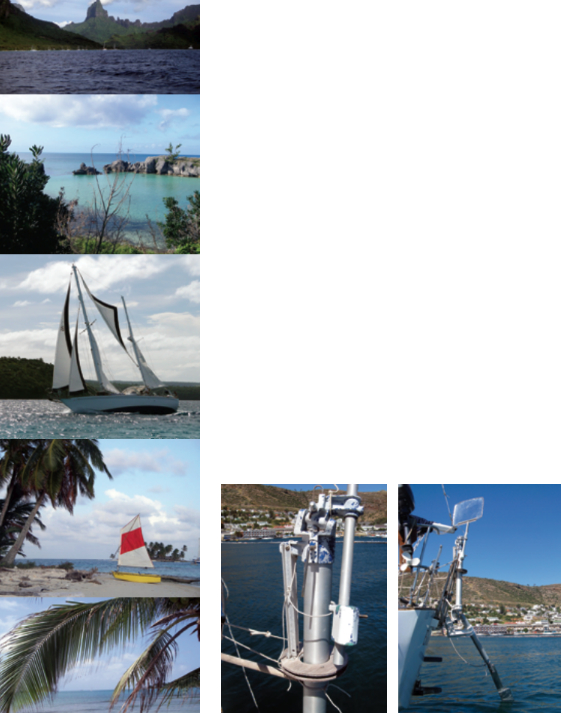
Don’t leave home without self-steering gear. You are going to want the boat to handle routine steering on her own almost all of the time. That is the overwhelming consensus among the voyagers I’ve talked to out here. An electronic autopilot is very nice to have, but these can and do break down. A functioning and effective windvane self-steering mechanism is a crucial ingredient in pleasant voyaging. I am speaking as one who has not yet achieved this ideal. When they work, windvanes are quiet, use no energy, and are easy to maintain and repair, compared with the black-box electronics of a modern autopilot.
We started out with a pretty good under-deck autopilot and an antiquated windvane unit that someone had given us and I installed at the last minute. It was worth what we paid for it and we left it behind in North Carolina. The autopilot was amazingly effective; it got us almost all the way to Rarotonga. However, three of us had to hand-steer for the last three days or so of that passage when the electric drive arm bit the dust. (Eight hours a day of hand-steering for several days is not an overwhelming burden, but it’s no walk in the park either.)
The boat at the quay next to us in Rarotonga had a Hydrovane unit for sale. We bought it (on approval, fortunately) and were able to install it using the existing transom brackets (from another brand entirely) which I hadn’t removed. You would think that with this set of happy coincidences, the darned thing would at least work, but it didn’t. I met up with the seller in Tonga and gave it back with my thanks. With repairs and improvements, the autopilot has been working pretty well some of the time, but after the 1,200-mile bash to windward from Fiji to New Zealand, I didn’t want to rely on it entirely.
In January 2008, I bought a used Sailomat in Opua, New Zealand. After a lot of adjustment I got it working pretty well, but always with much baby-sitting and always with a lot of yawing, even after I contrived a way to adjust the vane from the center cockpit.
I wish I had nailed this problem down before I set out. My sense is that most voyaging boats have both systems — autopilot and windvane. The autopilot works most of the time and is a lot more convenient unless it breaks down. The windvane hangs there as a backup system and when it is needed the crew may not have the experience to get it to function effectively. Of course, if the autopilot fails a long way from port, they will get a chance to figure it out.
Safety issues
Volumes have been written on the topic of safety, but I will make one observation about harnesses and jacklines. The conventional wisdom is to use flat webbing jacklines because they do not roll underfoot. Webbing, like all fabric, is vulnerable to UV breakdown and becomes gradually and unpredictably weaker as it lies in the sun month after month. We decided to use ordinary 1/2-inch double braid, reasoning that the inner core alone is adequate to the loads and that the outer core helps protect the inner core from UV breakdown. Regardless, jacklines, should be renewed on a regular basis and stowed between passages.
Maybe a sheathed material for flat jacklines is available, but I’ve never seen it. There are already lots of lines underfoot on BS so I couldn’t see that one more made much of a difference. As much as possible, it’s a good idea to keep the jacklines near the centerline and the tethers short so that being thrown over the side is less likely. The big problem with harnesses, of course, is that you ought to use them more or less all the time, and most of us don’t want to do that. I use them (and encourage the crew to use them) all the time at night and most of the time when I am out of the cockpit. The more you use them, the easier they are to use. A short extra tether is handy for transfers from jackline to jackline (if your setup makes that necessary) in really hairy conditions.
New sails for the voyage
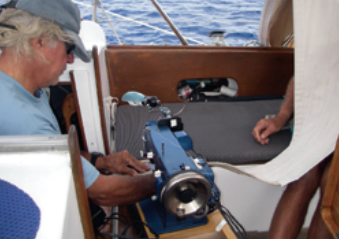
Blue Stocking is a ketch. She has five working sails, which when we started the refit were already 20 years old. That may be good enough for casual cruising, but we wanted to start with new sails for a circumnavigation. I had more time and energy than money, so I decided to build a sail from a Sailrite kit and see how it went. It was time-consuming, but I found the work pleasant and it saved about half the price of professionally built sails. Encouraged, I ended up building the working jib, the mainsail, the staysail, and the mizzen.
I built two sails in each of two winters, while it was too cold to do much else on the boat. They have stood up pretty well with no major failures. I made the main with full-length battens, which has been nice in many ways — a lot less flogging for one thing. But the battens hit the lower shrouds, even with the boom only halfway out. Naturally, there is chafe-through at these points. I haven’t figured out the best way to deal with this. I tried sewing some hard plastic wear strips on the outside of the batten pockets but they tore off after a few hours. After consultation and reading, I decided to put chafe strips of 2-inch-wide Spectra webbing on both sides of the batten pockets where the chafe damage is obvious.
It has also been hard to keep the Dutchman track slides fastened to the sail, especially the upper ones which are in use whether the sail is reefed or not. They are fairly cheap, though, and easy to replace. The Dutchman track-and-slide system and the Dutchman sail-flaking system were, in general, excellent choices, although they do require some regular maintenance. It’s very comforting to be able to pull the main down for reefing or dousing without having to round up into the wind, something that can be a hairy business in a seaway. A manufactured track-and-slide system (there are several out there) can make this possible, if not easy.
Making an entire suit of sails for a 40-footer is not going to be most people’s choice for a winter activity. Still, I would encourage sailors to get a good machine and build a small sail or a few canvas projects. This will give you the skills, tools, and confidence to do many sail and canvas repairs. It will also enable you to talk more intelligently and effectively with sailmakers. In remote places, you may know more than the sail repairer does. With tact, that can make for a good collaboration and a better end result for the repair.
Solving water worries
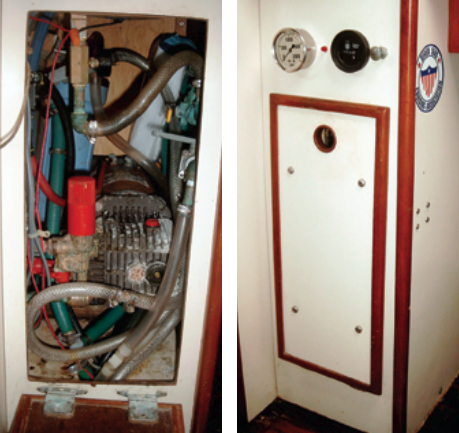
It was a last-minute decision, but I conjured up a homemade watermaker from generic parts following instructions from a Good Old Boat article (January 2003). It works great: 25 gallons an hour for less than $2,000. If you’re thinking about buying and installing a commercial watermaker, consider making your own. Apart from a little desk time figuring out the right combination of parts to use for your boat, it’s really pretty much the same work as installing a commercial one.
I set mine up in the garage and tested it part by part before installing it on Blue Stocking. That way, I was pretty sure it would work. The best thing about home-brewed is that, if it breaks down, all the parts are generic and available in any city in the world.
You can do without a watermaker, but it is nice not to have to pay for water of questionable quality and you don’t burden the supplies of islands that have little to spare. We’ve met some cruisers who enjoy catching fresh water the way others enjoy catching fish, but I don’t share their enthusiasm. It’s nice not feeling compelled to hassle crewmembers about how much water they use. I thought I might be nuts when I took on this project, but it turned out to be an excellent decision.
Food matters
Another Good Old Boat article we used to our great benefit was the one on canning meat (July 2003 or January 2006). We canned about 90 pounds, and it was wonderful to have on board. You are not allowed to bring canned meat (homemade or otherwise) into New Zealand or Australia, so don’t can too much if you’re going there.
Generating electricity
We would have liked to have put on a wind generator and solar panels. I finally decided, though, that it made more economic sense to put a second alternator on the engine. Blue Stocking has four 6-volt batteries (Trojans) for 425 amp-hours, plus a separate small starting battery. The two alternators can bulk-charge at 150 amps without breaking a sweat, and I can even run the watermaker (which draws a hefty 65 amps to deliver its 25 gallons per hour . . . commercial ones are admittedly more efficient) and still be putting 100 amps or so into the batteries. I have had good success with ordinary (non-marine) high-capacity alternators. They are about one-third the price. (Gas engines require ignition-protected marine alternators. This is not an issue for diesels.)
Blue Stocking does not have a genset but has a 2,000-watt inverter, which seems to work fine for the microwave and even the toaster oven. I probably would not have put these appliances on a boat, but BS came with them, and they are handy. Even without them, I would have an inverter on board for power tools. As far as I can see, the only reason for a genset on a voyaging boat is if you want to use air conditioning away from the marina.
Battery health
The key to happy batteries and short charging times seems to be to start charging as soon as you get down to 50 percent and don’t try to charge over 80 percent. This means having a large enough battery bank to meet your energy budget without dipping below 50 percent very often.
Whatever you decide to use for your energy needs, consider getting a modern battery monitor (mine is a Link 10) and learn what it can do. It will take most of the guesswork out of battery charging and increase the life and effectiveness of your charging system’s components.
Living aboard at anchor, I need to run the engine about an hour a day if the refrigerator is running. At sea with the autopilot, the SSB, the radar, running lights, and that pesky computer all running much of the time, charge time can be two hours or even a little more. Often we have needed the engine for propulsion while under way and then the charging is essentially free. (Most voyagers seem to motor between 20 and 40 percent of their hours under way.)
I bought a used towable generator at a swap meet and couldn’t wait to see if I could get some free amps while sailing. It didn’t develop enough voltage under any conditions to charge the battery at all, perhaps because it was homemade.
Fuel and filters
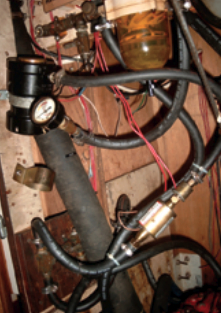
I carry 200 gallons of fuel in three tanks (tankage is a great feature of the Whitby) and use just over half a gallon an hour for charging or motorsailing. It seems to me slightly unseamanlike to carry jerry jugs of diesel on deck, but it is definitely the current fashion. I’m glad I don’t have to do it.
I installed a 100-micron cleanable grit filter in front of the usual Racor primary filters. This seems to have minimized filter clogs. I have lots of valves and filters and pumps to give me choices in moving fuel around, including the option of pre-filtering or polishing it as I transfer it from the storage tanks to the one I usually feed the engine with. Ideally, that tank never receives fuel directly from the outside, but I haven’t always achieved the ideal and fuel, as delivered, often seems to have some grit or water in it. I have found that the Racor’s vacuum gauge is among the most important instruments on the boat. I check it regularly when under way, especially at the beginning of voyages, when there has been a lot of pitching, and before a tricky maneuver, like going through a reef pass.
If you keep an eye on that gauge, you are less likely to be surprised by a filter clog and the engine croaking when you need it the most. As you know, almost all diesel-engine problems are fuel problems. Get clean fuel, free of air, to the injector pump and all will be well. For my next boat, or next refit, I will put in a small (say, 15-gallon) day tank with a drainable sump and nice big cleaning ports. I will feed it daily from the main tanks through the polishing system. Then I can be certain that the fuel to the engine will be clean, clean, clean.
Communications
I just love my Pactor, a system for sending email through the SSB radio. I have a ham general license. (Since the FCC got rid of the code requirement in 2007 there’s no excuse not to have one now. The theory test is pretty basic — you ought to know this stuff anyway even if you have a marine SSB.)
With a general license, you can use Winlink, which is free and has shorestations all over the world. It seemed to me at first that the coverage in the Pacific was pretty thin, but the stations are outstanding — the two in New Zealand particularly so — and I always was able to connect from Cape Cod to New Zealand, although a few times it took some persistence.
If you are not a ham, you can use Sailmail, which is not free but pretty cheap. Sailmail uses the same hardware and software as Winlink but with different shore stations. People who have it seem to like it. It takes a little while to get your SSB — ham or marine — tuned up, but if you use it regularly you’ll get the knack. We were often part of the informal SSB nets that voyagers use while on passage. The harder the passage is, it seems, the more you appreciate the net. A key element in the success of your SSB radio is the antenna tuner. Blue Stocking came with a separate automatic tuner made by SGC and it seems to work flawlessly. Satphones are great if you have the budget. Iridium seems to be the choice for ordinary mom-and-pop boats.
In port, more and more places have WiFi. I’m a half mile from town at anchor as I write this and have 24-hour Internet service on the boat for about $25 a month. This requires an external WiFi card and antenna, but they were pretty cheap. In population centers where there’s no WiFi, you can usually find Internet cafes. Security is a big issue, however, when using these. I can use Skype, which is almost free, to call all over the world from the boat when I have WiFi, but sometimes the calls are a little comical: “Can you hear me now?”
The essential computer
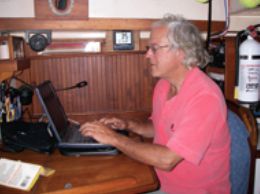
As on most other voyaging boats, the laptop is essential equipment on Blue Stocking for communications, Internet, and charting . . . not to mention writing articles like this. Mine is a 5-year-old Toshiba. I have all the critical files backed up in several forms, but it’s going to be a serious setback when (not if) the hard drive crashes. When that time comes, I’ll try to find a model that can boot from an external hard drive, something this one cannot do.
So far, I’ve managed to keep the computer dry, but this is a matter of concern and constant vigilance. I know from experience that a few drops on the keyboard can be fatal. Some cruisers keep a fully-loaded backup laptop in a vacuum-packed bag. Without that, I am prepared to be knocked back into the 19th century for a few weeks (or months, depending on the state of the kitty). Some supposedly waterproof laptops do exist, but you have to wonder if they really are entirely waterproof. Besides, they cost more than twice the minimum cost of the entry-level laptop (a basic laptop is all most cruisers need for ordinary voyaging).
I consumed an inordinate amount of time on problems with connections between accessories like the GPS and the Pactor modem and the computer. The current generation of laptops tends not to have serial inputs, so you need to use serial/USB converters. Several of these have failed on BS. If you need to use one of these, have a spare or two on board since they are hard to find “in the field.” As with all marine electronics, the plug connections to the laptop are a constant source of problems. Spray-on TV contact cleaner seems to be helpful for resolving some of these issues.
Anchoring gear
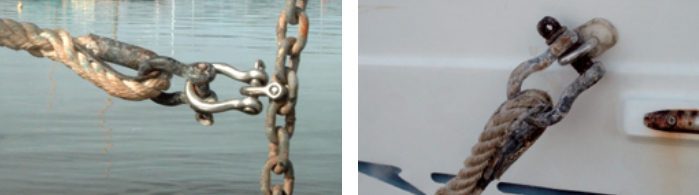
We put a lot of money and energy into Blue Stocking’s ground tackle . . . and even more would have been justified. We installed a new electric anchor windlass and bought 260 feet (a half barrel) of new chain. We bought a Spade anchor for use as a primary and carry the old CQR (in our experience the Spade has been better, even though it is lighter) and two Fortress anchors, one of which is really large and is stored disassembled.
I recommend Wichard HD shackles for the anchor chain. They are the only ones I have found with pins small enough to shackle on to the middle of the chain while having a tensile strength greater than the chain. I installed a Wichard U-bolt on the outside of the hull so I can have a snubber shackled to the boat and to the chain, with no possibility of chafe.
One big skill and set of equipment that I think is nearly essential for cruising in the tropics is scuba. Even though they’re careful, most cruisers eventually get their chain and/or anchor caught among the coral heads. Sometimes the gear can be extricated by persistence from the surface or by free-diving, but sometimes scuba will be the only real solution.
I don’t have scuba gear or recent certification (this is on my wish list), but I do have a Sea-Breathe 12-volt electric hookah. It has been invaluable for bottom scrubbing (which I do about every other month) and for underwater repairs and inspections. It is only good down to 20 feet, though, and many anchorages in the Pacific are a lot deeper than that.
Crew fitness
One final note about preparation for voyaging. Physical strength is your best asset at sea. Just about anyone at any age can double his or her physical strength in a few weeks with a simple weight-training program. This is not to be confused with body-building — just toning. Do it. You won’t regret it. The less strength you have to begin with, the more important this suggestion is for you. With increased toning, and with the judicious use of sailing gloves, you’ll be amazed at how much more you can do on the boat — with or without tools.
With luck, Blue Stocking will continue from New Zealand and, if the fates allow, we will cross her wake somewhere near Bermuda in the next few years to complete our first circumnavigation. The best thing about the voyaging life (aside from the amazing people you meet) are the things you learn . . . about sailing and about yourself.
Paul Denton is a life coach, freelance writer, and full-time voyager. We last reached him in Simons Town, South Africa, from where Blue Stocking was about to leave on her homeward journey.
Thank you to Sailrite Enterprises, Inc., for providing free access to back issues of Good Old Boat through intellectual property rights. Sailrite.com