A pair of throwable anchors is a valuable aid to “ungrounding”
Issue 68 : Sept/Oct 2009
T GIF! Friday had finally arrived. Soon we’d be off, just my little beauty and I, sailing out into the serenity and splendor of the Chesapeake. Casting off, I pointed the bow toward one of my favorite secret hideaways, a perfect little anchorage tucked just off the Poquoson River.
The anchor set deeply into the hard muddy bottom early that evening. As I sipped a cup of joe in the cockpit, the sun seemed to wink “goodnight” just before slipping below the horizon.
Sunrise greeted us with a brisk southwester, promising a fine sailing day. After a lazy breakfast, I hoisted the main, weighed anchor, and reached out of the perfect cove. Just outside the entrance, I lashed the tiller and went forward to raise the working jib. The little sail went up without a hitch and I made my way back to the cockpit. And that’s when I heard the thunder.
The whole foot of the jib was shaking violently, pouring over the leeward rail. I had forgotten to set the tack into the stemhead shackle. Glancing at the chart, I guessed that I could continue another few hundred yards before I needed to tack to clear the shoal ahead. I charged up to the mast, slacked off a couple of feet of jib halyard, and started moving toward the forestay. A moment later, my boat slammed into the mud, stopping with a jolt that almost knocked me off my feet.
Little anchors to the rescue
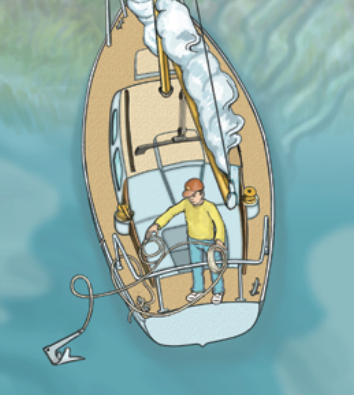
Down came the jib and main to keep the boat from driving any farther onto the mud. Out of the lazarette came two little 2 1⁄2-pound Bruce anchors. I quickly tied the bitter end of the line from one of these tiny anchors to a stern cleat, coiled the line, and climbed on top of the lazarette hatch cover. I heaved the anchor out toward deep water and pulled until the flukes dug in. Then I led the line to a sheet winch, took a couple of wraps, and started cranking. The boat started creeping foot by foot toward the anchor. As she closed in on the little Bruce, I stopped cranking and readied the second mini-hook.
I cast the second anchor, pulled until it took a hefty bite on the bottom, and led it to the other sheet winch. I then pulled up the first anchor, hoisted it aboard, and began to heave in on the second anchor. I repeated this sequence several more times, until the boat finally slid off the muddy shelf into deeper water. Free at last.
Upon inspecting the bilges, I found that the boat was dry as a bone, so no harm had been done. The little casting kedges had come through like champs to save the day.
The indispensable kedge
All of us run aground now and then. Most groundings, when they happen on soft sand or mud, are more irritating than serious, and kedge anchors have a great history of helping free grounded ships.
The traditional kedge looks like one of those anchors in a sailor’s tattoo, with U-shaped flukes and a long shank. Smaller vessels often need something light that can be thrown, and a pair of small, light anchors can be doubly useful. The 2 1⁄2-pound Bruce anchor is ideal. It has no moving parts and sets quickly. You might also try a strong folding or fixed grapnel anchor.
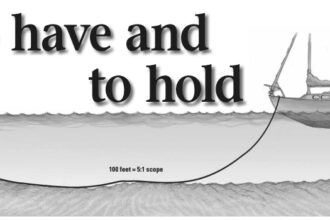
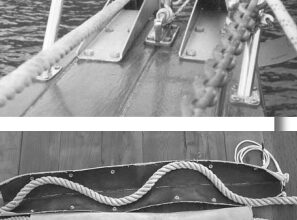
Each anchor needs its own line. Use two 100-foot lengths of 5⁄16-inch or 3⁄8-inch nylon line. Bend the lines to the rings at the end of each anchor’s shank and coil the lines. Store both anchors with their rodes attached in a cockpit locker.
Casting a kedge
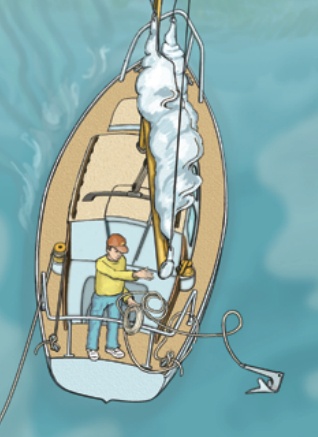
Pass the bitter end of the anchor line over and back under the stern rail and secure it to a quarter cleat. Coil the remainder of the line, working from the cleated end toward the end with the anchor. Brace yourself at the stern rail. Break the coil in half, with your non-dominant hand holding that part of the coil closest to the cleat. Taking care not to snag the backstay, throw the anchor as far as you can toward deeper water. If the first throw falls short of where you intended, haul in the anchor, re-coil the rode, and try again. When the anchor touches bottom, tug on the line a few times until you feel the flukes dig in.
Remove the bitter end from the quarter cleat and move it to a sheet winch. Take at least three wraps on the drum, then cleat the line (standard winch) or pass it over the stripper arm and into the self-tailer jaws (if you have a self-tailing winch).
Move your crew to the bow and to the same side of the boat as your line and winch. This decreases draft by heeling the boat and lifting the stern.
Grind until you have a lot of strain on the line. When the rode is taut, stop grinding. If you see no apparent movement, have the crew shift their weight from side to side while staying in the forward half of the boat. When the boat begins to move astern, continue grinding slowly, maintaining a constant strain on the kedge. Stop grinding when you’re within a few yards of the anchor, because further grinding risks breaking out the anchor.
Using the same process, cast out the other kedge as far past the first as possible. Take the second kedge line to the other sheet winch and make it taut. Retrieve the first kedge and haul in on the second one. Repeat the procedure until the boat is free.
John Jamieson recently directed the seamanship and chart-navigation departments at the Charles F. Chapman School of Seamanship in Stuart, Florida, where he taught on-the-water techniques on a fleet of 14 sailing and power vessels. He is the author of the new book, Seamanship Secrets, from International Marine/McGraw-Hill.
Thank you to Sailrite Enterprises, Inc., for providing free access to back issues of Good Old Boat through intellectual property rights. Sailrite.com