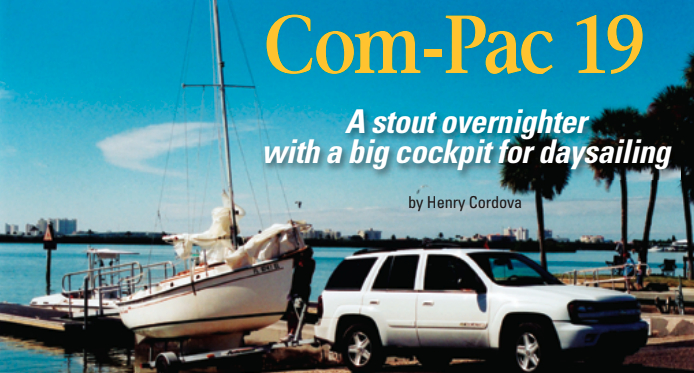
A stout overnighter with a big cockpit for daysailing
Issue 68 : Sept/Oct 2009
In 1974, the Hutchins Company found a market niche relatively unpopulated by competitors and filled it with a trailerable, well-designed, solidly built, and nicely finished mini-yacht. The Com-Pac 16 might be the minimum small boat for camping and gunkholing, but it still has enough capacity to actually travel to interesting places and stay out of trouble. It’s a boat for the weekend explorer, the adventurous couple, and the small family ready to try more than just a day on the lake. This basic concept became the guiding philosophy of subsequent Hutchins boats, including the Com-Pac 23 (designed by Clark Mills of Optimist pram fame), which was introduced in 1979.
History
The obvious market gap between the 16 and 23 was filled, in 1982, by the Com-Pac 19. This Com-Pac also was successful, with a production run of 624 units over the next 20 years, until damage to the tooling finally put an end to the model run. Its designer, Robert Johnson, the founder of Island Packet Yachts, went on to design the Com-Pac 27 in 1985. This boat marked Hutchins’ entry into the coastal cruiser market.
The Com-Pac 19’s superfi cial resemblance to the 16 and 23 is obvious to the casual observer, but Bob Johnson brought many of his own ideas to the Hutchins concept. Despite those differences, it is safe to consider the 19 as an affirmation of the mission of its predecessors. The boat is a pocket cruiser capable of getting into shallow water but still able to handle some coastal cruising. It is not a bluewater boat, nor can it be called a high-performance boat, but it is stout, dependable, and comfortable. New, it was reasonably priced: base price in 1984 was $8,495. Base price for a 2001 19 XL was $16,395. The price of a used boat today depends on its age, model, equipment, condition, and the vagaries of the market. A quick survey of classifieds on the Internet revealed asking prices between $3,750 and $7,000.
Design
Bob Johnson gave the 19 a sharper bow and a finer entry than the Clark Mills designs. This yields better windward performance. The 19 also has a flatter bottom and harder bilges, which make for a roomier interior than one might expect, as well as higher initial stability. This type of hull form sails better on an even keel than it does with the lee rail in the water, and it does not roll as quickly in a stiff breeze or when crew shift sides on deck. This resistance to rocking means it is friendlier and feels more stable to new sailors and is more comfortable lying at anchor.
Just as in the earlier Com-Pac designs, the 19’s keel is integral to the hull and ballasted with concrete. Four custom orders were produced by Hutchins with keel/centerboards, but the vast majority of the boats came off the line fitted with shoal keels.
Two boats were fitted with inboard diesel auxiliaries at customer request, but most of the 19s are powered by outboard motors.
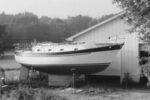
All 19s have an external cast-aluminum rudder with tiller steering. Although the rudder does not extend below the keel, it can be kicked up to prevent damage in the event of grounding. Where the Hutchins and Johnson philosophies really coincide is in the overall shape and character of the boat: she is all curves and grace, with a traditional look and a well-balanced shape. The boat has a wide beam, high freeboard, modest overhangs, and a jaunty sheer. She looks terrific and bigger than her size, both inside and out.
Construction
Construction methods on all Com-Pac yachts are fairly standardized. There is no fancy high-tech engineering here, just straightforward industry-accepted boatbuilding techniques and materials. The hull is built using the hand-layup method, where woven fiberglass cloth is manually placed in a mold already sprayed with NPG (neo-pentyl glycol) gelcoat, and then wetted out with polyester resin using rollers and squeegees. The deck is not cored with balsa or plywood, but with a blend of silicon-dioxide microballoons in polyester resin that is impervious to rot. It will last as long as the fiberglass skins do.
The hull-deck attachment is by means of an outside flange system. The hull and deck edges flare outward from the hull and parallel to the water’s surface. These flanges are coated with a marine sealant, pressed together, and fastened with rivets. The outside of this assembly is protected by a synthetic rubrail running along the entire length of the hull-to-deck seam. Inside, a wooden batten covers the seam, secured by screws. All deck hardware is through-bolted to reinforced pads embedded in the deck.
In 1985, the 19/2 was introduced, equipped with a bowsprit, slightly more sail area, and stainless-steel rails in place of the original aluminum. An overhead liner was added to the interior and the mahogany interior trim was replaced with teak. In 1988, the 19/3 was introduced. The major change with this model was a fabric covering for the hull interior; this replaced the original paint. The final iteration, the 19 XL in 1992, featured a full interior fiberglass hull liner and a teak-and-holly sole. Occasionally one may hear about the Com-Pac 20, which was not a separate model but the name given to the 19 XL in Europe, where it was quite popular.
The Com-Pac 19 is ballasted with 800 pounds of concrete placed inside the keel cavity. As noted above, the keel is an integral part of the hull, not bolted on. The top of the keel cavity, above the glassed-over ballast, serves as a sump to collect any stray water that gets into the boat. The bilge and pump-intake hose may be inspected by lifting a sole panel just forward of the companionway ladder. This hose leads to a pump on the port-side lazarette bulkhead; discharge is a transom through-hull well above the waterline. Other through-hulls in the transom include accommodation for the outboard motor wiring harness and fuel line and two cockpit drains.
Rigging
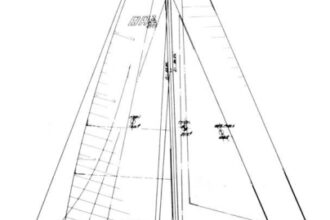
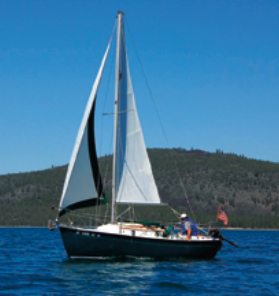
Whereas the Com-Pac 16 has a fractional rig, the 19 has a masthead rig with upper shrouds, a single set of lower shrouds, a forestay, and backstay. The mast is stepped on deck; below is a compression post to absorb rigging loads. The boat is easily maneuvered on and off a trailer. It may be an awkward operation to singlehandedly raise and lower the mast, but it is a snap for two.
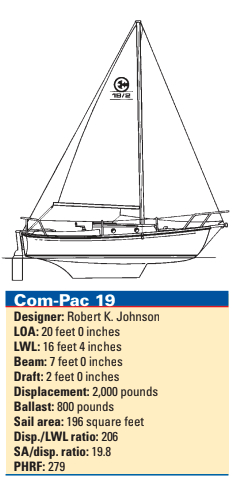
The initial design carried 188 square feet of sail area almost equally divided between the mainsail and headsail. Later variants — the Com-Pac 19/2, 19/3, and 19 XL — were fitted with a bowsprit which increased the area of the 110-percent jib to 98 square feet, the same area as the mainsail.
Another difference between older and newer models involves the reefing systems. Older boats have roller reefing; later models are equipped with slab reefing. Some owners have reported that reefing under way is difficult due to poor design of the reefing hook. Some owners have improvised a work-around. For example, one owner uses a stainless-steel ring in the mainsail grommet to fasten the reefing hook, and another suggests fitting the hook with a locking pin.
An optional 155-percent genoa with tracks and cars was offered. Other factory options included sheet winches and a halyard winch mounted on the mast. Standing rigging is 5⁄32-inch stainless-steel wire. The boat tested was equipped with a topping lift.
Deck hardware for the 19 is adequate for sail and line handling. At the bow, just aft of the bowsprit, is a single bronze cleat and two bronze fairleads to guide the anchor line. A chrome fitting on the foredeck allows the rode to deploy from the chain locker in the forepeak. Two other cleats and fairleads amidships handle the jibsheets, and two more at the quarters aid in docking. The boat tested also was equipped with a traveler just aft of the companionway hatch. A stern pulpit, stanchions, lifelines, and a swim ladder that were also available as factory options were present on the test boat.
Accommodations
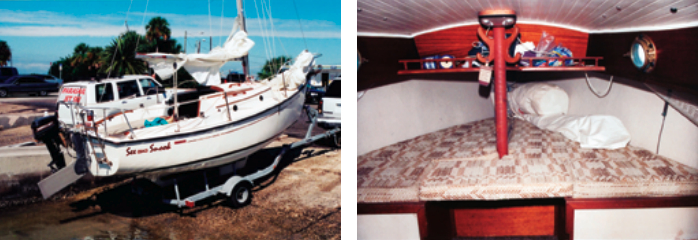
A fore-to-aft look below reveals a bare-bones cabin that is nonetheless roomy and efficient, beginning with a chain locker in the forepeak. A hatch above the V-berth provides foredeck access and ventilation. The berth, although compact, is comfortable for two children or one adult. In practice, however, it will probably be used primarily for stowage on anything longer than an overnighter. A notch in the V-berth, where the mast compression post is located, can hold an optional galley with a small sink and folding table.
Two small storage lockers are located under the cushions at the aft end of the V-berth, port and starboard. One of the shortcomings of this boat is a lack of storage; there simply is no room to spare. In spite of this, it is adequate for two adults willing to rough it on a week’s cruise, or for three or even four for a weekend. But the supplies needed for any sort of extended trip will have to be stored in containers scattered about the cabin, or in netting strung along the cabin sides.
Illumination below is provided by four sturdy brass portlights and by a light fixture on the overhead.
The optional chemical toilet stows beneath the companionway ladder, which can be folded out and up so the head can be deployed for action with some privacy. (The ladder covers the companionway entrance.) The electrical control panel is located directly above the void where the toilet is secured when not in use. Two quarter berths along the port and starboard sides double as settees; they do not have any storage underneath. From the aft end of each berth it’s possible to reach into the cockpit lazarettes, which also are accessible from the cockpit. The lazarettes are quite roomy and provide more than enough space for the usual deck gear, such as life vests, boathook, spare line, tool kit, battery, bilge pump, and spare parts. The small (2-gallon) fuel tank for the outboard fits in a space under a shelf between the two cockpit benches aft, flush with the transom. The port lazarette is roomy enough to accommodate a larger tank, and there is a through-hull from the lazarette through the transom that could pass a fuel line to a port-mounted outboard motor.
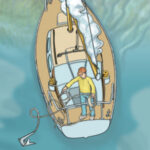
In a 19-foot boat, much time is spent in the cockpit, and this boat has a roomy one for its size with comfortable seating for four. With an improvised awning or boom tent, it would make an extended stay at anchor or dockside quite civilized.
Performance
The Com-Pac 19 was designed as a trailerable sailboat, and performance under tow and during launching and recovery is a fundamental consideration. Prospective buyers should ensure that their tow vehicle is up to the task and that the trailer is adequate. Although the factory towing gear is perfectly suited for the job, a used boat may not be mated to the same trailer it was sold with, and maintenance on the trailer over the years may not have been conscientious.
Under power at low speeds, the Com-Pac 19 can be a bit awkward due its relatively long keel, so it may be necessary to employ both rudder and engine when backing down in tight quarters. A 4- to 6-horsepower motor is recommended.
My test sail, aboard Dan and Laurie Snook’s Com-Pac 19, See (sic) Snook, was conducted in Clearwater, Florida, in light winds, and it was necessary to set the genoa to get the boat moving adequately. At low speeds, the boat maintained steerageway even when barely moving. Tacking and jibing at low speeds was acceptable, although a bit slow and deliberate. Light-air performance was adequate with the wind on the beam or quarter, but making headway was difficult close-hauled. This is not a high-performance boat. Its PHRF is 279; compare to a Rhodes 19 at 258 and a Precision 18 at 282.
Under brisker conditions, the boat comes alive. Reports from skippers are very positive, and the boat thrives on all points of sail. The weakest appears to be downwind; the 19 does not track well under these conditions and requires constant attention to the tiller (although rig upgrades such as whisker poles and boom vangs reportedly help, and an aftermarket foil rudder is popular with some owners). The boat feels safe and stable. It rides level and resists heeling. At wind speeds over 12 knots, or when overpowered, the boat tends to develop weather helm. The tendency to round up can be partially compensated for by using the outhaul to flatten the mainsail as much as possible and by replacing old worn-out sails.
The 19 is a very good rough-water boat, it heaves to easily, sails well when reefed, is resistant to broaching, and jibes well. The 19’s hull form provides high initial stability, but it might have some difficulty recovering from a capsize. But as noted above, this isn’t an offshore boat.
Conclusion
The Com-Pac 19 is a sturdy, well-designed and constructed boat, and it carries out its design function as an overnighter/weekender well. Its virtues make it particularly amenable to Florida sailors. A word of warning, however: as it is a small shoal-draft boat, its stability and solidity may tempt the inexperienced or overly bold skipper to push it too far.
Owners trade notes on towing, maintenance, and performance on a couple of websites, and the builder has an excellent record of providing advice and spare parts to owners of used boats. R.F. Burgess’ book, Handbook of Trailer Sailing, is also an invaluable source of information on the Com-Pac 19 and other comparable boats. Burgess discusses the Com-Pac 16 and 19 at length in his book — he has owned both!
Henry Cordova is a geographer/cartographer who has been a sailor of the military persuasion (U.S. Navy Reserve on the USS Dewey) and of the recreational variety (a San Francisco Pelican and a MacGregor 22).
Thank you to Sailrite Enterprises, Inc., for providing free access to back issues of Good Old Boat through intellectual property rights. Sailrite.com