A look at three long-waterline cruiser/racers
Issue 68 : Sept/Oct 2009
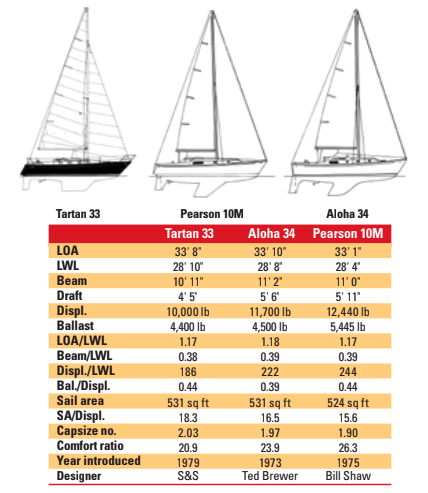
I had some difficulty finding two designs to compare to the very-long-waterline Tartan 33, actually a 34 by almost any standards — and more about that later! The Pearson 10-Meter was the only sailboat that seemed to fit into this category of long-waterline and 30-year-old boats until I realized that my Aloha 34 design was fairly close with only a couple of inches difference in her length overall (LOA) and length on the waterline (LWL). Still, while these three designs have a number of similarities, the Tartan stands alone with her Scheel keel and fractional rig, and that makes much of this review rather like comparing apples to oranges.
The Scheel keel is a patented bulbed fin, designed to provide shoal draft and easy access to the many small gunkholes cruising sailors love, but it does not provide the 33 with quite the performance of some cruiser/racers of its era. Indeed, while I was designing the Morgan 38, Morgan Yachts wanted to see if a Scheel fin would offer even shallower draft than the fairly thick 5-foot 0-inch draft NACA foil I had drawn. Stevens Institute tested a model of the 38 hull with the chubby NACA fin and then with a Scheel fin of only 2 inches less draft. The tank results greatly favored the NACA fin. Since it was also simpler to manufacture, Morgan selected it as the standard and offered an option with even deeper draft.
I feel that the Tartan 33’s fractional rig could benefit from the addition of running backstays, as the slight angle of the swept-back spreaders may not keep the forestay as taut as desired, especially for offshore work in heavy weather.
Fractional advantage
One advantage of the 33’s fractional rig, though, is that the large mainsail enables the boat to sail under main alone while retaining a reasonably balanced helm. This has advantages for the short-handed cruising sailor, particularly when entering a strange harbor and looking for a spot to drop the hook. However, the fractional rig is at a disadvantage in light air compared to a yacht with a large masthead spinnaker. As a result, Tartan later offered the 33R version with a 6.3-foot draft, a deep fin, and a double-spreader masthead rig to satisfy the more serious racing skipper.
The Tartan 33 seems to have an advantage over the other two designs with her lighter displacement giving a high sail area/displacement ratio. However, Practical Sailor reported that the 33 was never as light as specified. Indeed, in 1984, Tartan stretched the 33’s transom about 7 inches, resulting in a 34-foot 5-inch LOA, changed the rig to masthead and, all other things being the same, called the result the Tartan 34 with an advertised 11,000-pound displacement. That extra thousand pounds would lower the sail area ratio to 17.2, the capsize figure to 1.97, and raise the comfort ratio to 23. The only other difference in the 34 is an improved layout, but it’s hard to believe that would have added the extra 1,000 pounds to the displacement.
Performance prediction
For medium air, I’d like to believe the Aloha could have a slight performance edge over the 33 due to her deeper fin. In heavier air, the Pearson should show her mettle due to her even deeper draft, a high ballast ratio, and the added stability due to her displacement. The 10-Meter would be standing up and powering through when the other two might be feeling a bit pressed. Switch boats to the deep-draft fin and masthead rig of the Tartan 33R and 34, and it would be a whole new ball game, with the Tartans right in the front of the pack. Still, none of these yachts is truly competitive today except in club and old-timers’ races. Given good condition and equipment, any of the three, and Tartan’s variations on the 33, will make reasonably competent bluewater cruisers. However, their real forte will be as well-performing coastal cruisers and occasional club racers.
Ted Brewer is a contributing editor with Good Old Boat and one of North America’s best-known yacht designers. His long career has embraced ocean racers, America’s Cup yachts, Olympic classes, and production cruising boats, many of which are still sailing after all these years.
Thank you to Sailrite Enterprises, Inc., for providing free access to back issues of Good Old Boat through intellectual property rights. Sailrite.com