A handy extra work surface stows in a jiffy
Issue 69 : Nov/Dec 2009
Our 34-foot Creekmore, Eurisko, has a fixed dinette that’s always in use. When we’re not eating at it, our sons do their schoolwork there, and it serves as additional counter space throughout the day. The newest hobby of my husband, Dave, is jewelry-making. For this, he needs a stable flat surface, but he knew the dinette table was rarely available. What he needed was his own work area. Not wanting to alter Eurisko’s interior permanently, he built a sturdy yet easily removable table. His design can be altered to accommodate most boats.
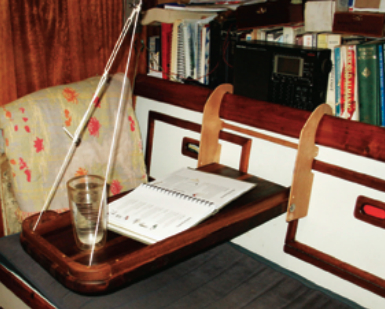
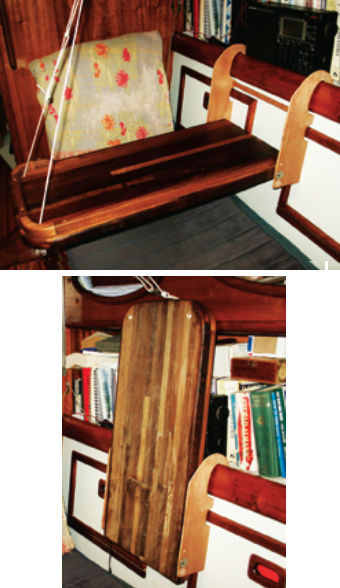
Dave’s temporary table hangs from the bookcase fiddle that runs along the top of the saloon settee back. The first step in designing it was to get an idea of the size for the supports. He didn’t have to replicate the shape of the fiddle exactly, so he simply formed a C with his index finger behind the fiddle and his thumb on the settee back. He transferred this outline to 1/4-inch plywood, then cut out two identical supports. These pieces are 12 inches long and 4 inches wide at the bottom and, so they would rest flush against the settee back, Dave cut notches in them to allow for the trim around the locker doors.
Next, Dave cut a 28 x 14-inch tabletop from a 1-inch thick mahogany board. To attach the supports, he drilled a hole on either side of this board 2 1/2 inches from the end. In the supports themselves, he drilled holes in three locations, since he was not yet sure of the most comfortable height for the table.
Because Dave wanted to be able to fold the table upward and out of the way when it’s not in use, he made sure the holes in the support were placed so the edge of the table would clear the settee back as it pivoted. He attached the supports to the table with screws, placing large washers under their heads.
Supported from above
The inboard end of the table is suspended from the overhead. Dave drilled two vertical holes in the inboard corners of the tabletop, passed a line through each of them, and knotted the lines underneath. He tied the lines around the grabrail in the overhead, using rolling hitches so he could adjust them. Once he’d determined the optimal height, he secured the lines with a clip to make connecting them easier. With the table supported at both ends, Dave noticed a wiggle, which he eliminated by screwing a dowel between the two outboard supports.
If you use this idea in your own boat, you’ll have to make a decision about fiddles: if you want them at all, on how many sides, and of what material. If you plan to eat at the table, you may want fiddles on all sides; for playing cards, none at all; for our purposes (jewelry-making and writing), we have fiddles on all but one side, so Dave can rest his arms on it.
Screwing 2-inch webbing to the edges as fiddles is another option. If you choose that route, you’ll want to leave the edges of your table square. For ours, Dave rounded the corners and edges and built teak fiddles.
When our new table is not being used, we can pivot it to rest flat against the bookshelf without having to disconnect the inboard end. To secure it in this position, Dave places a dowel into a hole drilled through the support and into the raised table. To completely remove the table, we unclip it from the grabrail and lift it off the bookcase fiddle. The supports fold down to rest on the table.
Dave completed this project from materials at hand, so our choices were limited. He would have liked to have made the supports out of hardwood, but they would have to be laminated to achieve the strength necessary in two directions. High-density polyethylene, acrylic, and polycarbonate might have been other possibilities. Likewise, the table could have been made of any material, though we prefer the look and feel of wood.
This temporary table is the perfect solution to our lack of adequate workspace. It is multi-functional, folds up out of the way, and can be quickly removed entirely. I have come to like it so much, Dave may have to build one for himself.
Connie McBride, her husband, Dave, and their sons have been living and exploring aboard their 34-foot Creekmore, Eurisko, for 8 years. After several years in the Eastern Caribbean, they are currently in Panama wondering what is next.
Thank you to Sailrite Enterprises, Inc., for providing free access to back issues of Good Old Boat through intellectual property rights. Sailrite.com