A sturdy, shoal-draft pocket cruiser
Issue 69 : Nov/Dec 2009
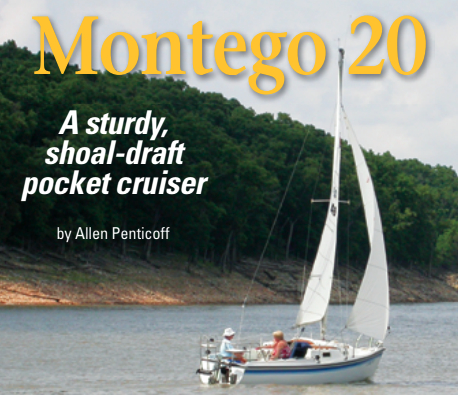
Trailersailing became popular during the 1970s, as it offered an economical way to get out on the water without having to pay slip fees in boats for which the cost of fuel was practically nothing. The most popular length was 22 feet; if you have an old sailboat directory, count ’em. There were dozens. The Montego 20, our review boat, is on the small side of average.
History
The Montego 20 was designed and built by Johannes “Jopie” Helsen, who was something of a child prodigy in the boating industry. His father, Louis, began building racing sailboats in his home country, the Netherlands, in the 1930s. He moved the family to the U.S. in 1957 after liking what he saw of the country when he visited the New York Boat Show. He was the first to import the Flying Dutchman one-design into the U.S.
Jopie was 10 that year. By the time he turned 13, he already knew he wanted to follow in his father’s footsteps. By age 15, Jopie was working in Charlie Morgan’s Florida boatshop, doing the grunt work one expects of a teenager, and it wasn’t long before he began crewing on some famous offshore racing yachts. He studied yacht design through the Westlawn Institute’s correspondence program and set out to design his own boats.
His first boat, which he designed at the age of 19, was the swing-keel Helsen 22, considered a midget ocean racer at the time. It was built in his father’s shop, Dutch Craft, in St. Petersburg, Florida. Louis wanted to stick to the old ways, but Jopie wanted to build in new ways, so he fledged his own company, Universal Marine Corporation, where he built 20 boats a month instead of the two per month his father produced at Dutch Craft.
In the early 1970s, Jopie and his wife, Sandy, began to acquire property along Salt Creek on Barboro Harbor in St. Petersburg. The company grew, adding a full-service marina, Sailor’s Wharf, just south of the Albert Whitted Airport.
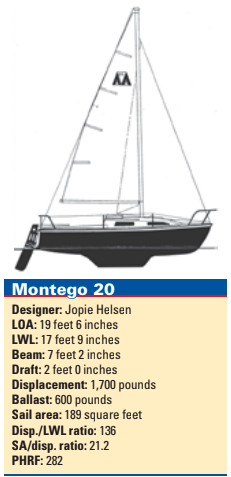
Universal Marine Corporation built four sailboats under the Montego line, the 19, 20, and 25, and the short-lived Montego 5.87. The Montego 20 and its fraternal twin, the Montego 19, share the same 19-foot, 6-inch hull but have different keel configurations; the 19 has a 450-pound swing keel and the 20 a fixed keel. The 20 was the more popular model by far, outselling the 19 by a ratio of five to one.
The 14-year-old company was sold in 1987. Production of the line ended then as the buyer could not make a go of it. A total of 2,300 boats designed and built by Helsen were sold. No fi gures are available for the production run of the Montego 20 model, designed in 1976.
As a side note, the Watkins 23 XL is an adaptation of the Helsen 22. Jopie Helsen also did some design work for other companies. The Sovereign 20, designed in 1982, is an example. He also designed the Hunter-Helsen Signature 470 for Hunter Marine, keeping the first boat for himself. In all, Jopie Helsen designed 31 boats, ending with a VIP 57 passenger boat built in Amsterdam. He is surprised that his first design, the Helsen 22, can still be found sailing and that, while they sold for $2,995 new in 1966, used models sell today for $4,000.
Our review boat is a 1984 Montego 20 owned by Leo and Judy Wehner of Byron, Illinois. Leo is essentially a self- taught sailor, and he found the stable Montego 20 to be an excellent platform on which to learn. As a beginner, he lucked out: the Montego 19/20 owners’ manual, a typed and photocopied affair, has the clearest and most detailed instructions for learning to set up and sail a boat I’ve ever seen in a manual. Since the Wehners acquired her in the summer of 1999, they’ve towed Free Wind from their landlocked home to many of the great Midwest sailing destinations including Lake Michigan, Kentucky Lake, Table Rock Lake and Mark Twain Lake in Missouri, White Bear Lake and Lake Vermillion in Minnesota, Lake Mendota in Wisconsin, and Lac Seul in Ontario. Northeastern Missouri’s very sailable Mark Twain Lake was the site of the photo shoot.
Design
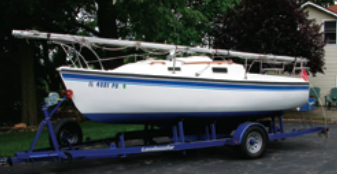
The Montego 20 has a raked bow, a slightly reversed transom, and a pleasant sweep to its sheer. The stubby 8-foot‐long keel leaves the small cabin free of a centerboard trunk and provides plenty of righting moment with 600 pounds of ballast encapsulated in the short 15 inches it extends below the hull. Despite the fixed keel, the draft is only 2 feet, making for easy launching at most boat ramps. The boat’s 1,700-pound dry weight allows for towing with lighter vehicles, and its designed displacement, fully loaded, is 2,300 pounds.
The boat’s beam is 7 feet 2 inches and the cockpit takes full advantage of it, which makes it very comfortable. The hull is nearly flat at the keel, rising and rounding firmly at the turn of the bilge to give good initial stability. All Montego 20s were tiller-steered with a kick-up transom-mounted rudder. A transom bracket is provided for an auxiliary outboard. The trailer was an option that sold with approximately 90 percent of the boats.
Earlier boats had fixed “Euro-style” tinted windows; later boats had Beckson opening portlights with screens. The fixed-window version has a somewhat sleeker appearance.
Construction
The Montego 20’s hull is solid hand-laid fiberglass. It has an outward-turning hull-to-deck flange that’s bonded with polyester putty, mechanically fastened with stainless-steel rivets, glassed over with mat and roving, and capped off with a substantial rubber rubrail mounted to an aluminum lock strip secured by the rivets. A sturdy aluminum cap at the bow further protects the hull.
A toerail is molded integrally with the deck and filled with resin-impregnated microspheres, while the deck itself is a sandwich, its core made up of 3- x 4-inch plywood blocks 3⁄8-inch thick. Gaps between the blocks were filled with a mixture of microballoons and resin. The Montego 20 has sufficient encapsulated foam flotation to be “unsinkable.”
In the attachment to the owners’ manual describing the construction, Jopie wrote: “Every boat we build is a restatement of the Helsen family tradition of over 50 years of boatbuilding. We are in no hurry. Our boats have been around for a long time. We want them to last.”
In the interior, a fiberglass pan forms the berth flats and two small counters. This liner does not extend above the berths; the inside of the hull and the overhead were sprayed with a pebble-texture gelcoat. A mast support transfers the rigging loads to the keel. The substantial rudder is solid fiberglass and pivots in an intricately cast aluminum bracket. The tiller is a sturdy wood lamination.
On deck
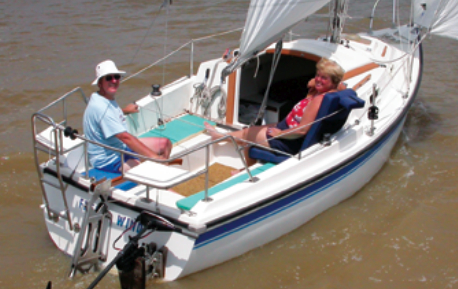
One of the first things you notice as you approach the Montego 20 is the single lifelines supported by aluminum bow and stern pulpits. Leo has had a new stainless-steel stern pulpit fabricated that includes integral seats in each corner . . . “Like the big boats,” he says. A previous owner also added a long swim ladder.
The cockpit seats are 6 feet 6 inches long and 19 inches wide and easily accommodate four people under sail. The coaming is angled and high enough to form a comfortable backrest. At 24 inches, the space between the seats is a comfortable distance for bracing while heeled; the 11-inch-deep footwell drains through two screened scuppers aft. A 14- x 22-inch lazarette bridges the seats aft and offers access to the entire aft end of the hull’s interior, a space which could accommodate considerable gear. The bridge deck is flush with the seats. In the case of Free Wind, a traveler is mounted on it for the mainsheet tackle, although this was not original equipment.
Forward of the cockpit, two screened opening portlights on each side of the cabin trunk plus a 10- x 17-inch fiberglass opening hatch provide excellent ventilation in the cabin. No provision is made at the bow for an anchor, however all deck cleats are substantial. Leo stores the anchor aft in the lazarette. Two Maxwell winches are mounted on the cockpit coamings with fixed fairleads.
The sidedecks on the Montego 20 are narrow, so the favored path to take when moving fore and aft is “over the top” of the cabin. The non-skid is reported by some to get slippery when wet. Free Wind’s deck was heavily oxidized; Leo used NewGlass2 to restore the gelcoat surface.
Among the cabin and deck fittings are a number of teak components, from sturdy handrails to cabin trim. Leo found all the exterior teak pieces on this 1984 model to be in decline and replaced them with parts he fabricated from maintenance-free PlasTEAK. Leo has replaced the original teak-faced plywood companionway boards with ones he made from King StarBoard polymer-sheet material. The companionway is 32 inches wide at the top, making for easy access to the cabin.
Accommodations
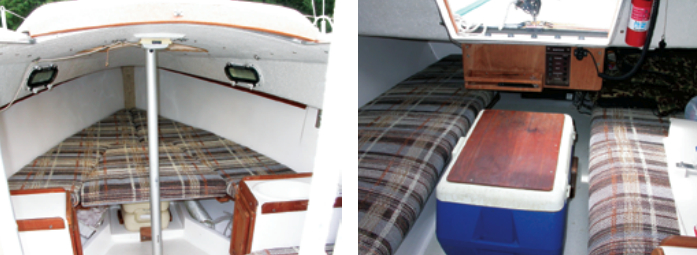
As one would expect in a pocket cruiser, space inside is limited. There are four berths: two in the 78-inch long x 65-inch-wide V-berth and two 76-inch x 25-inch quarter berths. All cushions are covered with plaid upholstery. The V-berth has a removable section to provide access to the portable toilet beneath. Stowage is also provided under the V-berth. There is no stowage under the quarter berths but they are open to the lazarette and the area under the cockpit sole, where Leo has his battery.
Just below the companionway is a small, clearly labeled fuse-protected electrical panel for the boat’s modest needs. Sitting headroom is adequate for anyone under 6 feet tall and is comfortable for two people.
An 8- x 11-inch sink is built into a countertop on the starboard side, its water supply pumped from a removable jug. To port, another small counter accommodates a stove. A small removable table bridges the space between these counters; below them are small storage areas with teak doors. A 50-quart cooler with a teak dressing serves as a somewhat wobbly companionway step. Headroom under the closed sliding companionway hatch is 51 inches. The opening ports provide light in the cabin and more enters through the forehatch even when it’s closed, because part of its surface has no gelcoat and is therefore translucent.
Overall, the cabin is light, airy, and comfortable. It would do in a pinch for a weekend or short vacation for crews who can stay on good terms in close quarters. A family of two adults and two kids could make the boat work with careful packing and limited provisioning. Good sailing naps may be had in the quarter berths or on the long cockpit seats. Except for some solo forays where Leo has stayed aboard alone, the Wehners typically plan to spend nights in a motel or a relative’s home — a good choice.
The rig
The 7⁄8 sloop rig has upper shrouds, single lower shrouds, a single set of spreaders, and inboard chainplates. The backstay is split above the tiller. The mast can be raised by one person without the use of a gin-pole or winch as long as someone is handy to pull on and hold the jib halyard while the forestay is connected. Leo has managed to put it all up by himself at times, however.
The mainsheet was originally rigged to the end of the boom with a bridle to the coamings port and starboard. This is a cumbersome arrangement that some report is unsuitable in high winds, as it cannot be released quickly to depower the mainsail. The owners of Free Wind have installed mid-boom sheeting on a traveler mounted on the bridge deck. Happily, the boom is mounted high enough so no ducking is needed when tacking. While there’s provision for a boom vang, Leo doesn’t have one.
The 89-square-foot mainsail comes with one fairly deep reef and a Cunningham. A reef hook is provided on the mast as jiffy reefing was standard. Leo has installed removable lazy-jacks to help with sail handling when short-handed. On Free Wind, the halyards lead aft to line clutches. The standard jib is a hanked-on, 100-square-foot, 125 percent genoa. Total sail area is 189 square feet, giving the Montego 20 a generous sail area/displacement ratio of 21.2. Mast height above the designed waterline is 27 feet 3 inches.
Performance
We sailed Free Wind on a windy day on Pierce Lake, a small lake near Rockford, Illinois, well known for swirling winds. This day was no exception.
When you step aboard, the Montego 20 doesn’t seem particularly tender and has the feel of a larger boat. Leo’s 50-pound-thrust trolling motor easily propelled Free Wind away from the dock and into the wind. The outboard bracket is rated to 7.5 horsepower, but such a large engine would be overkill.
The Montego 20 did well through the many tacks and course changes necessary when sailing this lake on a windy day. Such a long keel implies steady tracking but, by the same token, it does slow the turning process some, although not unreasonably so. Back-winding the jib a bit helps bring the bow around. Obviously, she’s no racing dinghy. In lighter air, the relatively heavy displacement gently carried us through tacks. Gusts heeled her over to the rubrail but we did not often feel overpowered despite carrying full canvas. We employed the Cunningham to help flatten the sail, but we really should have taken in a reef for we had some weather helm to contend with. The reef, however, appears to be deeper than what was needed on that day. I recommended that Leo consider adding another reef that would reduce the sail area by less and setting it up with jiffy reefing so he could tame the weather helm and reduce the rudder drag. Despite the boat being somewhat overcanvassed, the rudder showed no tendency to stall and allow a round-up. Although the pressure on the rudder was not uncomfortable to deal with, it would have been nice to have been properly trimmed for the conditions.
Leo reports the Montego 20 does not sail well under genoa alone. While some criticize the fixed fairleads for the genoa sheet, this arrangement does keep things simple and the fairleads are well placed for most conditions. The small winches worked well enough with the small headsail, but I found tying the sheet off to a conventional horn cleat to be cumbersome, particularly when my weight was really needed on the windward side. Leo ties the sheet on the windward cleat when crew is not in the way. We did not try out the symmetrical spinnaker that on downwind runs Leo sometimes sets from the bow in the same way you would an asymmetrical.
The Montego 20 accelerates reasonably well and feels fast, though we had no knotmeter to provide accurate numbers. Some reports indicate the short keel will “lose its grip” when heeled over and recommend that the Montego 20 be “sailed flat.” It pointed well enough on this day, considering its shallow keel, which doesn’t generate as much lift as a deeper fin keel.
The one Montego 20 with a PHRF rating is listed at 282 seconds per mile, which compares favorably with the more contemporary Starwind 19 at 288 and a Hunter 20 at 285.
Conclusion
The Montego 20 looks good on the trailer and in the water. An old aviation adage goes, “If it looks right, it’ll fly right.” In this case, the Montego 20 looks right and sails right.
While it’s not a “go anywhere” boat, coastal and inland lake cruising are reasonable expectations for Montego 20 owners. The shallow draft allows gunkholing at its finest and beaching within knee-deep wading distance of the shore.
Other than your typical gelcoat stress cracks and fading, there seem to be no inherent structural problems with the Montego 20. Following an altercation with a rock, Leo repainted Free Wind’s bottom and topsides with automotive paint and she now looks much newer than her 25 years. The original trailer was a bit undersized for her weight. This led to a bearing failure while on the highway. Leo has replaced the trailer with a first-class custom single-axle trailer by Loadmaster.
A recent Internet search found no Montego 20s listed for sale. The Wehners paid $3,500 for Free Wind 10 years ago. One Montego 19 sold in 2005 for $2,900. Pocket cruisers generally trade hands for anywhere from $500 for a desperately-in-need-of-work boat to $3,000 to $4,000 for a prime example. Finding a Montego 20 will probably require being lucky, as the Wehners were.
Allen Penticoff is a freelance writer, sailor, and longtime aviator. He has trailersailed on every Great Lake and on many inland waters and has had keelboat adventures on fresh and salt water. He presently owns three sailboats: an American 14.5, a MacGregor 26D, and a 1955 Beister 42-foot steel cutter that he’s restoring.
Thank you to Sailrite Enterprises, Inc., for providing free access to back issues of Good Old Boat through intellectual property rights. Sailrite.com