High winds and freak waves trap lake cruisers in a river
Issue 71 : Mar/Apr 2010
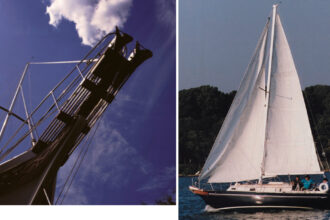
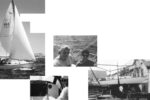
Two artist friends and I spent more than a week in June 2003 sailing my traditional 27-foot cutter along Lake Superior’s eastern shore north of the town of Wawa. The next city of any size, Marathon, is more than 100 miles away. Phyllis, Ladd, and I hadn’t seen another person for days as we gunkholed and explored the endless bays and islands that fringe this vast wilderness.
Little has changed in this area since the voyageurs paddled through centuries ago. VHF radios, weather forecasts, and cell phones are of little use as the nearest road is more than 50 miles away. Even the charts for this area are of such scale that they provide very little detail. We used every available means of dead reckoning, GPS, and Bonnie Dahl’s cruising guide, The Superior Way, which describes all of Lake Superior’s anchorages, bays, islands, and harbors.
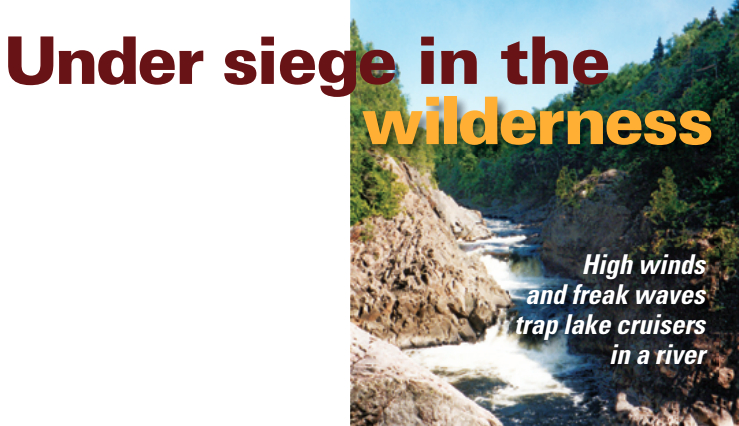
One day was perfectly clear, accompanied by a mild offshore breeze that blew us easily to the mouth of the Pukaskwa River (pronounced puck-a-saw) by early afternoon. We cleared the 6- to 8-foot shoal at the river’s entrance on flat water with just 3 feet to spare as Phyllis guided us past rocks and shoals from the bow. We anchored up the river near the falls — one anchor off the bow and another off the stern — facing downstream toward the lake.
Gifts of nature
We visited the falls and found a perfect swimming hole above the falls surrounded by automobile-sized boulders baked by the afternoon sun. The water was 70 degrees, compared to the 43-degree water in Lake Superior. We gladly splashed about, as we had not had the opportunity to bathe for several days. As evening approached, we wandered downstream past the boat to explore and sketch Superior’s shore. A bald eagle soared above us over the cliffs south of the river.
We were disgusted to discover what looked like large plastic sheets hanging over the edge of a cave on the cliffs. “Can’t even this area be spared from human trash?” we wondered. Ladd and I climbed up to investigate. Happily, what appeared to be plastic turned out to be tons of ice remaining from the previous winter. We could have all the ice we needed that day in late June to replenish the supply in our icebox.
As we made our way back to the boat, a river otter swam by toward the falls, motivating Ladd to set off with his fishing gear. Before he left, he confidently asked us what kind of fish we would like for dinner. Phyllis and I challenged him to bring us a rainbow trout. In less than an hour, Ladd reappeared with a two fine trout! We celebrated far into the night with the first fresh food in days, Chardonnay, and a deadly game of Scrabble. All of this, under the warm glow of oil lamps in the nocturnal silence of Ontario’s paradise, brought the day to a perfect end. “Yes,” Phyllis concluded, “life couldn’t get better than this.”
Nature less benign
Not usually a morning person, I awoke just as the first sunlight peered into the port above me. I had an uneasy feeling just before a huge wave roared by. Was this washing up the river from the lake? Perplexed, I peered out and saw that the river was now several feet lower than the day before. Low-water rocks and brambles lined the banks.
This had to be a seiche. This phenomenon is similar to a tide, but its timing is unpredictable because it’s caused by changes in weather conditions rather than the passage of the moon. Then another wave violently rocked the boat, knocking Phyllis and Ladd out of their bunks. I went up to the bow to check the anchor. All was well, but I felt apprehensive as I peered into the haze over the lake. Superior’s surf was building, making a deafening roar. Happily, the surf was not affecting the river . . . yet.
Ladd joined me on the bow. We were discussing the seiche when a crash of thunder sent us dashing back to the cockpit. A sudden gust heeled the boat 20 degrees, testing our anchor. Then a blinding torrent of rain, hail, and wind hammered us. Visibility dropped to zero. The only way we could sense our position was by gazing sideways at the spruce trees at the shore bending over like giant bows. Phyllis frantically battened down everything inside. Then, all of us felt the boat slip backward. Our forward anchor was dragging.
Storm strategy
I remembered facing another hurricane-force squall years earlier in another harbor. As my boat slipped helplessly astern, a sailor companion showed me a strategy that saved my boat on that day. Now, I fired up the engine and cautiously inched the throttle forward. I coached Ladd to pay out a little more line for the aft anchor and to then go forward to make sure we weren’t running over the bow rode. I held the stern line tight as I tried to steer into the wind. I had to power the boat just enough to weather with all of the twisting and turning while not tangling either line in the prop, a tricky proposition when you can’t see forward and with very little leeway behind. Motoring had to work; we had no other option.
In due course, the squall abated and we sat unharmed in the river’s waters, now murky from the runoff. We felt we had better revise our anchoring strategy in case there was another blow, so we mustered every sheet, dockline, and rope we could. We attached them to the anchor rodes, extending them so they reached opposite sides of the river, where we wrapped them around boulders and trees on shore. For the remainder of the day, we listened to and watched the cacophony of thunder and lightning as storm fronts raced to the north and south of us. The wind and waves built out of the southwest to a full gale on the lake, dashing any hope we had of leaving our river anchorage. Thankfully, our mooring lines held as our boat wiggled back and forth in the middle of the river.
We retired early that very dark night, fearful of being aroused at any moment. I slept like a fireman with my clothes on and my rain gear within easy reach.
Free at last
By the end of the fourth day, just hours before dusk, the seas diminished enough for us to make our escape. The setting sun shone through the clouds and it sleeted intermittently as we slid over the reef, leaving Pukaskwa River behind. We motored three miles north to Pointe La Canadienne, where we anchored in a large bay and went ashore to cook dinner over a campfire. As darkness loomed, northern lights appeared, stealing our attention while the fire thoroughly burned our dinner. The mishap hardly mattered as we reflected on our remarkable odyssey.
Although it was by then day 11 since leaving Wawa, we still had not seen another soul and had never missed civilization. We felt like children drunk with self-confidence, yet humble over our vulnerability. This wilderness is beautiful and compelling but fraught with unpredictable dangers. We wondered about the incredible resourcefulness of the ancient people who passed through here before us.
That night the gods were very quiet, the water became like glass, and we slept very soundly indeed.
Fritz Seegers is a Good Old Boat illustrator who also has documented lakes Michigan, Huron, and Superior in his illustrations while sailing in his hand-crafted boat, Alwihta. He has done illustrations for International Marine/McGraw Hill that have appeared in publications by Don Casey, Nigel Calder, David Burch, Dan Spurr, and Beth Leonard. His website is www.fritzseegers.com.
Thank you to Sailrite Enterprises, Inc., for providing free access to back issues of Good Old Boat through intellectual property rights. Sailrite.com