Fast and furious ultra-light fun
Issue 71 : Mar/Apr 2010
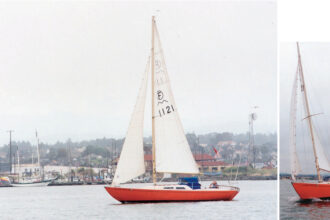
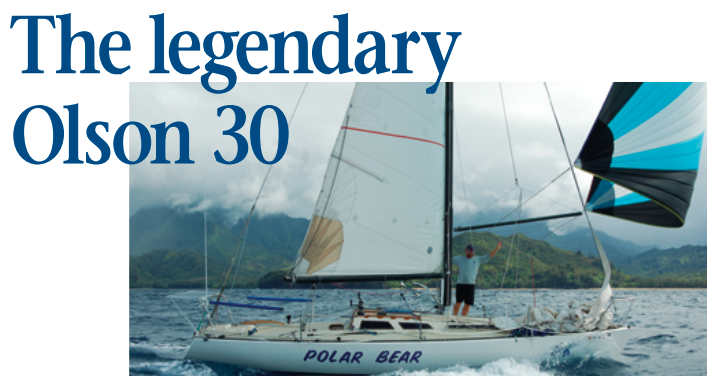
Eric Thomas doesn’t swagger. It’s not his style. Even though he has won an amazing collection of sailing honors with his good old boat, an Olson 30 named Polar Bear, he doesn’t brag. Eric and Polar Bear placed first in class and fourth overall in the singlehanded portion of the 2002 Port Huron-to-Mackinac Island Race. They won boat-for-boat and on corrected time in the singlehanded section of the Trans Superior Race in 2005 and 2007. They placed second in class and third overall in the singlehanded Chicago Mackinac Race in 2006. And they did it again (first in class and second overall) in the 2008 Singlehanded TransPac race from San Francisco to Hawaii’s Hanalei Bay in Kauai sponsored by San Francisco’s Singlehanded Sailing Society.
But bragging and swaggering aren’t part of this sailor. Eric knows who he is and what he can do. It isn’t important whether those with whom he comes in contact know about his sailing credentials. When he’s not involved in major racing events (which, really, is most of the time), Eric lives and breathes boats as the yard supervisor and service advisor with Barker’s Island Marina in Superior, Wisconsin. And he’s active in local Wednesday-night fleet racing when the water isn’t frozen.
The son of a sailor, Eric grew up aboard racing and cruising sailboats while his parents, Nelson and Margaret Thomas, and two older siblings sailed first a New Horizon 26 and then a Santana 27 in as many races as possible on Lake Erie and southern Lake Huron.
Far-flung starts
The family of five delivered and trailed boats to some even more far-flung starting lines (think: Key West Race Week) and home again. Sailing (and racing, in particular) has always meant “family time” for the Thomas family. It still does. His Wednesday-night crew is made up mostly of family members, and the family comes together in amazing ways to make sure that Eric and his boat make the starting line for those big events, whether that help comes in the form of delivery assistance, making repairs, or baking monster cookies.
Good Old Boat isn’t normally about sailboat racing. It’s about good old cruising sailboats. While some of our good old boats lead double lives and do get up and race from time to time, few do it as actively as Polar Bear. Just one look around the extremely Spartan accommodations aboard this Olson 30 will convince you that this is no cruising sailboat. But Eric lived aboard for about a month during the summer of 2008 (even if he was racing across the Pacific during the two weeks sandwiched in the middle of that time period). If you’re of the opinion that cruising means nothing more than “glorified camping aboard,” you might make an Olson 30 work for you. It offers a roof over your head (no standing headroom, I’m afraid) and amenities such as galley, bunks, head, and stove.
High-performance cruising
Did I mention that it goes like the wind? You could drive your fellow sailors crazy when you put the spinnaker up and manage speeds in the mid-teens. Call it “high-performance cruising,” if you will.
In 2009, I found listings for five of the original 255 or so Olson 30s built between 1978 and 1984. These days, they range in price between $9,000 and $18,000. Add “affordable” to the list of attributes. Most important, however, is the strong class enthusiasm and support for racers around North America from the Chesapeake to San Francisco and from the Great Lakes to the Southeast.
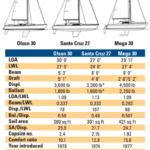
A final attribute is that this keelboat is trailerable. It takes a crane to lift her onto the trailer, since this is no keel/centerboard sloop, but once there she’s lightweight, displacing 3,750 pounds in racing trim, and narrow, with a beam of 9 feet 4 inches. Eric says the boat on the trailer stands 12 feet tall (the draft is 5 feet 2 inches) and the unstepped mast extends 40 feet. Not a daysailer, perhaps, but you can take her cross-country when you want to.
The Olson 30 was designed in 1978 by George Olson, of Santa Cruz, California. He was a surfer who decided to design an ultra-light-displacement boat (ULDB) while sailing on Bill Lee’s Merlin, one of the early ULDBs of that time. George was part of the crew bringing the 68-foot Merlin home to Santa Cruz from Honolulu following the 1977 TransPac. You might say George designed this 30-footer with the TransPac in mind. It was clearly designed as a 30-foot ULDB capable of offshore racing. Eric says there has been an Olson 30 in nearly every singlehanded TransPac since that time. And he adds, “They have yet to come up with a new one to replace the Olson 30. There are sport boats, like the Melges 24, but these were not built for offshore sailing.”
Purposefully built
Polar Bear, hull #140, built in 1981, is fairly representative of her sisters. Eric did not strip this boat out to make it competitive. It began life as a stripped-out raceboat. Once the cruiser in you recovers from the surprise of the no-nonsense accommodations below, Eric will regale you with her construction highlights. The Olson 30 was designed by a surfer and built by surfers. As a result, the fiberglass work is a level above that seen on most good old boats. Eric shows that you can put your hand inside a locker anywhere and find good, finished glasswork. No nasty splinters lurk just out of sight. The hull-to-deck joint is similarly well done. Ditto for the stanchions, the joint between the sole and any furniture within, the glassed-in bilge drain, and so forth. All was done by a team of people who cared.
“Historically,” Eric points out, “There have been no delamination issues in these hulls.” Like many sailboats of this era, the Olson 30s were constructed with balsa core in the hull and the horizontal surfaces of the deck. The difference is that the Olson’s laminates were vacuum-bagged. The laminate is built up of roving, with mat used adjacent to the core as a bonding layer. Some areas were further reinforced with additional woven roving. As on other good old boats, localized wet-core issues around long-neglected deck hardware at the mast partners and turning blocks are issues of concern with this fleet.
Ankle-level cables
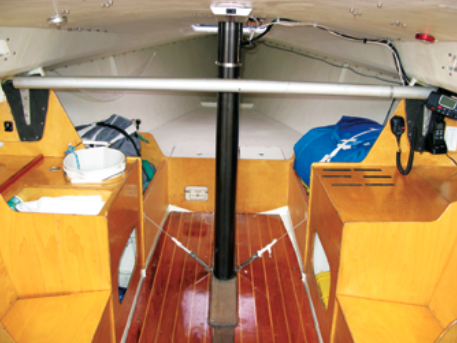
Eric is quick to point out the crossbar that spans the cabin just aft of the mast and ties the sides together. That and the ankle-level cables that tie the base of the mast to the chainplates create a spider web that makes it hard to access the bow from the main cabin. But not to worry. You should keep the bow light anyway. Light? Even set up as a club-racer sailed by a crew of as many as nine, Polar Bear has absolutely nothing stowed in the V-berth, a standard practice with the Olson 30s to prevent submarining as they race down-wave at high speed. Port and starboard pipe berths are tucked under the cockpit, quarter-berth fashion, and there’s room for heavy stowage between them under the cockpit sole. On his passage to Hawaii, that’s where Eric kept his water supply and extra sails.
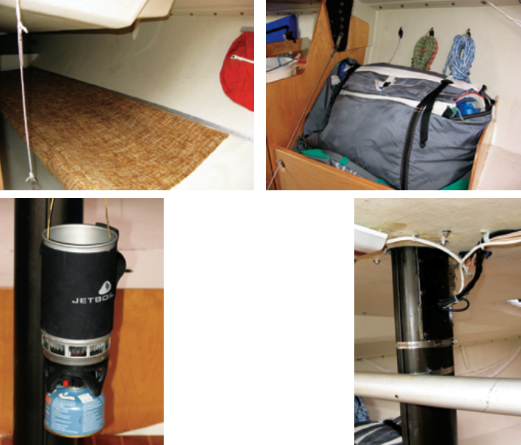
The central cabin contains two simple birch-plywood benches that provide seats and could be where one does cooking or dishwashing. That probably is their intended purpose. These boats came with a two-burner gimbaled Origo stovetop but, during his solo races, Eric cooks on a small mast-hung propane burner. In the bare interior, the teak-and-holly sole seems like overkill. But it’s a nice feature. Pacific Boats, the manufacturer, even added four small seabags to the kit. The bags were hung from mounts to keep them off the furniture. Eric still has the original bags and mounts. There’s a Porta Potti tucked under a lid in the bow and plenty of space for gear. That pretty much covers it. Who could want anything more?
Extensive modifications
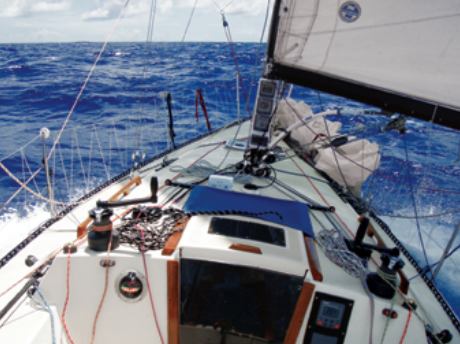
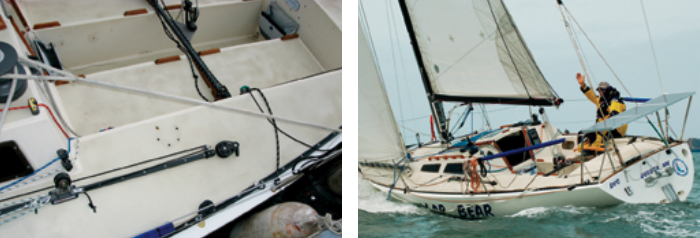
Eric did. Since he bought Polar Bear in 1997, his modifications have included the installation of new ports and hatches, an addition to the cabinetry to make two stowage areas more secure, the removal of six of the eight self-tailing winches sprinkled about the deck, and a beefing up of the chainplates. For his solo adventures, he ran the reefing lines to the cockpit and added a baby stay, solar panels, SSB, jacklines, a sat phone, EPIRB, a ditch bag with an emergency desalinator, and backup autopilots for the backup autopilots (he carried four in all). He also had to carry anchoring gear because he’d anchor in a bouncy bay once he reached Hawaii, and an outboard and fuel because he’d have to deliver the boat to Honolulu for the trip home aboard a ship. That last stretch to Honolulu after the race was the worst part of the whole trip, and made it possible to forgive the outboard for the unnecessary weight it contributed during the race.
Polar Bear carried two Dacron mainsails with two reefs: a lightweight main and one made of heavy material with very stout battens. She also carried 3DL headsails: a 155 percent genoa and a 100 percent jib. Her spinnaker collection included two 3/4-ounce kites, one 1/2-ounce kite, and a 3/4-ounce asymmetrical reaching spinnaker. Eric also had these sails stowed below the cockpit sole: a 40 percent storm jib, a storm trysail, a heavy-air 80 percent jib, another spare spinnaker, and a lightweight Kevlar racing main.
Crack in the mast
Eric made one more modification at the eleventh hour. Once he and Polar Bear were launched in Alameda, California, and preparing for the race, Eric noticed a crack where the mast wiring exits the mast at the overhead. Buying a section of mast for emergency overnight delivery, getting that sleeve delivered to the correct marina, and installing it with the tools he had aboard make a great sea story, and Eric tells it well. A similar saga ensued when he decided that the boltrope in the mainsail really should be replaced and reinforced. This was done in a day.
He tells of the inspector, a five-time veteran of the TransPac, who cleared his boat to join the race. He took one look at Eric’s smallish solar panel and asked, “So, you plan to hand-steer?” Eric, an innocent from the Great Lakes who expected nothing but sun while crossing the deep blue sea, had another think coming. “There will be nothing but clouds for 1,500 miles offshore,” the inspector said. Eric (the man with four autopilots, remember?) had no intention of hand-steering. In fact, he steered, on average, only about an hour in 24. “The next day,” he says, “I went right out and added a third more area to my solar panels. On the race, I needed about 60 amp hours per day. My solar collectors kept up with that.”
That siren call
Eric heard the TransPac’s siren call for years before hauling his boat halfway across the continent and then sailing it halfway across the Pacific. In the summer of 2007, after having a “wonderful time” in the solo Trans Superior, Eric, who says he’d “been keeping an eye on that race for 10 to 20 years,” told Sarah, his high-school sweetheart and wife of 15 years, “I think I want to do the Hawaii race.” Knowing him as well as she does, Sarah was unfazed. It took much of the next several months to apply for acceptance in the race, to lay plans for the complicated delivery dance required any time a vessel goes on a one-way trip, and to arrange for time off, since there is a six-week commitment from the moment you drive your boat down the driveway until the day you return to your job. “Half the game is getting to the start,” Eric admits.
The TransPac committee not only chooses who can participate in the race, it also requires and makes sure with a final inspection that certain equipment (such as an EPIRB) be carried aboard, along with 30 days’ worth of food and 21 gallons of water for the passage that generally takes two to three weeks.
Once the big day arrives in mid-July, the fleet of 20 to 30 boats of all sizes — from a 54-foot multihull to a Cal 20 in the 2008 race — begins with four separate starts for what amounts to five fleet classifications. The “course” is a 2,120-nautical mile Pacific Ocean crossing in generally following winds between 22 and 25 knots punctuated with frequent squalls.
South until the butter melts
“You generally sail upwind to the Golden Gate Bridge,” Eric says. “Then it’s heavy-air reaching. You tack once to the gate, reach for three days (sail south until the butter melts), and jibe once as you turn dead downwind.” Actually Eric says he jibed “probably a half-dozen times during the whole trip.” He generally had the spinnaker up during the day and took it down overnight when he caught a couple of hours of sleep. “A big part of the performance is getting up and pushing the boat hard,” he says.
Working Polar Bear hard for 14 days, Eric occasionally saw speeds as high as 17.9 knots with the spinnaker, averaged 8 to 10 knots most of the time, and ticked off 190-mile days, although the wind near California, and again near Hawaii, was light, making for a frustrating first few and last few days.
A typical day meant getting up early in the morning, launching the spinnaker and sailing hard until mid-afternoon (taking the helm only when a squall hit), snatching catnaps during the afternoon with a lookout every 20 minutes or so, making dinner, continuing to sail hard until call-in time to report his whereabouts to the race organizers and family, and finally taking the spinnaker down and taking more catnaps between midnight and 5 a.m. Eric figures he slept 4 to 5 hours a day and lost about 20 pounds on MREs, beefstick and crackers, and those marvelous monster cookies.
Slumped athwartships
This was no luxury cruise. He never actually crawled into one of the two pipe berths (it might take too much time to get out); instead, he slumped athwartships in the forward end of one of the berths with his feet at the companionway landing and a harness already buckled up. One of his log entries says:
“Just finished roll call, lost a little gained a little, just sailing. Many people have had some sort of breakdown or scare at this point (Note: One of the racers lost a mast and another lost a rudder on the way to Hawaii, while a third, very experienced, sailor lost his boat on the return trip. –Eds). Some are starting to be more conservative, realizing how far from anywhere they are and the consequences that has. I was doing all those calculations in my head a few days ago and it really gets you down. Not that they are bad, they are real. So one has to calculate the risks in all actions. I always wear my harness; I sleep in the damn thing. I am clipped on whenever I am out of the cabin. My big worry has been the rig and the fact that losing it would make this a really long downwind race, Black Feathers (the Cal 20) would eat me for lunch! Luckily the wind blows toward Hawaii and one would eventually get there. Enough rambling. Time to tighten the tiller-head fitting on the rudder post, it’s starting to work loose. Got to get done before dark and do a general scout around the deck before nightfall to remember where the halyards are and straighten up for the coming squalls. We have 622 miles to go.”
A psychological journey
Eric notes that this sort of voyage is not so much a physical journey as it is a psychological one. He says participants generally get blue for the first several days as they disconnect from their land-based lives. The actual crossing is pleasant and could be endless, as far as he’s concerned. But there’s also a seemingly endless period of time toward the finish during which most participants get caught up in anticipating the approaching landfall. These final days drag on also.
And there’s another psychological demon to slay: gear fear. Eric learned of this from other competitors and firsthand. “I was obsessed during the first few days with the backstay. My brother-in-law had broken his mast the day I left.” Watching that spinnaker pull the boat ahead at 17.9 knots with the boom resting on the shrouds filled him with dread, Eric says. He notes that the spreaders are in line on the Olson 30 so the backstay is the only thing preventing the mast from being pulled forward. As the guy back home at the marina repair shop who sees many equipment failures, Eric began imagining the worst-case scenario. “I ran another halyard and shackle back to the transom. Then the wind filled in and I got busy. After that, I was calm as a cat,” he says.
Before he knew it, he’d raced into Hanalei Bay where, in the tradition in this race, Sarah was waiting for him under the tree with the rest of the race committee and anxious family members. He’d made the crossing in 14 days, 1 hour, 53 minutes, and 27 seconds, averaging better than 6 knots for the entire trip in spite of calms at the beginning and end of the journey. Polar Bear was the second boat to arrive. The next week is generally spent under the tree swapping tales of each participant’s experiences while waiting for the rest of the fleet to arrive.
Eric has no illusions about who gets credit for a race well run.
“The Olson 30 performs really well in light air, but it’s also very efficient in heavy air,” he says. “People say they’re light and go really well downwind. But they also go upwind.” Polar Bear was the perfect choice for an experienced round-the-buoys racer who occasionally heads out on a long single-handed racing adventure.
“This boat rewards you for good sail trim,” Eric says. “It does not forgive you for bad sail trim. It really is a wonderful boat . . . a lot of fun to sail.”
Karen Larson and her husband, Jerry Powlas, the founders of Good Old Boat, have been sailing their C&C 30 on Lake Superior for nearly 20 years. They also have a C&C Mega 30 project boat in the backyard. With it they are learning some important do-it-yourself truths and don’t welcome questions about how soon it will be ready.
Thank you to Sailrite Enterprises, Inc., for providing free access to back issues of Good Old Boat through intellectual property rights. Sailrite.com