They’ve stuck together through thick and thin
Issue 73 : Jul/Aug 2010
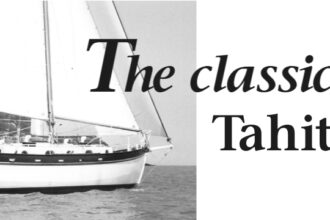
Durkee Richards found the girl of his dreams at age 18 and became a one-woman man. He and Mary Jeanne hit all the expected stops along their passage from innocent youth to modern maturity: education, children, and a fulfilling career. Then, when it came time to buy a cruising sailboat, they bought the right one on the first try — no need to fix up a series of incrementally larger boats before falling in love with the right one.
When the newly introduced J/32 caught their attention, the two became a one-boat couple and, in the process, saved a lot of the time, money, and stomach lining the rest of us sacrifice in our attempts to meander through a mine-field of compromises in sailboat design. Some people are just blessed with the ability to get it right the first time.
Durkee’s adventures in sailing are all thanks to a friend named Eric Jacobson, whose family owned a Snipe and who encouraged Durkee to sail with him and to get involved in Sea Scouts in their hometown of Vancouver, Washington, near the Columbia River. The Sea Scout vessel was an old 26-foot Navy lifeboat that had been converted to a ketch-rigged centerboarder and was sailed with live ballast. Durkee earned his Quartermaster Sea Explorer, the equivalent to an Eagle Scout rank, and earned his Permit to Command under Sail and Oars.
When Durkee and Eric wanted to go for a longish daysail aboard Eric’s Snipe , it occurred to them that they’d need a picnic lunch. They reasoned that, since girls can be relied upon to produce this sort of thing, they should invite a couple of young women to come along. Eric suggested that Durkee invite 16-year-old Mary Jeanne Hopper to come along as his “date.”
Off they went on the 15-foot 6-inch Orion: two young men with a bit of sailing experience and a couple of girls named Mary, neither of whom had ever been sailing before. Although neither Durkee nor Mary Jeanne knew it at the time, this was the start of something big.
A lifetime commitment
The two continued to date and married when they were old enough. Mary Jeanne followed Durkee to Iowa where he earned his Ph.D. in physics. A move from there to the 3M Company’s headquarters in St. Paul, Minnesota, followed. This pair of West Coast transplants remained in the Midwest (far away from salt water) for the remainder of Durkee’s professional career. At 3M, he was in the center of things as magnetic recording technology evolved.
“I was in the field before we hit our heyday,” he says, “but I didn’t have as much fun as the real pioneers did.
Now the field (recording process, materials, and applications including tape drives and discs and magnetic media) has definitely reached the mature stage.” Durkee earned nine patents before he turned in his badge at the 3M division that had been renamed Imation and spun off in the late 1990s.
During this time, Durkee became a private pilot but found that keeping a license current was an expensive proposition. They dabbled with whitewater canoeing on the rivers of Minnesota and Wisconsin. Meanwhile, Mary Jeanne was developing her talent as a fiber artist and patternmaker. She took a two-week course in boot-making and learned to make professional-quality shoes. And she gathered an interesting collection of very specialized sewing machines while nurturing her amazing ability to see patterns and work artistic magic with yarn and fabric. Mary Jeanne sees the potential in materials that the rest of us would miss and turns out amazing quilts and wall hangings.
Interest reawakened
It wasn’t until their two sons, Trevor and Brad, grew up and retirement loomed that Durkee thought much about the fun they’d had aboard Orion. During the 1990s, Durkee — sometimes with Mary Jeanne and sometimes with a crew of friends — chartered boats 24 times on cruises varying in length from a weekend to a week or more, primarily in Wisconsin’s popular Apostle Islands on Lake Superior. Durkee also took a series of beginner-to-advanced sailing courses during the time. The hook was set.
Starting with a Bristol 29.9, the many charters gave him the chance to learn what he liked and didn’t like about sailboat design without having to go through three-foot-itis disease. The first boat he and Mary Jeanne chartered together was a 30-foot S2. “That was the transition phase,” he says. It gave us the confidence that we could manage a boat this size, just the two of us.”
There was the Beneteau 28, which Mary Jeanne embraced because she could dock it herself. And there was the 45-foot Morgan that Durkee chartered with a group of men and on which he realized that a boat of this size made no sense for their cruising ambitions, since none of the men aboard could reach the halyard at the headboard of the mainsail without an awkward boost from one of the others.
A sail on a Crealock 34 in the San Juan Islands of Washington state introduced them to the area that would become their retirement home and future sailing grounds. They now knew their plans for the future and were thinking closely about the size of boat that would fit into them.
Narrowing their focus
When Durkee and Mary Jeanne chartered a C&C 33, they learned that the effort involved in winching in the large masthead jib was too much. This narrowed their focus to a fractional rig. An article in Sail magazine in the late 1990s compared four new boats in the 32-foot size range. Among these was the new fractional-rigged J/32 cruising boat.
While J/Boats is certainly best known for racing models, it introduced several models in the 1980s that company founder Rod Johnstone viewed as “performance cruisers.” These were the J/28 (1986), J/34c (1987), J/37c (1989), and the J/40 (1985).
The J/35c was introduced in Then the J/32 — the only other mid-length cruiser to come from the company to date — was introduced in 1996 and a total of 85 hulls were built.
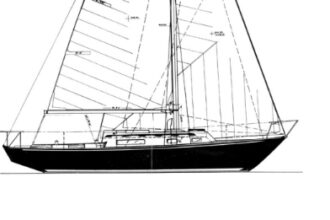
Alan Johnstone, Rod’s son, is credited with the design of the J/32. Alan has listed his criteria as “. . . the boat should sail well and handle well. It was targeted to younger families with children as an entry-level boat and for older sailors who may have tired of bigger boats and want to step down in size.”
After reading about this new offering from the company, Durkee contacted J/Boats to ask if there were any for charter in the Midwest. It just so happened that one was nearby at Hooper’s Yachts and would be going out very soon for a test sail. Durkee and Mary Jeanne were invited to come along for that sail with the boat reviewer, the broker, and the new owners. It was the summer of 1998. They never looked back. Mary Jeanne says, “You just know when you find your boat.”
Casually looking
They’d narrowed the field to one candidate, but Durkee had not yet retired. Although that would come in 2001, they felt they were about a decade away from relocating to Washington. They moved into that fuzzy mental zone known to sailors as “casually looking” while being well aware that there weren’t many of this sailboat model — new or used — available on the market.
A two-year-old J/32 turned up in a classified ad in Sailing magazine that Durkee saw while flying to Seattle for business. Mary Jeanne had left a few days ahead of him to spend some time with her family in Vancouver, Washington. The two planned to wind up with a couple of relaxing days in a bed-and-breakfast while considering communities on the Olympic Peninsula as possible retirement locations. But that classified ad for a used J/32 changed everything.
“Durkee was a cat on a hot tin roof,” Mary Jeanne says. There they were in the Pacific Northwest and the boat of their dreams was in Little Traverse Bay, Michigan. “It was too soon to find an available boat and too much money,” Mary Jeanne remembers. But logic doesn’t enter into decisions such as this. These boats were rare, and this one would not be waiting when they were ready. Lights and sirens! Battle stations! They chose the future community (Sequim, Washington) and checked out the available marinas. They went home and headed to Michigan as soon as they could to meet with the brokers at Irish Boat Shop.
The next time they headed west to the Pacific Northwest, they were the owners of a boat, had their name on the waiting list for a slip at the John Wayne Marina near Sequim, and were moving full tilt into what had been a hazy retirement plan.
Written in the stars
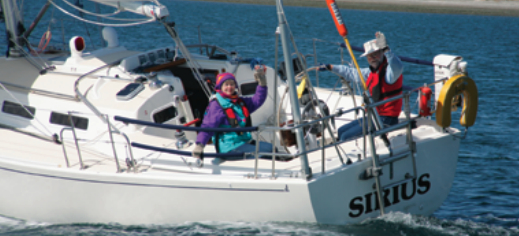
When the boat was hauled out for an inspection in Michigan, Durkee noted quietly to himself that the bottom showed that this was a “serious boat.” Mary Jeanne overheard and jumped on that pronouncement. Her name would be Sirius, since the star of that name is closely associated with the Orion constellation and the name of the boat on which they had fallen in love those many years before.
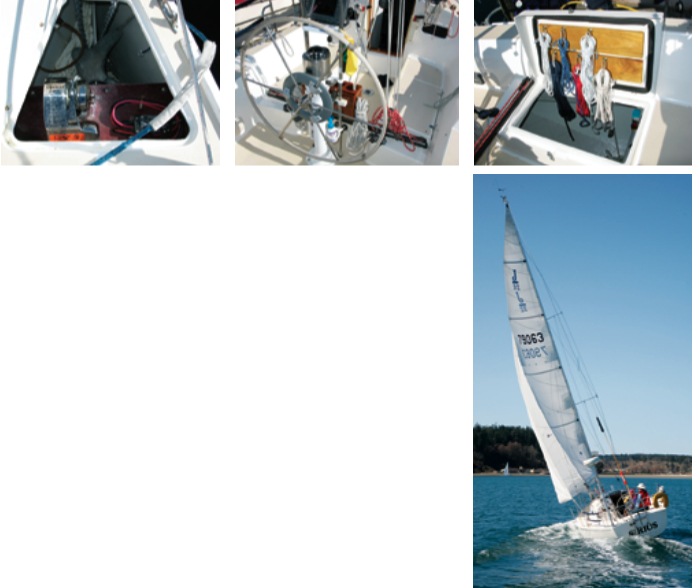
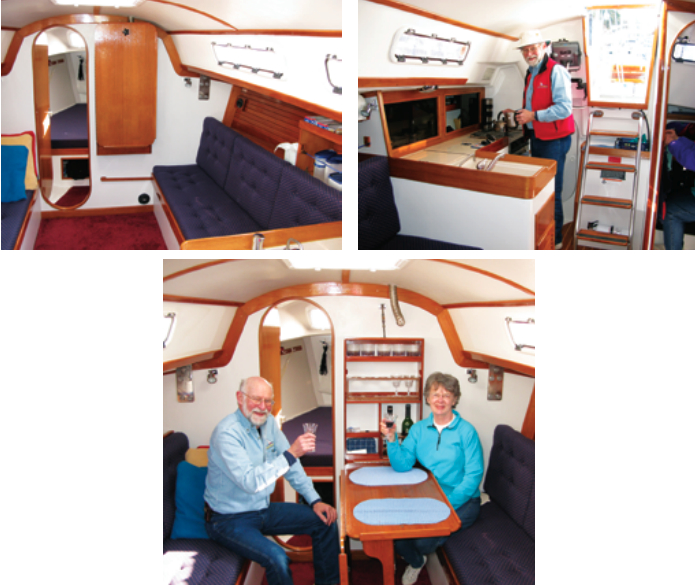
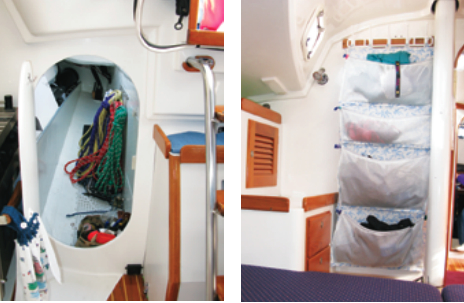
Sirius was built in 1997 as hull #5 and still had only 500 miles on the log. She had many of the options they liked: a V-berth design without battens and shelves and a cockpit- and cabin-accessible stowage locker instead of a quarter berth. When Mary Jeanne saw the immense cockpit locker from inside the boat, she amused the broker when she announced with delight that this boat even had a sewing room with a skylight.
It also had a Yanmar 3GM30F diesel engine, a Martec folding prop, an early model Garmin chart plotter, and one extra item that Durkee thought was overkill: an electric halyard winch. However, he began to appreciate this luxury item the first time Mary Jeanne had to haul him to the masthead. They insisted on adding radar before sailing their new boat to her new home marina at the far end of Lake Superior. Durkee also added an inverter right away so that anytime Mary Jeanne wanted to have a sewing machine aboard, power would not be a problem.
Making Sirius their own
Thus the boat came before their retirement by a couple of years and the Richards sailed her in Wisconsin’s Apostle Islands, keeping Sirius in the same marina where Jerry and I had a slip for Mystic at the time. Once they were there, they continued laboring to add all the thoughtful touches that appeared to be missing: Mary Jeanne’s efficient storage pouches for clothing and charts, a laundry bag in the forepeak, a clever wine rack and glassware organizer, and the other bits and pieces that make a boat a home.
The two problem-solvers worked as a team to make this boat work for them inside and out. Over time, once they’d made their move to the Pacific Northwest, Durkee also added a propane detector, upgraded the Garmin chart plotter, rigged jacklines, added a diesel heater and, most recently, added a windlass that fits out of sight in the anchor locker at the bow.
Once they were settled, Durkee got involved with the Sequim Bay Yacht Club, racing on Sirius and crewing on other boats. He also took part each May in Victoria’s well-known annual Swiftsure Race.
One year, they experienced a devastating setback: while they were not present, a fire aboard Sirius caused enough smoke damage for insurance assessors to consider her totaled. In our November 2009 issue, Durkee wrote about the cause of the fire, their emotional response, and the many hours of labor they committed to bringing Sirius back to better-than-new. As far as they’re concerned, if you have found the boat of your dreams, you labor to save her. No question.
Expanding their range
Together with Sirius, these two have been exploring the Pacific Northwest coastline, extending the distances traveled with every cruise. Durkee refers to each long step farther afield as the crossing of “psychological barriers.” First they explored the local cruising grounds. Then they crossed the Strait of Juan de Fuca (psychological barrier number one for many Seattle sailors) to Washington’s San Juan Islands and Canada’s Vancouver Island. Next they explored the Strait of Georgia between Vancouver Island and the British Columbia coast (psychological barrier number two).
Then they went beyond Vancouver Island to cruise in Canada’s Queen Charlotte Islands (also called Haida Gwaii) and visited the homeland of the Haida people. They arrived by way of the Inside Passage and returned home via Vancouver Island’s wild western shore (psychological barriers numbers three and four).
Other goals await them along the rugged and beautiful coastline of British Columbia and Alaska to the north. It’s just a matter of time and planning. “As we reached the Strait of Juan de Fuca and could see Washington once more, I realized that I didn’t want to come home from that Queen Charlotte cruise,” Mary Jeanne says. It is hard to come back to civilization after a wilderness cruise in which time moves at a slower pace and priorities are reduced to the minimum and the essential.
So there will be more, many more, explorations for this cruising couple as they continue to push the psychological barriers back while exploring ever greater distances. One man. One woman. One boat.
Karen Larson and her husband, Jerry Powlas, the founders of Good Old Boat, have been sailing their C&C 30 on Lake Superior for nearly 20 years. Their C&C Mega 30 project boat might soon be moving from the backyard to the tow hitch on the good old truck.
Thank you to Sailrite Enterprises, Inc., for providing free access to back issues of Good Old Boat through intellectual property rights. Sailrite.com