A Tartan 37’s rig survives a disintegrating chainplate
Issue 75 : Nov/Dec 2010
At the time I wrote about replacing the backstay on my best friend, Adam’s, new-to-him Tartan 37 (see Good Old Boat May/June 2010), I was smugly confident that, based on a professional rigging survey and my own inspections, the rest of the rig was in good shape and would be just fine for Chesapeake Bay sailing. I went on to note that if Adam intended to replace all the standing rigging, he would need to upgrade the chainplates as well. “A rig is only as strong as its weakest link,” I wrote, “and often the wire is stronger than the chainplates.” At the time, I had no idea that I was making a prophesy.
With the new backstay installed and the rig tuned conservatively at the dock, we prepared Audentia for the quick romp across the Chesapeake to her new home at Bay Bridge Marina. Adam was off flying fighter planes in Mississippi with the Air National Guard, so I stood in as skipper. It felt strange sailing his new boat before he’d had a chance to take the helm, but I was happy to do him the favor. With my father (a lifelong sailor and a captain himself) and Adam’s father along as crew, we set off on Audentia’s maiden voyage on a cloudy, blustery day in April.
I’m not a racing sailor, but I do like to get the best performance from boats I sail, so I was eager to test Audentia in a fresh breeze. We set the main with a reef and unrolled the genoa. I immediately got Adam on the phone, excited to tell him that all of us aboard were convinced he’d found the right boat and that it sails like a dream.
As we crossed the bay, the wind increased, blowing strong from the north and kicking up a sloppy Chesapeake chop. I rolled a few turns in the genoa to settle things down a bit. Audentia immediately stood up and sprinted away like an eager filly who’d been confined too long in a pasture. The delivery only took about an hour.
At the new slip, I methodically checked all the rigging again to make sure I’d replaced all the cotter pins — we had re-tuned the rig slightly under sail, after giving it a chance to stretch a bit.
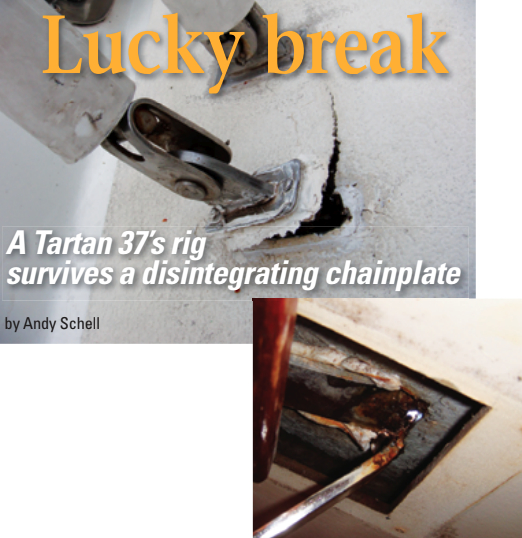
The starboard aft lower shroud was strangely loose. I didn’t think the wire could have stretched that much. Puzzled, I glanced around the deck. My heart sank when I saw what had happened. The top section of the chainplate, the part exposed on deck, had pulled up about 2 inches, taking with it a portion of the nonskid and leaving a gaping hole. The chainplate had apparently broken off belowdecks. We were lucky the mast didn’t go with it.
Uncovering the problem
Older Tartan 37s have three chainplates on each side, anchoring the forward and aft lower shrouds and the cap shrouds. The chainplates pass through the deck about midway between the coachroof and the toerail and are attached to bulkheads belowdecks. The culprit was the starboard aft lower chainplate. It made me suspect the integrity of Audentia’s remaining five chainplates, as she’s an older boat.
At sea, a broken chainplate can be disastrous. With no way of repairing it, save having a spare on board, the rig is severely compromised and, in all likelihood, will come down. We were lucky that we had been sailing on port tack most of the day and that it was the starboard chainplate that broke. After the initial shock, followed by relief that the mast was still standing, my dad and I dove headfirst into the problem.
For a new boatowner, such an event raises a number of worries: fear of not knowing how to fix it, concern that getting professionals involved in the repair is going to cost a fortune, and disappointment that maybe this wasn’t the right boat after all. Adam’s father, who’s sailed with us for years but has never experienced the “joys” of owning and maintaining a boat, had all these thoughts while Dad and I got to work.
Stabilizing the mast
It’s absolutely imperative to support the mast before unscrewing any of the rigging. The lower shroud was already loose, obviously, so the cap shroud and the forward lower were supporting the mast. This would have been adequate. However, I anticipated also removing the big chainplate holding the cap shroud, which would have left only a forward lower to support the mast. This would be unacceptable.
We led the main halyard outboard and slightly aft, secured it to the outboard genoa track on the toerail as far forward as possible, and cranked down on it with the halyard winch. I also loosened the shrouds on the port side to ease the tension on the entire rig. Just to be safe, I re-attached the cap shroud to one of the lifeline stanchion bases, leaving it snug but not tight. With the mast properly supported, we mentally prepared ourselves for the challenge we’d find belowdecks.
Extracting the chainplates
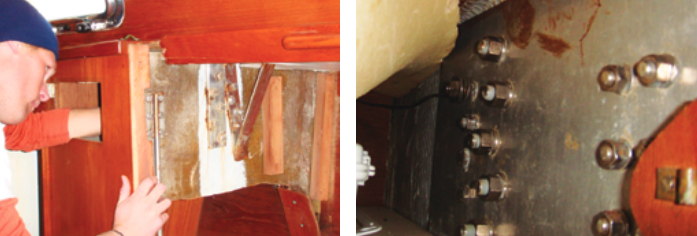
On the Tartan 37, the chainplates are located inboard and bolted to the bulkheads. The aft lower and cap shroud chainplates are backed up by one enormous aluminum plate to which a beefy tie rod is bolted to transfer the load to the hull. The arrangement is simple, impressive, and appeared to be quite stout. But, of course, removing a chainplate couldn’t be as simple as undoing some bolts and removing the plates — this is a boat project.
The broken plate was concealed behind a thin veneer covering the bulkhead. Getting to it entailed removing the pilot berth trim and a bookshelf. Before it was over, we had destroyed the veneer to get at the bolt heads. Once the plates were exposed, however, it was a simple matter to remove the bolts and take them out. We’d already removed the rigging, so once the bolts came out (with a normal set of wrenches), we simply pulled the chainplates down through the deck and part one of the repair was complete. The whole process took about two hours, and the majority of that time was spent removing the trim and the veneer.
Evaluating the damage
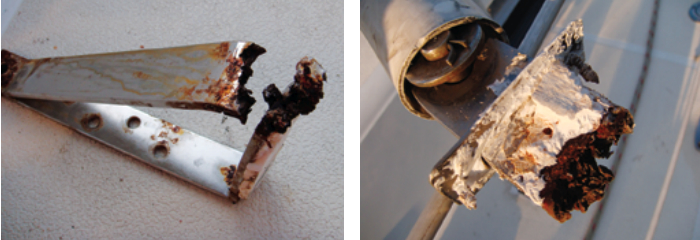
As it turned out, the aft lower chainplate didn’t really break — it disintegrated. These chainplates on both sides of the boat are fairly complicated triangular affairs with several welds on them. A shortcoming of stainless steel is its susceptibility to crevice corrosion, especially in an environment where it’s deprived of oxygen and exposed to water. Where chainplates enter the deck is a common trouble spot on many boats. Welds are particularly vulnerable. After years of water seeping through the deck, crevice corrosion had eaten away most of the weld on the chainplate. The hard sailing we’d experienced was essentially the final straw, but the plate was compromised long before we ever left the dock.
Repair and rebuild
We left Audentia that afternoon with one chainplate broken into three pieces, one questionable chainplate, two holes in the deck, makeshift shrouds, and a pilot berth in a shambles down below. I carefully covered the deck holes with plastic bags and lots of duct tape. We straightened out the cabin as best we could and went off in search of a stainless fabricator.
To further complicate matters, Adam was coming home in less than a week for a weekend’s leave and was eager to sail his new boat . . . which I had managed to break on her maiden voyage. Just as I’d felt responsible when helping him find the right boat, I now felt I had to put it back together for him so he could actually enjoy it.
I took both stainless-steel plates to Madden Masts & Rigging in Annapolis, where I’d been getting all of the metal-work done for my 1966 Seabreeze yawl and for my dad’s 1986 Wauquiez Hood 38. The guys at Madden are consummate professionals; I had the utmost confidence in them.
Rich Krolak took one look at the broken plate and immediately said it would be no problem to fabricate a new one, despite the complicated arrangement. He promised to have it done within a few days.
Insiduous corrosion
Rich polished off the remaining bedding compound from the larger chainplate and carefully inspected it for signs of crevice corrosion. I thought the plate looked OK, but Rich had other ideas. He pointed out several spots on the plate where crevice corrosion had started, noting that to grind down those areas, he would have to bore deep into the plate, severely compromising its structural integrity. He pointed out the difference between harmless surface scratches and the damaging corrosion. The corrosion appeared as slightly graying round splotches that looked like tiny swirls drawn on the metal with a pencil. It was easy to spot once I knew what to look for.
In a few days, Rich had completed a mockup of the lower chainplate. It was unpolished and tack-welded together. These chainplates on the Tartan 37 have a few important angles that needed to be exact — where the plate bolts onto the bulkhead and where the upper leg of the triangle comes to rest under the deck. Rich wanted me to take the mockup to Audentia for a test fit before he finished it.
The plate fit precisely. I picked up the finished chainplates the following day. What I received from Rich weren’t merely structural pieces of metal. They were more like works of art, polished to a mirror finish with elegantly rounded edges, precise bolt holes, and a confidence-inspiring heft.
I returned to Audentia with the new hardware, faced once again with a rigging project only hours before we were to set sail. Adam was returning that night and I had a promise to keep.
Swift reassembly
Putting the pieces back together proved remarkably simple; I had purchased nine new bolts (no sense in having a weak link in an otherwise new system) and had them in place and snugged down in a matter of minutes. After re-attaching and tuning the shrouds, we liberally applied bedding compound around the chainplates where they pass through the deck. Less than a week after what seemed like a disaster, Audentia was ready to sail again.
The entire repair — dismantling the veneer and the pilot berth trim, removing the chainplates, securing the mast, and putting everything back together again — took only about one full day of my labor. The new chainplates were fabricated in about six hours and cost around $800. Rich noted that the cost per chainplate would have diminished considerably had we replaced all six at once. In a bind, the entire project could probably have been completed in one day . . . an amazing thought, considering the doom and gloom we’d felt on discovering the damage.
Adam elected to leave off the veneer that had covered the chainplates. With some elbow grease, the exposed chainplates on a newly varnished bulkhead will look very seaworthy, match the already exposed chainplates on the port side, and be much easier to access in the future. Putting the pilot berth back together was just a matter of re-attaching some trim pieces.
Audentia is all the better
In hindsight, Adam did get the right boat, even if all the chainplates need to be replaced, which I now suspect they do. We did not remove the other four chainplates, though that project will be at the top of Adam’s list when he returns from flight school. We did carefully check the deck around the other chainplates looking for wet spots in the core, a sign that crevice corrosion might be present. We then re-bedded them with BoatLife caulk. The experience of removing and rebuilding two of the six was painless and, aside from the moderate cost of fabrication, repeating the procedure on the remaining four should be a simple task. The two starboard chainplates happened to be the only two hidden behind veneer, so removing the other four should be a simple matter of unscrewing the bolts.
Both the backstay replacement and the chainplate replacement have improved Audentia considerably and at a very reasonable cost, considering her purchase price. In my estimation, it is well worth it to simply replace all the chainplates on a good old boat at the time of purchase and to accept the cost as part of the overall price. The peace of mind gained, especially if you plan on sailing offshore, is priceless.
Andy Schell is a professional captain, rigger, and freelance writer. He lives aboard his Allied Seabreeze yawl, Arcturus and runs sail training and navigation workshops with his father, also a captain. Andy and his fiancée, Mia, are fitting out Arcturus ahead of sailing her to Sweden, Mia’s home country.
Thank you to Sailrite Enterprises, Inc., for providing free access to back issues of Good Old Boat through intellectual property rights. Sailrite.com