How we see in the dark, or not
Issue 83: March/April 2012
We live in a world of constant bright light: sunlight during the day and artificial light at night. As a result, we may not realize that there’s a big difference in how our eyes function when exposed to bright light (day vision) compared to dim light (night vision). This is of particular importance to any mariner who is bold (or foolish) enough to venture out at night upon the sea.
To explore the differences between day and night vision, we’ll look at the changes our eyes undergo during a 24-hour offshore passage with no artificial light allowed. This will help us decide what artificial light is best to use aboard at night and why.
First, though, we must understand the nature of light and how our eyes respond to it.
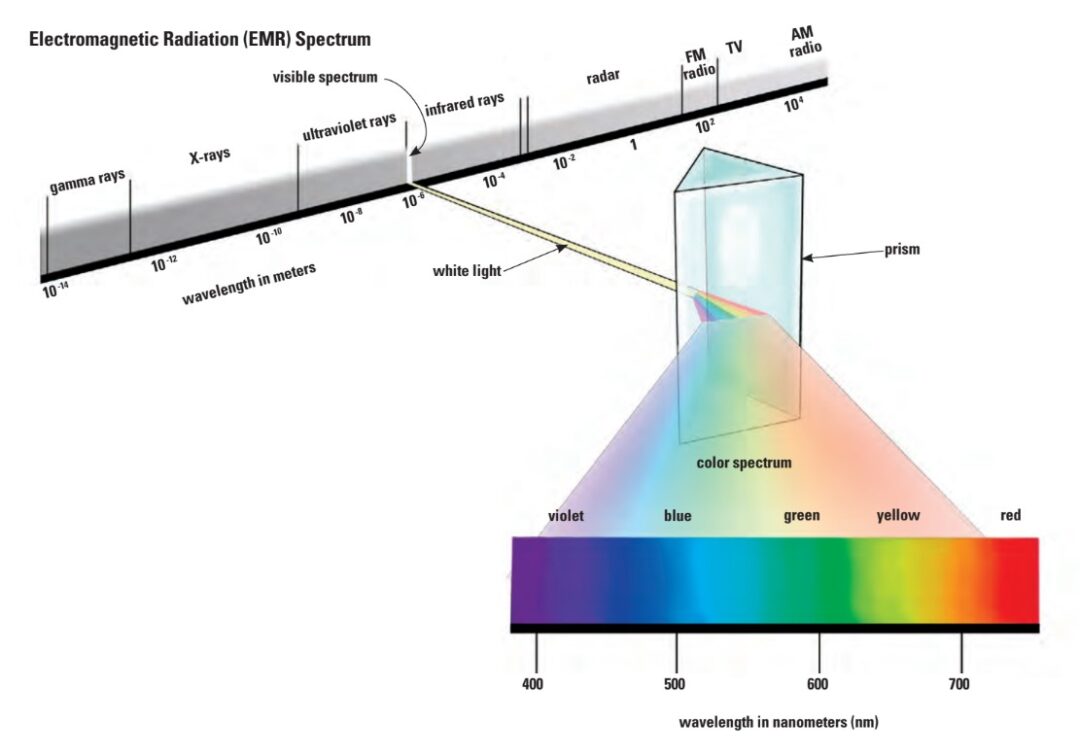
Visible light is part of a basic form of energy, electromagnetic radiation (EMR). One measure of EMR is wavelength. For us, the visible spectrum is in the wavelength range between about 380 and 740 nanometers (nm). The primary source of EMR at these wavelengths is our sun. White light is all the wavelengths of the visible spectrum together, while colored light is a subset or mixture of some of the wavelengths.
Rods and cones
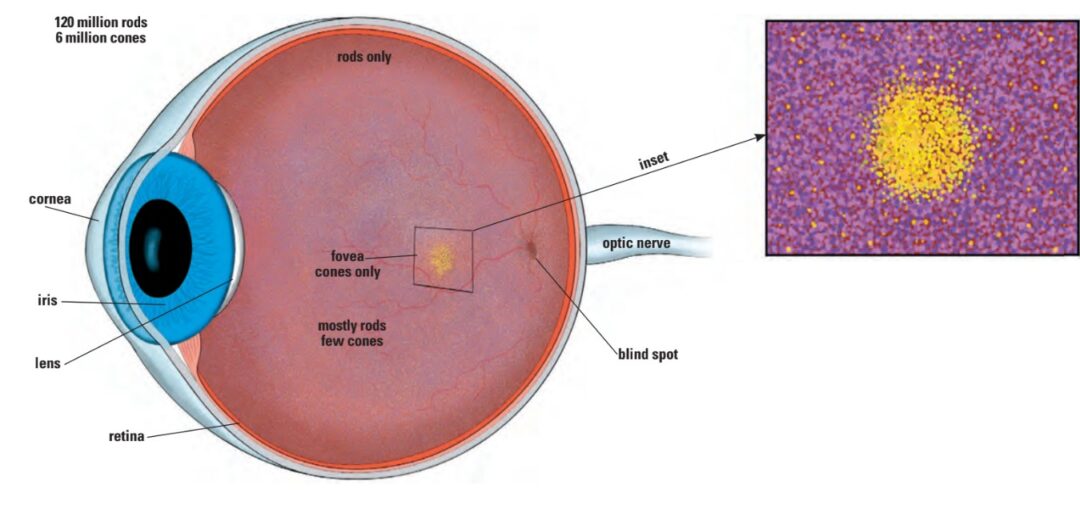
Our eyes respond to light with sensory receptors in the retina called rods and cones. These receptors use chemical molecules called photopigments, or simply pigments, to convert light energy into neural impulses that travel via the optic nerve to the visual cortex. This is what creates our vision (see illustrations above and below).
There are three types of cones, each with a different pigment that makes it most sensitive to a particular wavelength of light. This “tuning” is what makes cones responsible for color vision. Cones have a relatively low overall sensitivity and need a lot of light to function. They occur sparsely in most of the retina but are densely packed in the middle, an area called the fovea. Visually, this is where we have our narrow center of focus and get our highest acuity (seeing fine details, such as letters or numbers on a chart).
The rods are in the surrounding retina only and are responsible for our peripheral vision. They don’t provide color and have poor acuity, but they have a higher sensitivity than cones and are the only receptors that function in night vision. They are good at detecting movement and the edges of light-dark contrasts.
The passage begins
You will begin your passage on deck at noon, bathed in sunlight under a cloudless sky. The pupils of your eyes are constricted to their smallest size to let in the least amount of light and the pigments are reduced to their lowest levels to make the rods and cones least sensitive. Since your eyes are superbly adapted to sunlight, they are in their element. All aspects of vision — color, acuity, motion detection, depth perception, etc. — are optimal. This is your day vision.
When you go below, your eyes adjust to the drop in light energy by dilating the pupils to let in more light. There’s still plenty of light, so your pigment levels remain low and all aspects of your vision are very good.
If you then stick your head into a poorly lit locker, your pupils will dilate to their maximum. But since there still isn’t enough light to see inside the locker, your eyes will begin a second kind of adjustment by increasing pigment levels that will, in turn, increase their rod and cone sensitivity. This is called dark adaptation. Unlike the milliseconds for the pupil response, this process is measured in minutes. You’ll have to wait a bit to see what’s in that dark locker.
Once back in the cabin, your eyes constrict the pupils and reduce the pigments to readjust to the brighter conditions. This is called light adaptation. It’s important to note that, although it takes minutes — up to 25 to 30 in some cases — for dark adaptation, it takes only tenths of a second to a few seconds for light adaptation. We get increased receptor sensitivity slowly but we lose it quickly.
Back on deck in the sunlight, your eyes need only the cat-quick pupil response to take care of minor fluctuations in light, such as those caused by shades and shadows and by the sun setting lower in the sky.
The decreasing light energy late in the day eventually will cause your pupils to reach their maximum dilation. At this point, dark adaptation begins and pigment levels rise. Rod and cone sensitivity increases and your vision remains good. As the light continues to wane, the cones will be the first to reach their limits. Around sunset, they quit. Color and acuity are gone. The rods are still functioning and, if it’s a clear, moonlit night, you can see and move about on the boat quite well. This is your night vision.
If the moon sets and the sky remains clear, starlight will still give you minimal vision. But it’s getting thin. Your pupil size and pigment levels are maxed. Your rods are reaching their limit. Once some clouds roll in, the parameters are exceeded. You’re really in the dark now and must wait for first light.
First light brings you back into the lower limits of night vision. As dawn approaches and light energy levels rise, pigment levels drop and receptors become less sensitive. Light adaptation continues and around daybreak there is enough light for your pupils to begin responding. Soon, the sun is high enough in the sky to put you back into day vision again.
Which light will help?
If this 24-hour journey teaches us anything, it’s that we don’t do very well visually after sunset. Under the best of moonlit conditions, we do OK, but we often need help from artificial light, especially if we want cone vision and its acuity. The question is, what artificial light is best for the mariner at night?
The right light must cause the minimum loss of our vulnerable night vision sensitivity. Imagine that, after reaching peak night vision (a process that can take up to 30 minutes), your eyes are exposed to a bright light such as a flashlight or overhead cabin light. Light adaptation happens in an instant. Pigment and sensitivity levels drop. How much depends on how bright the light is and how long it’s on. If the light is now turned off, you’re left with reduced night vision. You have been literally “blinded by the light.”
In a very brief period of time, you have lost a precious commodity. Your night vision has been degraded or, with a really bright light, obliterated. It will take minutes to regain. But what if you’re trying to set a course for the faint outline of a gap between two approaching squalls and can’t afford to lose precious minutes of night vision?
The guiding principle when selecting the best artificial light is to minimize its negative effect on your night vision. The way to do this is by using the absolute lowest level of light needed to get the job done. It’s a matter of physics and physiology. The brighter the light (physics), the more pigment reduction and loss of sensitivity (physiology). Hence, the greater the loss of night vision and the longer it takes to recover.
Therefore, the best artificial light to use at sea at night is one that has an adjustable light level. One with a continuously adjustable light level is ideal. Rather than having two or three settings, with perhaps the lowest setting still being too bright, a continuous adjustment lets you fine-tune the light to the ideal minimum-to-get-the-job-done level.
Red light is traditional
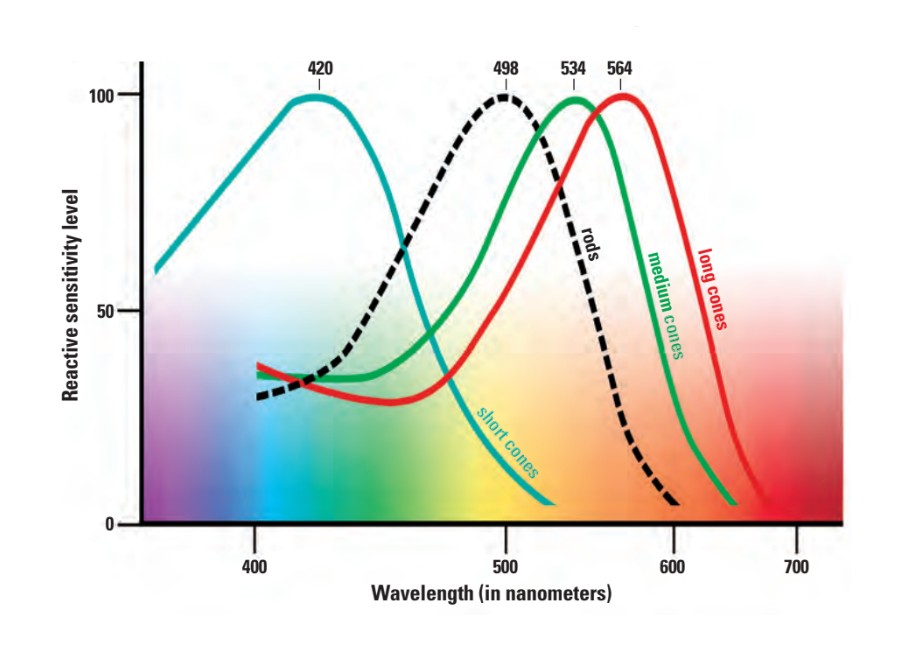
What about color? Red light has been used traditionally for nightlights at sea. A look at the illustration below shows why. Two of the cone types have a high sensitivity to light in the red-wavelength region while rods have a low sensitivity to it. Given the right level, a light around 600-nanometer wavelength would stimulate cone vision but leave the rods relatively unaffected. This would leave the rods with less dark adaptation readjustment when the light is turned off. Your eyes would more quickly regain good night vision.
Research has shown that dark adaptation is faster after exposure to red light compared to other colors. But the effect is modest. Unless the light is a deep, pure red, other wavelengths will be mixed in. These wavelengths can stimulate the rods and cancel the shortened dark adaptation effect.
The task at hand also must be considered. If it calls for good peripheral vision, a red light that doesn’t stimulate the rods is not ideal. Tasks involving depth perception — such as moving about the boat or grabbing a sheet or halyard — require good peripheral vision. A broader-band light would be best. This would allow both cones and rods to function and give you your best overall vision.
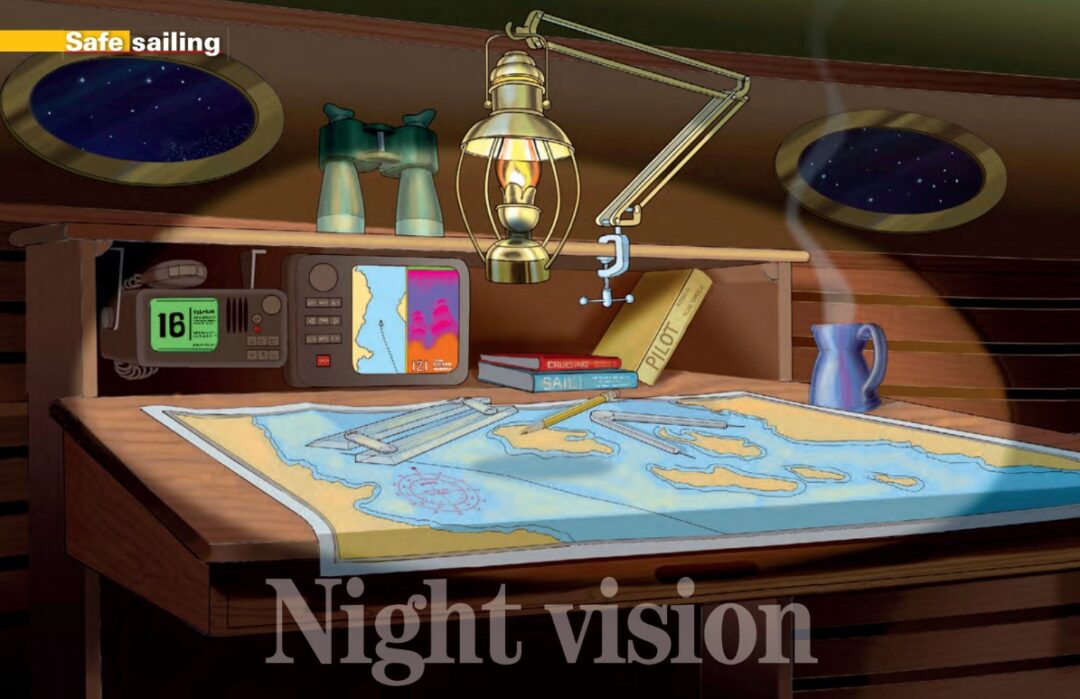
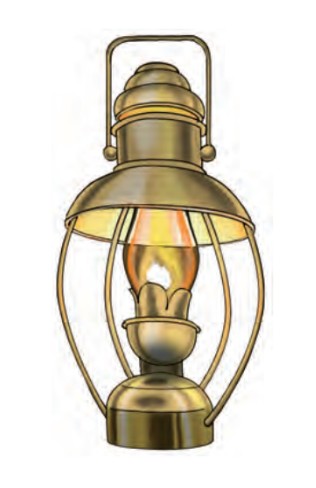
You can go high-tech and use electronic gadgetry to produce a broad-band, continuously variable light, or you can go low-tech and use an option that’s widely available and has been around for ages. It’s the variable-wick oil lamp. It has both qualities you’re looking for, a relatively broad-band light to engage all the retinal receptors and a continuously adjustable light output that will let you fine-tune to the minimum-to-get-the-job-done ideal level. With the right lens and shade configuration, it should serve equally well at the chart table, in the cabin, and outside on deck.
Enjoy the night
When the sun sets at sea, let your night vision develop early and completely. Safeguard it jealously by using the absolute minimum of artificial light. Then sit back and watch the silvery play of moonlight on the waves, catch a glimpse of that meteor streaking across the Milky Way, or enjoy the bioluminescent display swirling in your wake.
Robert Fisher is a retired psychology professor who first learned about night vision at sea during a hitch in the Navy in the 1960s. He’s a member of the Laguna Madre Yacht Club in Port Isabel, Texas, where he sails Zephyr, a good old 1979 Cape Dory 28.
Thank you to Sailrite Enterprises, Inc., for providing free access to back issues of Good Old Boat through intellectual property rights. Sailrite.com