How the CCA rule influenced sailboat aesthetics

Issue 82 : Jan/Feb 2012
It’s not unusual for people to look at older boats and marvel at their beauty and remark how today’s boats just aren’t as good looking. I do it. But you might be surprised to learn that the features you admire on some older boats are in fact artifacts of the rating rules that were in place at the time the boats were designed.
Rating rules came about to allow boats of different sizes to race against each other. They varied from place to place, but the boats we commonly see today that date from the 1950s to the late 1960s were usually influenced by the CCA (Cruising Club of America) rule, and those from the late ’60s through the ’70s by the IOR (International Offshore Rule). I could argue that the International Rule that governed 12-Meters, 6-Meters, and 8-Meters, had a lot of influence also. The famous Dorade that put Olin Stephens on the map was based upon meter-boat shapes.
Is this rule stuff important to us? Not really. We like our boats for what they are. But from studying the basics of these rating rules you may better understand why your boat and other older boats are the way they are. I’ll focus on the CCA here (and the IOR in a future article) because these rules were in effect in the U.S. early in the era of GRP production-built boats. For this article I am going to use a late (1967) revision of the CCA rule because it’s the only one I have saved intact. Like all rating rules, the CCA went through a number of revisions over the years to “plug loopholes” and ensure that the boats not venture into extreme proportions. But for many years, the CCA provided a lot of fun and highly competitive racing.
Not all boats show the effects of raceboat rating rules. A lot of cruising boats were developed without regard to any rating rule. The Colin Archer types and Colin Archer wannabes are examples (although Colin Archer had his own rigid rule for distribution of volume). Many of our traditional types were modeled after sailing workboats, so you could argue that their restricted or focused purpose did, in fact, impose a “rule” on them. Some boats just grew out of the designer’s idea of what a “perfect” boat would be and rules be damned. Bill Garden’s amazing Oceanus comes to mind as a great example of that type, as does L. Francis Herreshoff’s Ticonderoga. That Ticonderoga was very successful racing under the CCA rule is a sign of the skill of L. Francis. Today, with the popularity of one-design racing, we see a lot of modern “rules be damned” boats. My own Flying Tiger 10 Meter class is an example of that. I just wanted to design a fast, fun boat. Rating rules generally penalize this type of boat heavily.
Weighing fast and slow elements
Now please sit up straight, spit out your gum, and pay attention.
The origins of the CCA rule were laid down in 1932 by Wells Lippincott of Chicago. With minor changes, the rule was adopted by the Cruising Club of America and the CCA rule was the dominant U.S. handicap rule until 1970. If you want to see typical CCA boats, look at the designs of Bill Tripp Jr., Bill Lapworth, Kettenburg Boatworks, Bill Shaw, C&C, Phil Rhodes, and Sparkman & Stephens. This is my short list — many designers produced CCA-type designs.
Rating rules balance the speed-producing elements of a boat against the speed-reducing elements. Length is speed-producing as are sail area, draft, and stability. Beam, displacement, and prop drag are speed-reducing elements. The key to understanding how the CCA (and the IOR) work is in the way each rule dictates exactly how to measure and “weight” those elements.
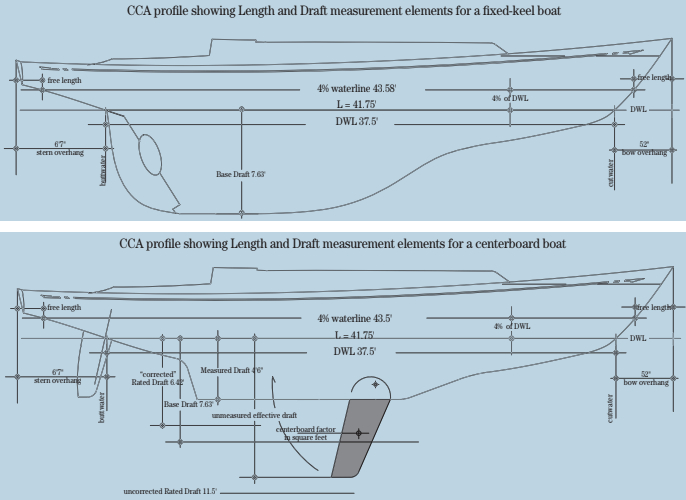
The one element common to almost all CCA designs was overhangs. Today, we look at those boats from the 1950s and early ’60s and admire their overhangs and strong spoon bows. Primarily, overhangs were a product of how the CCA measured length. The actual rule is short and simple (see the cutline on the facing page). It begins with a Measured Length, which it adjusts with a series of factors based on other dimensions.
Length
Measured Length (L) is the most important factor and it was established by measuring the waterline length (DWL) of the boat and another waterline length 4% of DWL above the DWL. These measurements were weighted: 30% of the DWL was added to 70% of the 4% waterline. What does this mean? It means that to have a low L you needed a short DWL and a short 4% waterline. But once you got beyond where the 4% waterline crosses the bow and the stern counter, your length was free, i.e., unmeasured. This is why CCA boats almost always had long overhangs.
The overhang was an attempt to capture back some of that length lost to the L measurement. If you look at the designs of Lapworth, Kettenburg, and Bill Tripp Jr. you will see very full bow sections. By pushing volume forward in this way, the designer was trying to make the bow overhang do some “work” in adding to sailing length. Fine bow sections would not do this. Unfortunately, full bow sections don’t help a boat on the wind as the half-angle of entry becomes excessive. But the good news is that full bow sections can make for a boat that is fast when reaching and running. I’m not sure why sterns were not wider in those days. Bill Tripp Jr. did push his sterns out to what at the time was considered almost extreme, as did Lapworth, but the sterns of S&S and Rhodes designs were relatively trim, although broader than the sterns of meter boats. If the 4% waterline intersected the transom, a correction factor was added.
Beam
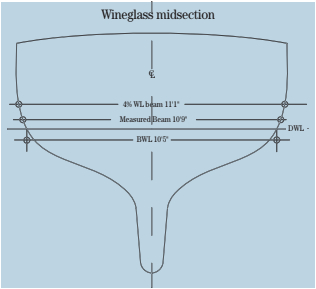
Beam was measured at the DWL and the 4% waterline and not at the deck. That’s why CCA boats look rather slab sided. Once you had hit your Measured Beam points at the DWL and 4% WL, there was no reason to go on increasing beam and you would pay when you got to the stability correction. The Beam correction factor was based on a “Base Beam” of .187 (L) + 3.2. If your Measured Beam was below the Base Beam, you gained L. If your Measured Beam was above the Base Beam, your L was reduced. But the way the corrections were weighted, there was little incentive to go above Base Beam and going below Base Beam incurred a more punitive correction to L.
Draft
Draft also affected L. If your actual draft, Measured Draft, exceeded the Base Draft of .147(L) + 1.5, 85% of the excess draft was added to Measured Draft to obtain a Rated Draft. Draft on CCA boats tended to be modest, so it is evident that designers seldom took the draft penalty. For instance, for an L of 34 feet the Base Draft is 6.5 feet. But Rated Draft was measured differently with centerboard boats, where the exposed centerboard area in square feet was divided by .167 L to give a CBF (Centerboard Factor). This was added to the measured draft. If Rated Draft was less than Base Draft, centerboard-down draft was “cheaper” than fixed-keel draft as CB boats had low Measured Draft. As time went on, the low-aspect-ratio centerboards like Finisterre’s were replaced by centerboards with higher aspect ratios, like the one on Charlie Morgan’s successful Paper Tiger, to reduce the CBF without giving up board-down draft. (More on the centerboarder’s advantage when we discuss stability.)
Displacement and stability
Displacement went through a similar correction by comparing actual displacement to a Base Displacement. Boats were actually weighed to determine displacement. Due to space restrictions, I am going to avoid Displacement corrections.
Measuring the stability of the boat went through major changes over the life of the CCA. In its early years, the rule did not require an inclining test but used ballast-to-displacement (B/D) ratios. This assumes the lower the B/D the more tender and slower the boat. Problems arose defining “ballast” after designers put very heavy metal structures in the bilges of centerboard boats to support the large centerboard trunks. These were effectively ballast but were not technically counted as such, so a more accurate way was needed to measure stability. By 1967, the boats were physically inclined in calm water to obtain an accurate Vertical Center of Gravity (VCG) and Righting Moment (RM). This actual RM was compared to a Base Righting Moment to produce a Stability Factor. A penalty to L was incurred if your Measured RM exceeded your Base RM. Early CCA boats tended to have a firm turn to the bilge because this was not measured. This produced relatively stiff boats.
The Prop factor was based upon the type of installation, diameter of the prop, and whether the blades were fixed, folding, or feathering.
Beauties and rule beaters
When we look at drawings or photos of the old S&S boat, Finisterre, launched in 1954 and three times the winner of the Bermuda Race, we see a beautiful, “classic” looking yacht. But Finisterre was a CCA-rule-designed boat and considered, at least by Olin Stephens, an “extreme” example of the type. In the Cal 40, designed by Bill Lapworth in 1963, we see another boat that by today’s standards shows beautiful ”classic” lines. But the Cal 40 represents the epitome of CCA-rule-induced design features. ln its day, the Cal 40 was a “rule beater” and won just about everything for a few years.
These were pretty boats, and the obvious conclusion you could come to was the CCA produced beautiful, wholesome boats. But the Worth Brown-designed Hoot Mon, a contemporary of Finisterre, was anything but pretty. Hoot Mon was a CCA-rule freak and a very successful one. On a LOA of 39 feet, she had a DWL of 21 feet 7 inches and extremely full ends. In fact, you could consider Hoot Mon almost a scow-type hull form. I recall thinking, even as a kid, how ugly she was and, at the same time, how intriguing this approach to the rule was. Overtime, just about every rating rule eventually produces freaks as clever designers learn where the loopholes are and how best to exploit them to achieve the greatest boat speed for the lowest rated speed.
Sails and rigs
Let’s look at how the CCA approached sail area and gave us the rig proportions you see in the boats of the ’50s and early ’60s. Measured Sail Area (MSA) was determined using the basic sail-plan dimensions; today we call them “I”, “J”, “P,” and “E” but the CCA used other initials. Base Sail Area (BSA) was calculated based upon Measured Length, L. In the early days of the CCA, yawls like Finisterre were popular because staysails and spinnakers flown off the mizzen were not counted in the MSA. Off the wind, these mizzen flying sails gave you additional unmeasured and effective sail area. In time, that loophole was closed and you paid for that area, and yawls quickly disappeared from the racecourse.
Also in the early days of the CCA, mainsail area was more heavily weighted compared to the overlap (or LP) of genoas. Bill Luders saw the loophole here and designed a 44-footer called Storm that was technically a yawl but had no mainsail at all, resulting in a very low RSA. Storm carried big overlapping genoas, a mizzen, and a complement of mizzen flying sails and won everything her first year. This annoyed the rule makers, who decided you had to have a mainsail and changed the rule to reflect that. Bill Luders, still looking at the loophole, modified Storm so she carried the mainsail, as I recall, of a Penguin dinghy, and still had a low RSA. The next year, the rule was again changed to require that the boat would be rated with a mainsail area based upon the CCA “P2” dimension (the height of the foretriangle) whether it carried a mainsail of that size or not. So big mainsails were back in vogue.
Throughout most of the CCA days, genoa overlap was not heavily weighted, so we saw genoas with LPs in excess of 160%, with some so long that they sheeted to the corner of the transom. Obviously, this was a not a good trend, and the rule in time addressed this with LP weighting changes.
If Rated Sail Area exceeded the Base Sail Area you were penalized with a correction factor of 1.15 times the excess. I’m really not sure why mainsails stayed big under the CCA and base foretriangles stayed small. My best explanation is that it was just the style of the day and designers were still clinging to the old accepted rig geometries. The 1.15 factor for excess sail area was a heavy penalty, so the typical CCA rig was quite short by today’s standards. The classic Tripp Bermuda 40 had a sail-area-to-displacement ratio (SA/D) of only 16.36 and the Cal 40, a later design, had a SA/D of 18.38. Both of these numbers would be considered anemic on the racecourse today. The typical mom-and-pop cruising boat today has a SA/D of around 17.0 or better.
The CCA legacy
Let’s say you own a nice old early ’60s boat. What characteristics would it have acquired from the CCA rule?
I hate to generalize, and in that day we saw some real variations in design, but given the CCA’s focus on DWL, it prob- ably has a short DWL and longish overhangs. This translates to a small interior for a given LOA. Accommodations were further reduced because cockpits were just bigger then and seldom extended to the transom as there was little volume in the overhang aft. The accommodations of a Bermuda 40 would be similar to those in a modern snub-ended 32 footer. Beam on the CCA boat would be relatively narrow. The L/B of the Bermuda 40 is 3.46. Finisterre, considered almost excessively beamy in her day, had an L/B of 3.42. These relatively high L/Bs would further reduce interior volume.
One thing the CCA boats had going for them was stability. Although I don’t have any numbers for them, I think some of the centerboard models might have had low ultimate stability, but the typical deep-keel, wineglass-section, firm-bilge CCA boat would have had both good initial stability and good ultimate stability. CCA boats were heavy by today’s standards. Finisterre had a displacement-to-length ratio (D/L) of 478! The Bermuda 40 had a D/L of 404 and the radically “light” Cal 40 a D/L of 236.
In terms of sailing performance, your typical CCA boat was not close-winded, and for several reasons. Sails in those days were not as efficient (and that has nothing to do with the CCA) but the low-aspect-ratio rig of the CCA boat with its huge overlapping genoas was not weatherly. Sheeting angles would have been wider than on today’s boats, so it was physically impossible to point as high as a modern boat. It’s important to remember that today’s boats have the advantage of newer and lighter construction methods and a general improvement in the science of what makes sailboats go.
Also keep in mind that, in the early ’60s and before, true fin keels were not common. Ben Seaborn in Seattle, C&C, and Bill Lapworth had begun playing with fin keels but the successful CCA boats that I raced on in high school had what today we would call modified full keels. The rudder was attached to the keel’s trailing edge. In an effort to reduce wetted surface, rudders moved forward, and this resulted in some boats that were hard to steer off the wind. If there was any doubt that the fin keel and spade rudder was the fastest underwater configuration, the Cal 40 quickly put an end to the debate.
The CCA boat would have been slow in light air. Excessive genoa overlap did not make up for the low aspect ratio of the overall rig. Interestingly, in the early years of the CCA, fractional rigs were common. Over time, many fractional-rigged boats were converted to masthead rigs. Today, we know the fractional rig is the more efficient rig. Off the wind, the CCA boat was usually a nice boat to sail, especially when it had a spade or skeg-hung rudder. With the full ends, the boat was usually stable downwind and fast. The sail area distribution on squatty rigs with the big mainsails was well balanced, so going dead downwind in a blow was seldom a problem.
But the heyday of the CCA was before my time. I graduated from high school in 1964 in time to see Ted Turner and his radical Cal 40 win the SORC. But I had raced on CCA boats and I knew the type well, if not the inner workings of the rule itself. I have probably missed some or even many of the nuances to the CCA rule here. CCA experts are very hard to find today. I think I have covered the basics. In the next issue I will compare the CCA rule to the often dreaded IOR.
Robert Perry is a contributing editor with Good Old Boat. He began his career designing yachts on the cusp of the change from the CCA to the IOR. He has designed many boats to the IOR, many to no rule at all, and some of his designs pay tribute to the CCA rule in terms of style.
Thank you to Sailrite Enterprises, Inc., for providing free access to back issues of Good Old Boat through intellectual property rights. Sailrite.com