New sailors freshen up an Irwin 32
Issue 88 : Jan/Feb 2013
I learned to sail when I was 5 or 6 years old on Curaçao in the Caribbean. While I was in my early teens, my family moved to the Netherlands where “everybody” sails. I became an active sailor in racing dinghies, starting with a Cadet I built, and worked my way up through the Vaurien, Flying Junior, Flying Dutchman, and Tornado classes, and finally to cruising boats.
When I came to the States, more than 30 years ago, I didn’t do much sailing at first. I dabbled in small weekend boats with friends on inland lakes and rivers before becoming a classic powerboater. I’ve always been stricken by woodies and wound up restoring several Chris-Crafts.
My friend Tim Hafner envied sailors leaving the channel out of South Haven, Michigan, but he had never been a boater, so he asked me if I would like to buy a sailboat with him. I jumped at the offer. We started looking for used boats but, as Tim and his wife, Mary, had no boating experience and my lovely wife, Doris, had only motorboat experience, I was the only sailor. I determined that we needed a solid good old boat, such as a Morgan, Pearson, C&C, or Chris-Craft, for a reasonable initial investment. I knew it was possible that any of the three other partners might not like the sailing experience and we might therefore have to sell after the first season. For this reason, we did not consider boats costing $40,000 or more.
After looking at many boats, we settled on a 1972 Irwin 32 Classic, a boat big enough for four of us and one with great motion comfort and capsize ratios. It’s not the fastest boat . . . but it’s not the slowest either. This would be a good cruiser for Lake Michigan, the “big” lake. I crawled all over the boat checking for possible problems and found none that really concerned me. We made an offer while she was on stands and covered with snow. It was contingent on a sea trial.
Even prior to the final sale, we took the sails home and spread them out on the grass to check them over. The 160 genoa needed a minor repair and we opted to do that at our expense before the sea trial. It poured rain during the sea trial, but everything worked. We signed the contract that afternoon and planned to sail 84 nautical miles to her home port that weekend.
As well as inspecting and repairing the sails in advance of the sale, we convinced the previous owner that he should let us clean and wax the boat before she was launched. This would be a win-win situation for all, as we would have the boat clean and shining if we accepted her and, even if we did not sign the purchase papers, he would have a clean boat. We scrubbed and cleaned and polished and rubbed for two weekends and she didn’t look bad, except none of us liked the off-white color of the old gelcoat. She wasn’t in bad shape but colorwise we thought she was “blah.”
We began to understand what a great sailing vessel we had when we completed the 84-mile passage in just 13 hours.
Repairs and cosmetics
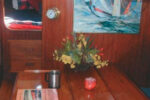
Once she was in her new home port, I made new companionway dropboards of solid mahogany and varnished them. I also made a mahogany cabin table as the boat came without it and it was necessary as the bottom for the port “double” berth. To support the table I used a pedestal receiver and chrome pipe of the type used for cockpit chairs. I admit that cutting a hole in the cabin sole for the receiver was hair-raising, as I did not know what might lie beneath.
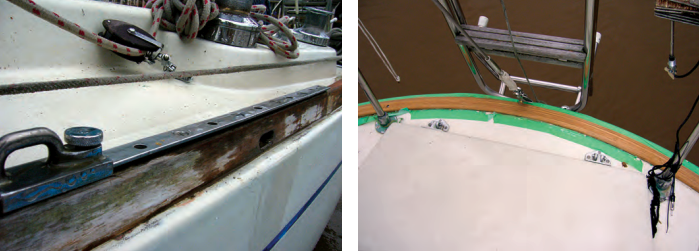
As a group, we agreed to attack the teak toerails and handholds first. We soon realized we’d rather sail when
the weather was nice than work on scraping and sanding. For simplicity, I opted for Cetol teak finish, even though I was used to using Interlux Schooner varnish in my mahogany Chris-Craft work.
I rebuilt the forehatch with mahogany and new acrylic as the old one was completely crazed, the teak trim was rotted and leaking, and I didn’t trust it to carry our weight. It was interesting getting the trapezoid form with the dado for the seal put together. I used clear 3⁄8-inch acrylic and put a limousine-grade film on it to block damaging sunlight and provide some privacy. To this, I added a solar-powered Nicro ventilator.
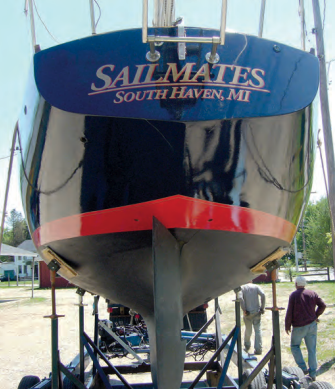
After a season of great sailing, Tim confirmed that he really liked to sail. We knew then we’d keep the boat and decided she needed a new color. Since she was almost 40 years old, we looked at classic colors — red, burgundy, dark green — and settled on blue. I then needed to determine which system to use. I considered Awlgrip, Alexseal, and Interlux. I had painted two 30-footers and many smaller ones with Interlux paint and Interlux varnish so I knew these were good products.
Then, at the Strictly Sail Chicago show, I saw a good old boat that had been repainted with Interlux Perfection in flag blue and I was sold. We chose Interlux Perfection two-part polyurethane. The cost was many times less than for Alexseal and Awlgrip. The Interlux representative at the boat show cinched the deal when he said the temperature range and paint application was more amateur-friendly than my other two choices. Since we live in Michigan, application temperature was important.
Painting by degrees (F)
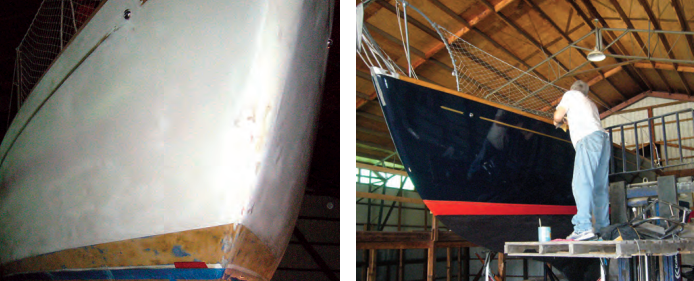
We were able to store the boat inside an old lumberyard building. We spent approximately 80 man-hours removing the boot and cove stripes and “roughing up” the gelcoat with palm sanders and 60-grit paper in order to assure good paint adhesion. We used heat guns to remove the vinyl name from the boat and I filled a couple of small gouges with epoxy.
We then had to wait for the right temperature for applying the first coat of primer. This was followed by another 20 hours of sanding, this time with 120-grit paper, and another coat of primer. We opted for the roll-and-tip method as spraying required a minimum of 50-degree weather and roller painting could begin in 45-degree weather. These temperatures were hard to find in early spring in Michigan.
After the two primer coats we applied a new red bootstripe and waterline. This required two finish coats. We did all our work on weekends and some evenings. Tim is a hard worker but not a do-it-yourselfer. As he was often away on business, he could only help when I was there, so some evenings and weekends I worked alone.
While we waited for another weather break, Tim worked on the teak toerail and handholds. I put in another bronze through-hull for a raw-water pickup in the head as it had been designed to use potable water. I repaired the urethane prop that had been nicked by flotsam over the years and had a slight vibration. I used West System epoxy with fairing filler for this and it worked great.
At last the time came to apply the first coat of blue. I caught a weekend in late April 2011 that was forecast to be 46 to 50 Fahrenheit. I mixed the paint (based on volume), let it stand, and applied it with a high-density foam roller. These are not the inexpensive black rollers you buy at the hardware store. We used West System rollers. Tim rolled and I followed immediately, tipping the paint out with a high-quality brush.
We were disappointed when the first coat didn’t cover as well as we’d hoped. It was a bit too cold and we discovered that the paint didn’t level out as well as we’d hoped. It flowed OK while we were applying it, but a higher temperature would have made it “settle” better.
After letting the paint harden, we sanded the hull once again, this time with 220-grit paper, and cleaned it again with MEK. Waiting for warmer weather in order to apply the second and third coats was unbearable, but I finally had a couple of days that looked acceptable and applied another coat by myself.
With the second coat, the boat looked beautiful and we decided to do a third coat, if needed, in the spring of 2012. All that remained was the cove striping. We opted for gold as we also had a small gold pinstripe at the waterline. Originally, we were going to paint it, but I found a nice gold vinyl tape that fit perfectly in our cove. The waterline stripe was one that remained from one of my Chris-Craft restorations and we applied that also.
Additions and improvements
While the mast was down and it was too cold for painting, we removed, restored (that is to say, filled the rot), and varnished the oak spreaders. I also rerouted some of the wiring and installed spreader lights using automotive LED fog lamps.
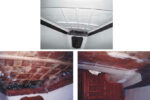
During the winter and spring of 2012, we installed a second lifeline and a new imitation-wood cabin sole. I used a product I had discovered at Menards (also at Lowe’s) called Aquarius. It is specifically made to be 100-percent waterproof and snaps together like most modern laminate flooring. This was a great and inexpensive way to quickly improve the appearance of the old cabin.
All that is left to do now is to repaint the deck and cabintop and maybe even put on PlasTeak decking. Before we tackle those items, I’d like to look into getting new sails, halyards, and lines even though the current ones aren’t too bad. I’d just like to be sure that nothing fails while in 40-knot winds on Lake Michigan. A good old boat is always a work in process.
E-J Ohler was a very active sailor as a child and in his teens. He and his wife, Doris, now sail with their boat partners, Tim and Mary Hafner, out of South Haven, Michigan, on the Irwin 32, SailMates, they have been restoring.
Thank you to Sailrite Enterprises, Inc., for providing free access to back issues of Good Old Boat through intellectual property rights. Sailrite.com