A low-profile high-value center-cockpit
Issue 88 : Jan/Feb 2013
Founded by George O’Day, an Olympic gold medalist and crew on two successful America’s Cup defenders, the O’Day Corporation was at one time America’s largest manufacturer of fiberglass sailboats. Over a span of more than three decades, the company’s offerings ranged from 12-foot daysailers to 40-foot bluewater cruisers.
The company started out building small boats from 12 to 22 feet and by 1966, when Bangor Punta purchased the company, had sold more than 70,000 of these smaller craft. The new owners redirected emphasis toward larger boats, such as the O’Day 23 and 25 pocket cruisers, the 27 and 30 keelboats, and the company’s first center-cockpit design, the O’Day 32.
While the O’Day 32 enjoyed reasonable success and a production run of about eight years, it was the introduction of the O’Day 37 that captured the attention of center-cockpit aficionados. Its good looks, sailing ability, and well-designed accommodations quickly made it popular with charter companies, sailing schools, and liveaboards.
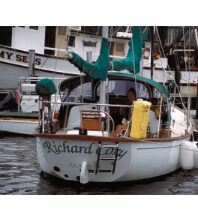
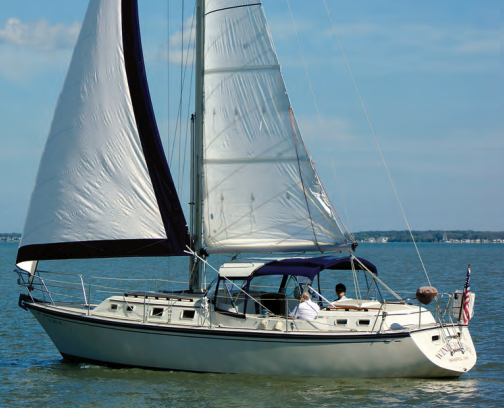
Windermere is a 1984 O’Day 37, 25th Anniversary Edition, owned by David Ruckman and Tina Hart. During a trip to Canada on their O’Day 28, Dave and Tina met a couple sailing an O’Day 37 and were very taken with it. They thought it would be the ideal cruising boat for them. Two or three years later, they accidentally found one for sale locally and were impressed all over again. Their offer was accepted and they have enjoyed ownership for the past 17 years.
Since the purchase, Dave and Tina have made both comfort- and system-related upgrades. Three of the most significant include a hard dodger and canvas, a custom mattress for the aft cabin, and Peekaboo window shades. System upgrades include two new heads and hoses, the segregation of port and starboard 120 VAC circuits, and replacement lenses in the saloon portlights.
Design
O’Day’s product line of smaller boats arose from the talents of several naval architects. When the emphasis changed to larger family cruisers, O’Day chose the firm of C. Raymond Hunt Associates, headed by John Deknatel, to design the entire line, including the O’Day 37. Introduced in 1978, the O’Day 37 was still in production at the company’s 25th Anniversary in 1984 but was absent from the line the following year.
The O’Day 37 does not suffer from the chunky lines often associated with commodious center-cockpit boats. A wide cove stripe highlights the boat’s subtle sheer from the raked stem to the reverse transom and the cockpit coaming makes a smooth connection between the main cabin trunk and aft cabin. This sleekness in design creates a good visual first impression. Under the water, the O’Day 37 has a swept-back fin keel and a rudder supported by a full-length skeg.
Construction
The O’Day 37’s hull is solid hand-laminated fiberglass and its deck is cored with balsa except in structural areas, where plywood is used. The hull-to-deck joint is a flange that’s chemically bonded, mechanically fastened, glassed over, and covered with a two-piece gunwale guard.
Interior structural and cosmetic components include a molded fiberglass headliner and a textured fiberglass floor pan. All bulkheads are teak-veneered plywood and are tabbed to the hull. Any exposed portions of the hull are covered with a foam-backed fabric hull liner that has some insulation and noise-absorption properties. Where the sole is not textured fiberglass, it is teak and holly. All teak surfaces, veneer and solid trim, are treated with a hand-rubbed oil finish. Over the years, Tina’s judicious oiling has yielded a warm, reddish patina.
The boat has 6,000 pounds of lead ballast bonded into the keel cavity and glassed over. The skeg-hung rudder is a sandwich of high-density foam within a fiberglass shell. All of the through-hulls are bronze with Zytel seacocks and a lightning protection system bonds all the metal components. Backing plates are used under all the deck hardware.
The engineering, execution, and components used in the O’Day 37 are above average for a boat built to the production standards of the day.
Deck features
On the bow, the welded stainless-steel stemhead fitting has an integral anchor roller, which is a bit undersized. Just aft of it, a pair of chocks lead to a single 10-inch open-throat cleat mounted amidships and just forward of the anchor locker.
A pair of flush-mounted deck prisms fitted in the foredeck just forward of the cabin trunk direct light into the forward cabin. On Windermere, one of these prisms was replaced with a low-profile solar vent. On the forward end of the cabintop, the flush fiberglass forward hatch with a translucent polycarbonate panel lets in more light. Between the forward hatch and the mast is the main-cabin hatch, and the forward companionway with its molded-in sea hood is aft of the mast. On each side of the cabin trunk, a pair of small opening portlights admit light and air into the forward accommodations and a pair of much larger opening portlights help ventilate the main cabin. Full-length teak handrails flank the cabintop.
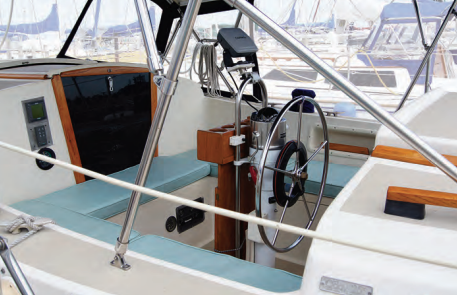
In the cockpit, which is 6 feet long, the bridge deck forward forms part of a U-shaped seating arrangement. This configuration allows neither a dedicated seat for the helmsman nor a bridge deck to protect the aft companionway. However, the seating is properly sloped and, along with the 14-inch-high coamings, gives good support. Beneath the port and starboard cockpit seats are large (but not overly deep) lockers and, beneath them, the fiberglass potable water tanks. The aluminum fuel tank is inboard of the starboard water tank. Water that enters the cockpit drains via a pair of 1 1/2-inch scuppers.
The cockpit is deep and reasonably comfortable, and visibility from the helm is excellent. From the pedestal steering, with its 28-inch wheel, the helmsman can easily reach all the sheets. Fitting a fully enclosed Bimini over the entire cockpit could significantly increase the amount and versatility of the living space.
The forward companionway is offset to starboard and fitted with smoked-acrylic hatchboards. The aft companionway, which is offset to port, has a pair of solid-teak doors.
The aft cabintop is a bit cluttered with the sliding hatch and its guides, a pair of teak handrails, the mainsheet and winch, and an optional hatch over the aft head compartment. Two opening portlights are fitted on each side of the cabin trunk.
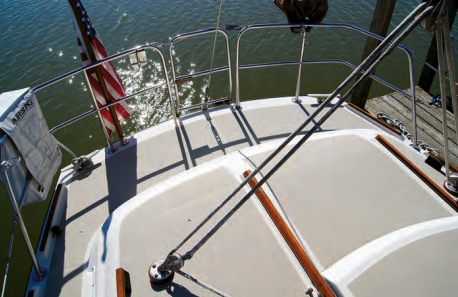
Aft of the cabin is a nicely sized and obstruction-free fantail or aft deck that allows easy access to the centerline boarding/swim ladder. A pair of 10-inch open-throat mooring cleats are mounted outboard.
Double lifelines (single was standard equipment) connect the stainless-steel bow and stern pulpits. Deck surfaces have molded-in non-skid and a teak-capped toerail is a valuable safety feature.
Belowdecks
The accommodation plan is straight-forward. In the forward cabin there’s a V-berth with a removable insert, lockers, a vanity with a mirror and drawers, a little floor space for a changing area, and a surprising 6-feet 1-inch of headroom. More stowage is located beneath the berth and outboard and above it. A solid-teak folding privacy door closes off the cabin from the rest of the boat.
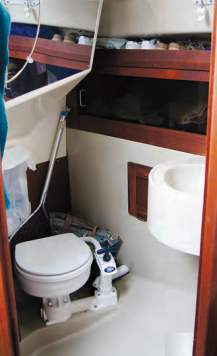
Aft and to port of this cabin is a rather small head compartment. The vanity, sink, and a couple of handy storage lockers are all part of a fiber-glass unit, but there is still a significant amount of teak trim. To protect this from water damage when showering, Dave and Tina installed a shower curtain on a track. Pressurized hot-and-cold water is a standard feature. To starboard of the compartment is a large hanging locker.
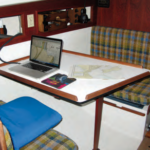
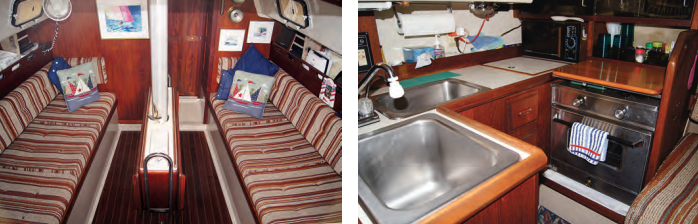
Another solid-teak folding door opens onto the saloon, which is quite conventional with its port and starboard opposing settee berths and centerline drop-leaf table. It has 6 feet 4 inches of headroom. With the seatbacks down, the settees measure 76 x 30 inches. Raising the seatbacks increases the settee width considerably and gives access to a novel storage area that’s great for soft gear such as bedding and bulky clothing. Above both settees are shelves behind deep fiddles that incorporate handholds. More handholds are fitted to the overhead. The holding tank for the forward head is beneath the port settee along with a small storage area. Storage bins under the starboard settee lift out to reveal additional stowage beneath.
The centerline drop-leaf table surrounds the keel-stepped mast. It is supported forward and aft by stainless-steel handholds and has a pair of spirits lockers built in. Four large opening portlights plus an overhead hatch contribute light and fresh air.
Aft of the port settee is the U-shaped galley, which houses a gimbaled two-burner alcohol stove with oven, a pair of individual stainless-steel sinks (one deep, one shallow) with pressurized hot-and-cold water, and a collection of bins, shelves, and a series of drawers for galleyware and dry-food storage. Not wanting to rely solely on the alcohol stove, Dave built in a microwave.
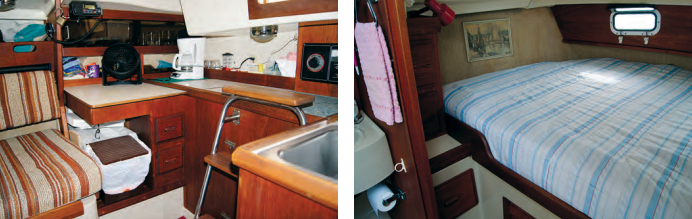
The galley counter spans the entire aft bulkhead and ends on the starboard side with a small aft-facing chart table. A portion of the counter is one of the companionway steps. Beneath the starboard end of the counter is the 6.3-cubic-foot icebox. Like most iceboxes of the era, this one could benefit from additional insulation, especially for cruising in warmer climates or if refrigeration is to be installed.
Just two steps down from the cockpit is the aft cabin and the defining feature of the O’Day 37. Under 6 feet of headroom it contains an athwartships double berth, stowage galore in the form of a hanging locker, shelves, bins, and drawers, and its own head. Six opening portlights, four in the cabin trunk and a pair in the transom, add light and cross-ventilation. The steering gear and some additional stowage are beneath the bunk.
While a little on the small side, the head provides all the necessary amenities in a self-contained fiberglass unit. An optional overhead hatch improves the overall atmosphere by admitting light and air. Just as they did in the forward head, Dave and Tina added a curtain track and shower curtain. Dave also replaced the plastic-backed mirror that had warped and produced a “fun house” effect. The head’s 15-gallon holding tank is on the starboard side, sandwiched between the hull and the liner.
The rig
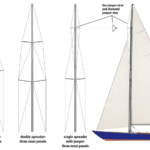
The O’Day 37 is a masthead sloop with a single set of airfoil spreaders. The keel-stepped mast is supported by three sets of shrouds (uppers and double lowers) and a single backstay. All halyards are sheaved internally and are made fast at the base of the mast adjacent to a pair of Barlow #19 halyard winches. The mainsail, which came standard with two sets of reef points, is sheeted at the end of the boom to a triangular block and tackle (Crosby rig) mounted on the aft cabintop and controlled by another Barlow #19 winch. The headsail sheets are led aft through turning blocks mounted on tracks located directly outboard of the cockpit and from there to Barlow #25 primaries.
The rigging on Windermere is near original with just a couple of exceptions. A self-tailing winch and a pair of rope clutches were mounted on the starboard aft edge of the main cabintop. The main halyard and the first reef were then led aft. Also, a boom vang (optional equipment) was installed.
Under way
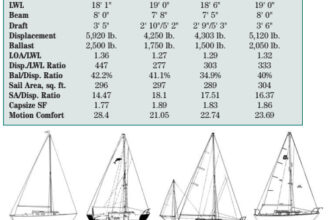
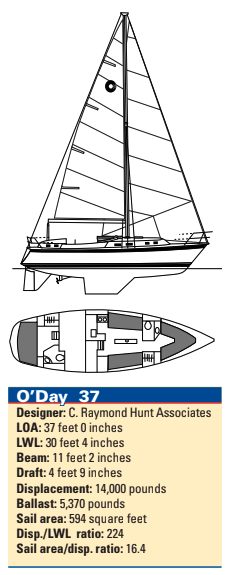
According to Dave, the boat’s best point of sail is a beam reach. With that said, he added that starboard tack seemed better than port tack. He suspects it has something to do with balance and all the tankage on the starboard side. At about 10 knots of wind, the boat starts strutting her stuff. When the wind approaches 20 knots, Dave is reefing. Both Dave and Tina feel that the boat is reasonably close-winded and dry when going to weather. Neither of them enjoys down-wind sailing. With a bit of wind, the boat tends to hobbyhorse some but it tracks well. The sail area/displacement ratio of 16.4 and the displacement/length ratio of 224 places the O’Day 37 in the category for which it was designed, a coastal cruiser, although it has been taken on offshore passages (see “O’Day 37 owner comments”).
For auxiliary power, the O’Day 37 has a 32-horsepower Universal M40 4-cylinder diesel. Dave has yet to encounter sea conditions that this engine couldn’t push the boat through. In reverse gear, the boat exhibits severe prop walk to port. Access to the engine for maintenance is poor. Gaining access to the front of the engine requires removing the companionway stairs and a panel behind them and crawling over the boat’s three batteries. Access to the aft end is better, via the steps and a panel in the aft cabin.
Things to check out
Not only Dave and Tina but also every O’Day owner I spoke with had one word of criticism: leaks. The flush-mounted forward hatch is the main offender, especially around the polycarbonate window where it’s set into the frame. Other culprits are the deck prisms and the portlights. If rebedding them does not cure the problem, replacing them is the only solution.
Deck delamination, especially around the bow area, is a common malady. All areas around deck fittings should be checked for water ingress, either with a moisture meter or by sounding them out, or both.
When he installed the 120 VAC microwave, Dave discovered that the boat’s existing AC circuitry was inadequate. He corrected the problem by isolating the port and starboard circuits.
Conclusion
The O’Day 37 is an affordable coastal cruiser. Its center-cockpit configuration and accommodations make it great for living aboard and its design, construction, and basic components are above average for a production boat of its era. If that isn’t enough, it sails pretty well too.
Expect to pay in the region of $30,000 to $45,000 for a late-model O’Day 37 in decent shape.
Gregg Nestor , a contributing editor with Good Old Boat, has had a lifelong interest in all things aquatic. He and his wife, Joyce, are currently refitting, upgrading, and sailing a 1994 Caliber 35.
Thank you to Sailrite Enterprises, Inc., for providing free access to back issues of Good Old Boat through intellectual property rights. Sailrite.com