Shelter for a cockpit that’s active in winter
Issue 92 : Sept/Oct 2013
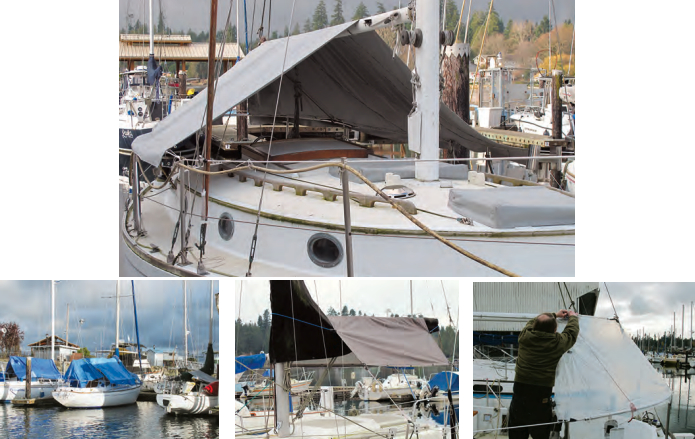
Blue plastic hardware-store tarps appear in our marina about the time mushrooms sprout in the nearby woods. Slung over booms and lashed to lifelines and cleats with leftover line, bungees, and bits of string, some are better than others . . . but most are quick improvisations. They are often too short or hung too high to provide much shelter. Many are torn to shreds by the first heavy wind. I’ve replaced mine annually without noticeable improvement in its form or function. This year, I thought I could make a better tarp.
Design desires
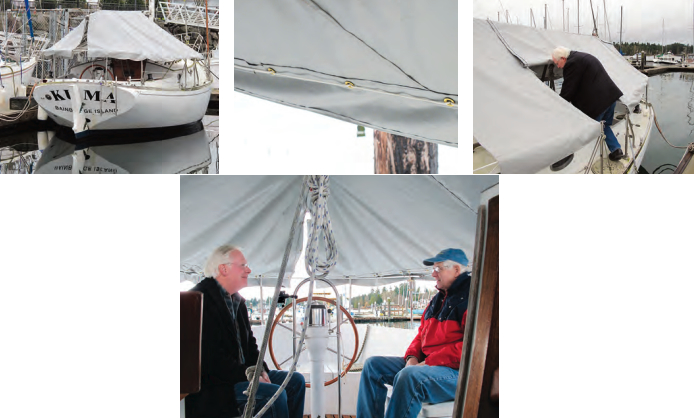
During the winter months, while my boat is still in the water but the sailing conditions are somewhat less enticing, I would like to be able to work on projects on a chilly afternoon in a cockpit with standing headroom, sheltered from the worst of the wind and rain. Basically, I wanted a snug, better-fitting tent slung over the boom and attached to the lifelines from forward of the companionway to the curving pushpit. It would be tightly lashed through solid brass grommets to reduce flapping in a blow. The tent would protect instruments, the binnacle and wooden wheel, the wooden cockpit sole, and the teak trim. The after end of the enclosure would be opened slightly to keep pressure from building up in the wind. I would be able to remove the cover without a lot of hassle for the occasional winter sail.
Another consideration was that I take turns with marina shipmates Jerry and David hosting semi-monthly coffee klatches in our boats. I fire up the Dickinson and we sit below telling lies about summers past and future. It helps us pass the winter months. But getting aboard under close-fitting boom tents is a chore that requires awkward bodily contortions, weaving through a maze of lines, and/or partial removal of the tarpaulin. For the sake of my guests, I would have a “door” built into the cover that could be zippered open from the outside and closed from within the cockpit.
Material considerations
To get all this done, I found an upholsterer, Terry McDonald, who’d done good work for me in the past. I showed him some sketches I’d made to get at the main idea. To help keep the cost down, Terry suggested a vinyl-coated polyester material called Sea-Tarp. This industrial-grade material costs about 25 percent less than Sunbrella. He’d used it when building a watch tent for a Coast Guard cutter and it worked out well. Sea-Tarp comes in several colors, including a gray that matches my boat’s cove stripe and canvas. At 18 ounces a square yard, it is about twice the weight of Sunbrella and has good strength, abrasion-resistance, and cold-weather characteristics. We also thought the smooth vinyl surface might confound the daily efforts of herring gulls and blue herons to mess about with the boat. I would give it a try.
Construction concerns
Terry took measurements and worked up a cost estimate. We talked about size and positioning, grommets, lashing versus attaching it with hooks, the zippered opening, and anything else we could think of. The next day, he called with the estimate. It seemed reasonable and we decided to go ahead.
Terry brought a sheet of Sea-Tarp that we draped over the boom and lifelines so I could get an idea of what it would look like. He also brought a sample of the edge treatment complete with 16-gauge grommets and an idea for a flap that would extend over and below the upper lifeline by a few inches to provide a little more protection from slanting rain. After considering individual hooks to secure the cover to the lifeline and pushpit, we settled on a lashing system that, though a little less convenient than hooks, could be anchored more securely. It was also cheaper and stronger.
Terry made patterns of thin plastic sheet for the difficult shape at the aft end, from the end of the boom to the curved pushpit rail. We agreed upon a price and Terry went back to his shop to sew up the cover.
Rigging it right
Designing a better tarp is one thing; rigging it properly is quite another. We slung the completed tarp over the boom and decided on the lashing method shown in the photographs.
We’ll try others until we get it right. We found that centering the boom and tarp on the centerline of the boat and drawing up the lashing evenly on both sides is critical to keeping the wrinkling to a minimum. This is best done by two people to avoid bunching between grommets. Time will tell whether or not we should add some grommets and line to the leading edge to reduce flutter.
In appearance, our cockpit enclosure is not as elegant as a nicely fitted cockpit dodger but it looks better than any of my succession of run-of-the-mill cockpit tents. It certainly provides more protection. All in all, this better tarp is a snug shelter that should see us through many winters.
Richard Smith, a contributing editor with Good Old Boat, is an architect. He specializes in designing and building very small houses and has built, restored, and maintained a wide variety of boats. He and his wife, Beth, sail their Ericson Cruising 31, Kuma, on the reaches of Puget Sound.
Thank you to Sailrite Enterprises, Inc., for providing free access to back issues of Good Old Boat through intellectual property rights. Sailrite.com