. . . and an International Folkboat feels the love
Issue 98: Sept/Oct 2014
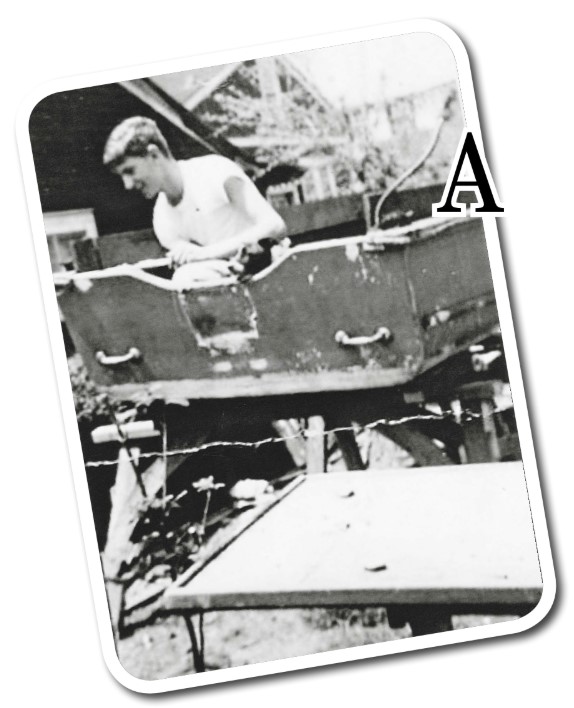
It’s my belief that an obscure gene compels some of us to complicate our lives with elderly boats. In my case, it first appeared when I was a teenager, drawing me to a pre-1955 outboard runabout my older brother Henry had found half-sunk in New York’s Coney Island Creek.
The boat was one of the early experiments in fiberglass, finished without the benefit of gelcoat and painted bright blue on the outside and red on the inside. Unencumbered by any experience in boat restoration, I spent the next six months scrounging scrap plywood for seats and improving frames to reduce the old boat’s alarming tendency to flex.
Although it never won any prizes, that little runabout gave me a summer of fun and taught me not to fear taking on projects that others thought foolish or hopeless. Even better, when I sold the boat the next spring, it helped pay for my first year in college.
The old-boat gene was dormant over the next three decades, subdued by the demands of family and career. It was not until the early 1990s, a few years after I retired from the Navy, that it struck again — and with a vengeance. At a time in life when I was at loose ends, I came across a 1961 Alberg 35, a true handyman’s special with decks so saturated they squished. “Make an offer,” the broker suggested, “They’re about to give it to the Sea Scouts.”
My lowball offer was accepted. I renamed her Invincible Summer, from an Albert Camus quote I’d always loved. The project was a moveable feast. It began at a little yard in Yorktown, Virginia, continued after the boat was trucked over the mountains to a spot behind our barn in Kentucky, and was finally completed (if “complete” can ever describe an old boat) after we moved to our new home in Charleston, South Carolina. Before long, though, I began to realize that, while varnishing, cleaning, and upgrading stretched ahead endlessly, getting away from the dock for a sail was becoming more of a challenge each year.
In the end, my insurance company and the marina management made up my mind for me by raising the cost of owning Invincible Summer beyond my tolerance level. It was time to sell. The decision, taken with sadness and reluctance, turned out to be a wise one. Invincible Summer went at a fair price to a knowledgeable, experienced sailor and, for the first time in almost two decades, I was boatless.
Switched on again
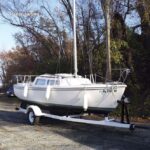
But not for long. Within a few months the old-boat gene, lured by the siren song of eBay, led me to a tired old 1967 Boston Whaler 13 that cried out for rescue. Then, as work on the Whaler progressed, I was tripped up again by another eBay offering: a sweet 1976 Marieholm International Folkboat, a design I had long admired. Frihet was one of the fiberglass models of the classic design by Tord Sunden, introduced in the 1970s and built until the mid-’80s. A lot of restoration work had been done, but it had apparently ended suddenly during the main cabin’s renovation.
Cosmetic, I told myself. All minor stuff. And I placed my bid. It won and, just like that, I was back in the old-boat business. Frihet was shipped to Dolphin Cove Marina, one of the last DIY boatyards in the Charleston area, and within a few weeks I was waxing the hull and admiring the new dark green bottom paint. I’d had a fleeting urge to sand and paint the bottom myself, but old memories of paint dust in my hair, skin, meals, and bedding made me pause and surrender to the wisdom and privilege of age. I let the yard do the work.
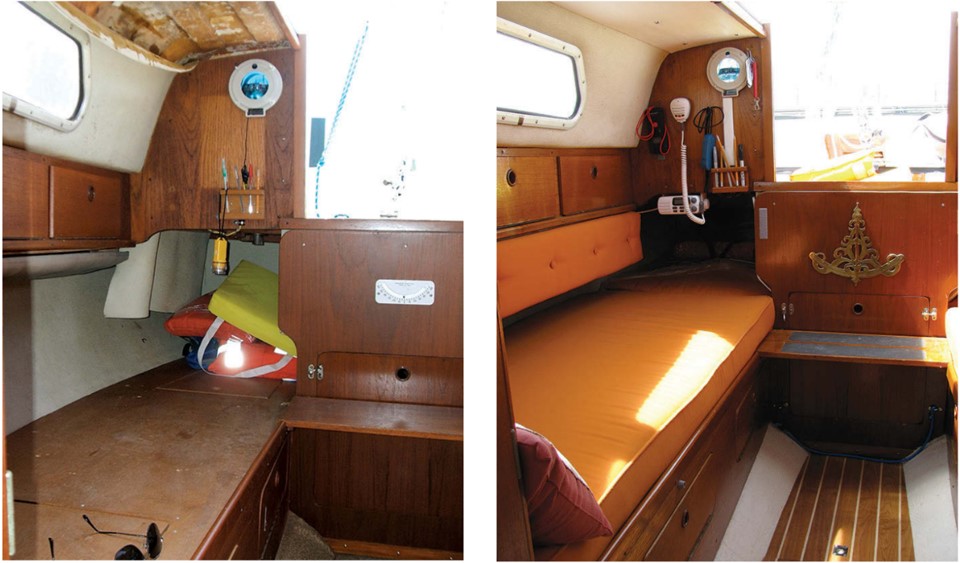
Once the boat was back in the water, an inspection confirmed that my first impression had not been too far from the mark. The hull and rig were sound, the sails had been professionally cleaned, and the renovation work already done was careful and neat. The interior, though, was a bit shabby. The headliner was gone from the overhead and the material covering the cabin sides hung in forlorn strips over faded green bunk cushions. Tan plastic flooring curled up around the edges of the cabin sole and the oiled teak bulkheads showed the tracks of old leaks and long-gone fixtures. It was a depressing sight, suggesting to me each time I opened the companionway hatch that I owed Frihet more care than I had so far given her. “Restraint,” my sensible self said. This boat was not going to be a long, expensive project. “Cosmetic,” I kept telling myself. “Cosmetic, realistic, and modest.” But no cutting corners. And that’s how the work began.
Easy does it
The teak brightwork below had originally been finished with some unknown product that had aged to a dull, muddy brown. Stripping and varnishing it was beyond my “modest and cosmetic” boundaries. Instead, I scrubbed the brightwork with household cleaner, rinsed it, and wiped it down with paper towels saturated with mineral spirits. Still not sure of what the original finish was, I lightly sanded one small spot and applied a few test coats of Minwax semigloss polyurethane, my favorite belowdecks varnish. After a few days, it was apparent that the varnish was adhering and drying normally and the teak would need no further prep work beyond a light sanding and a final wipedown with mineral spirits.
The forward bulkhead of the main cabin was another story. Both port and starboard sections were disfigured by screw holes, cutouts for long-gone equipment, and an assortment of water stains. Again seeking the simplest fix, I fastened new 1⁄8-inch teak veneer over the old bulkheads. I finished all the interior teak with four coats of satin finish Minwax.
The next challenge was the sorry state of the hull liner that had become separated from the hull at various places and drooped like a flag at half mast. My first instinct was to tear out all the old vinyl, clean the surface, and install new material. The thought of that task was not appealing. It would require chemical adhesive removers, scraping and cleanup of the resulting goo, and application of fresh adhesive before fitting new material. I could see myself in the hot little cabin in the middle of a South Carolina summer, wrestling with sheet vinyl and addling my remaining wits with toxic chemical fumes. There had to be a plan B.
Upon closer inspection I noticed that, although the original adhesive had broken down in some areas, it was holding up well in others. I would need to repair only the bad areas and let the good adhesive stay in place. I cleaned the old liner and the hull sides where the old system had failed, then sprayed the cleaned areas with 3M Super 77 adhesive and reattached the old liner. For overhead areas over the quarter berths and places where gravity worked against me, I used improvised braces and props to hold the liner in place while the new adhesive set up.
Tick stick and patterns
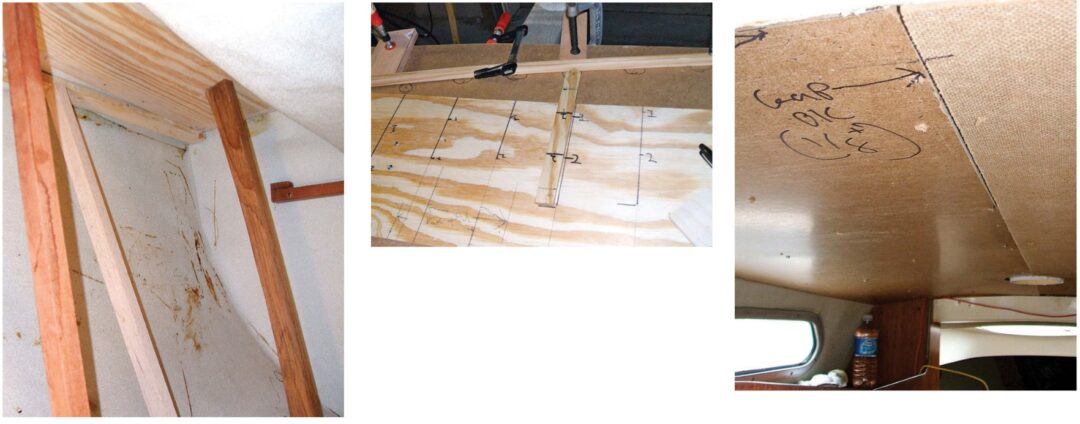
The overhead in the main cabin was a bigger problem. The original headliner material and rigid backing had been removed and discarded. Fortunately, the liner material was still adhering to the cabin trunk sides and was usable after re-gluing with Super 77. The uneven top edge would be hidden once new overhead material was in place.
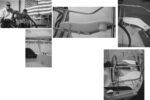
I used the traditional boatbuilder’s tick stick system to transfer the overhead lines to a pattern, marking off a series of points from the centerline to the outboard edge to establish the curve of the overhead for the port and starboard halves. Then I laid the lines out on sheets of Formica countertop laminate from the local DIY store. This would be the rigid backing for the overhead material. Staff at a helpful paint and wallpaper store found vinyl wall covering that was close enough in texture. With their help, I matched the color with an industrial acrylic latex paint. I glued the new vinyl to the port and starboard Formica sheets with Super 77 and painted them with the acrylic paint.
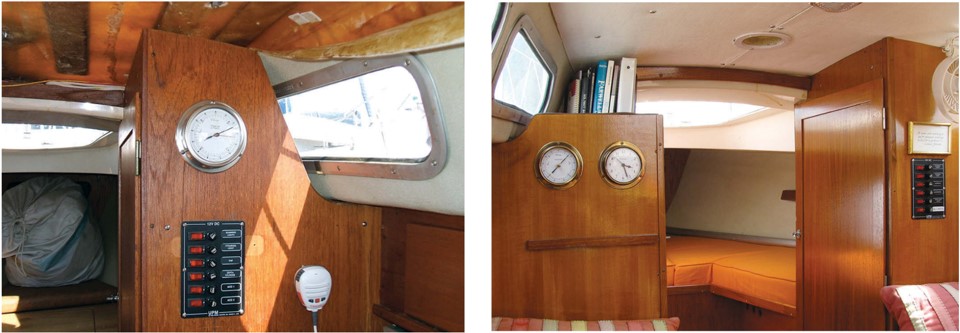
The original overhead material had provided no heat insulation and on hot days Frihet’s interior was a sweatbox. I decided to try reflective foil insulation. The brand I used, Reflectix, consists of a 5-mm layer of foam sandwiched and loosely fastened between two layers of aluminum foil. I fastened it to the backside of the new Formica overhead panels with double-sided foam tape. While 5 mm of insulation is not a lot, the Reflectix seems to have lived up to its billing. It keeps the cabin interior at least bearable in summer. It was certainly worth the effort.
I installed the new overhead panels with trim washers and self-tapping stainless-steel screws driven into the longitudinal plywood stiffeners. The color and texture match between the old vinyl hull liner and the new overhead panels was close enough to fool all but the most critical eye.
Sole remaining task
I’d ordered new interior cushions and backrests in persimmon orange and, once they were installed, the renewal of Frihet’s interior was one step closer to completion. Unfortunately, the freshly varnished teak, new overhead, and bright upholstery made the dingy cabin sole stand out. A nubbly tan vinyl material, with a pattern reminiscent of a 1950s diner, covered the sole and extended up into the curve of the hull. I hadn’t thought much about replacing it but, with a little creative rationalization, I convinced myself that the job would be, well, sort of cosmetic and, by many standards, sort of modest too.
So I set about it. The vinyl was already loose enough to rip out by hand. The adhesive was long dried, sparing me the job of using a smelly chemical to remove old goop. Now, though, I had to decide on something to replace it.
I don’t much like carpet, but a teak-and-holly sole would require a prohibitive amount of money and effort and still leave unsolved the problem of covering the curved hull sides.
I decided on a combination and a compromise. I recalled seeing synthetic teak decking in the March 2011 issue of Good Old Boat. The brand I chose, NuTeak, is a 4-mm-thick PVC-based material that looks convincingly like the real thing. It’s sold in 3-foot lengths and is available in 2 1⁄4-inch-wide planks with separate 1⁄4-inch-wide imitation holly strips, both with grooved edges for a good fit. It can be cut easily with a utility knife.
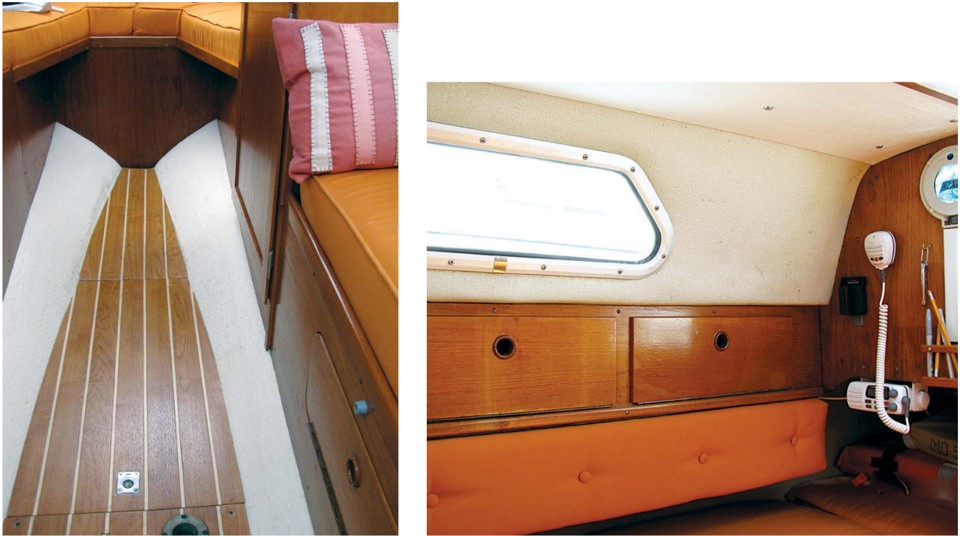
I made patterns from heavy contractor’s paper, picked up the removable floorboards, and brought everything home for ease of assembly. I cut and dry fit the NuTeak planks to the paper patterns at home, then disassembled them for final installation on the boat. I used the special adhesive sold by NuTeak that has a working time of about 15 minutes, more than adequate to lay and align the planks and strips.
The curved hull sides above the sole presented a minor problem until I remembered I had some Ultra Tuff non-skid paint left over from the Boston Whaler job. It produces a finish that’s rough but not painfully abrasive (see “Fresh Traction on an Old Deck,” July 2009). After sanding, I applied a coat of Ultra Tuff primer then two coats of the non-skid itself, tinted pale beige.
Finishing touches
The job was now essentially done. A pair of bright throw cushions from IKEA and my brass clinometer and old clock and barometer from Invincible Summer gave a final “decorator touch” to my modest restoration and reminded me of the continuity between the old boats that had claimed me. In the end, of course, the job turned out to be much less modest, more expensive, and more challenging than I had originally planned. But then, I suppose I knew all along that was going to happen.
The demands of the old-boat gene were placated . . . for now.
Ken Jacobsen rescued his first old boat and restored it to working order at the tender age of 16 and still hasn’t learned his lesson. When he retired after 26 years as a seagoing naval officer, he began a new career as a freelance writer and defense analyst. He lives in James Island, South Carolina, and sails his 1976 International Folkboat, Frihet, out of the Cooper River Marina in Charleston, South Carolina.
Thank you to Sailrite Enterprises, Inc., for providing free access to back issues of Good Old Boat through intellectual property rights. Sailrite.com