A well-earned renovation for a well-used boat
Issue 92 : Sept/Oct 2013
When Ken and Ginny Reinink decided to buy a good old boat, they had a list of criteria. The boat had to be the right size for two people to easily handle, it had to have a wheel rather than a tiller, and it had to have a diesel engine and standing headroom. At the top of the list was that it had to be trailerable. Ken and Ginny wanted to be able to tow it from their home in lower Michigan to their favorite cruising grounds on the northern end of Lake Michigan.
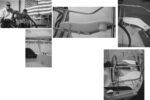
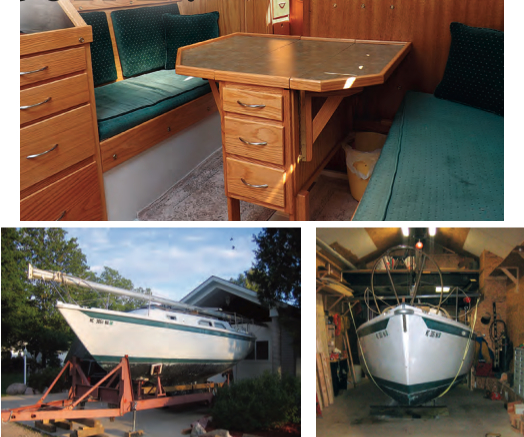
They looked at Catalinas, Cals, Morgans, Bayfields, and boats from many other builders before they found and bought a 1977 Ericson 27. “Wait a minute!” you’re probably thinking, “The Ericson 27 was never designed to be trailerable.” Well, it wasn’t. But that didn’t stop Ken from acquiring the boat and designing and building a custom trailer that allowed him to rig, launch, and retrieve his 27-footer just like he would a Catalina 22.
To make an Ericson 27 trailerable, Ken had to build a trailer. In fact, he built two. The prototype left something to be desired but, based on lessons learned with that one, Ken created his masterpiece. This trailer sports tandem axles, each capable of carrying 6,000 pounds, giving it a total load capacity of 12,000 pounds. The trailer itself weighs 3,500 pounds and has no problem hauling the 6,500- pound Ericson 27. Several Ph.D.s from Ferris State University in Big Rapids, Michigan, assisted him by calculating the rig’s center of gravityand made recommendations for the safest way to load the boat on her new trailer. The final tongue weight is only 1,650 pounds.
Ken’s ingenious design includes a sectional tongue extension, a self-centering loading technique, and a special safety board that automatically secures the boat once it’s loaded. It also has customized anchor rings for tie-down straps and storage space for all the components directly on the trailer.
A proper boat shed
Ken and Ginny bought Reinsnest in 1990 and sailed her as she was until 2006. Then the boat went into Ken’s building shed for her five-year refit.
Yes, not only did Ken design and build a special trailer for Reinsnest, he also constructed a special building shed that included, among other unique features, a “keel pit” reminiscent of lube pits once found in gas stations in the 1940s and ’50s and in some oil-change operations to this day. With the keel in a pit, the deck could be closer to floor level, making it much easier to get materials aboard. As the project eventually lasted five years, Ken figures he saved more than four miles’ of climbing up and down a longer ladder.
In addition to the creative touches Ken added to the boat, the shed itself is a work of genius. It’s 16 feet wide, 38 feet long, and 14 feet from the floor to the ridge. The keel pit is 4 feet wide, 4 feet deep, and 20 feet long. A steel I-beam, 6 inches wide, 16 inches deep, and 35 feet long, runs along the ridge. Two chain hoists, each capable of lifting 6,000 pounds, are positioned along the beam.
To set up Reinsnest in the shed, Ken places her on the trailer over the keel pit and passes nylon straps from each of the hoists under the hull. He then lifts her off the trailer and lowers her into the keel pit. Once she’s secured on adjustable stands, Ken can get to work on any project he may have in mind. The shed is heated and fully equipped with tools so work can proceed year-round.
The refit begins
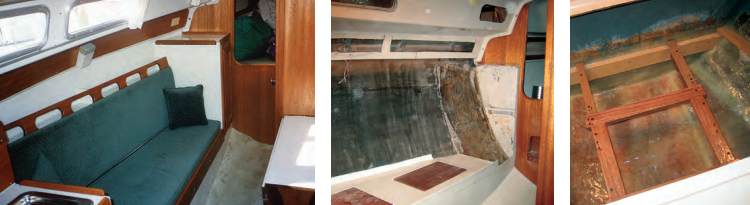
Ken began his refit of Reinsnest after he and Ginny had sailed her for many seasons. First, he removed much of the original interior. Little was spared. From the V-berth to the galley, most of the furniture simply vanished.
While he was at it, Ken removed the original holding tank and water tanks. He molded in a new 30-gallon holding tank under the V-berth. To take further advantage of the space there, he installed a 25-gallon Todd polyethylene water tank directly on top of the new holding tank.
Ken replaced all the original wiring, increasing the number of circuits from five to 12, and installed a 12-volt fused panel with 12 circuits. He fitted a new stereo system with four speakers and a disc player, five new dome lights, a VHF radio, two new bilge pumps, and a 110-volt shorepower panel. While he was at it, Ken also installed a pressure water system and an onboard battery charging system.
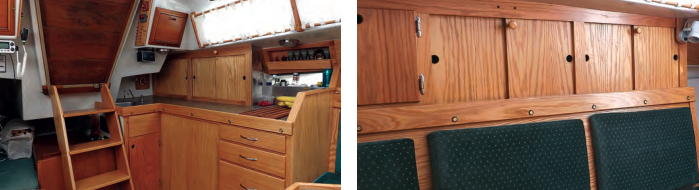
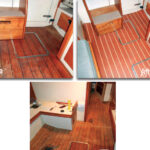
For the new furniture, Ken selected red oak as his building material because the lighter wood tones would give the finished interior an open, light, and airy atmosphere. It was also readily available at a reasonable cost.
On the port side, Ken removed the original hanging locker, settee back, storage shelf, and a portion of the galley counter to make way for his new design. On the starboard side, he removed the dinette table, settee back, and storage areas.
The port-side renovation began with the construction of a new double hanging locker with a clothes hamper and drawers beside it, all in the space occupied by the original hanging locker. Then he shortened the original port settee to allow for a 2-foot extension to the galley that now houses a stove and a new water-cooled refrigerator. Additional storage is located above and below the counter. The new galley arrangement triples the amount of storage. A new spice rack is also part of the redesigned galley.
Ken came up with many innovative ideas for additional storage space. He rebuilt the port and starboard settees, adding storage behind and beneath both. Lockers behind the settee backs are closed by unique “drop in and lock, lift up to remove” panels covered with the same fabric used for the settee cushions. Storage areas above the seats and beneath the sidedecks are secured with a retaining-pin locking system of Ken’s design.
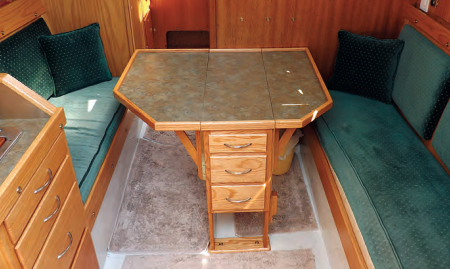
The original dinette table went the way of the original hanging locker and holding tank. Its replacement has two leaves with fiddles and three drawers built into the center section. Ken also fitted a support on it for the starboard settee that slides out to make a large single berth. He re-surfaced the table and all the countertops with Formica.
In the final phase of the renovation, Ken replaced two of the original portswith Bomar 2000 extruded-aluminum opening ports, one in the head compartment and one on the port side in the main cabin. To do so, he had to enlarge the original openings, but the result was much-improved ventilation.
Reinsnest now has a truly beautiful interior that even the original Ericson 27 designers would no doubt be proud to claim as their own.
Jim Shroeger has been sailing for 50 years. He began in Jet 14s at the University of Michigan and progressed through a series of small to medium-sized daysailers including a Star. In the early 1970s, he and his wife, Barbara, and their two kids began their summer family cruises on the Great Lakes, which they continue to this day in their current boat, Sundew, a Watkins 27.
Thank you to Sailrite Enterprises, Inc., for providing free access to back issues of Good Old Boat through intellectual property rights. Sailrite.com