Where there’s no wheel, there’s still a way
Issue 101 : Mar/Apr 2015
Numerous dining tables have been designed to fit on the binnacle consoles on sailboats with wheel steering, but on a tiller-steered boat, like mine, making a table and its support to accommodate the tiller presents challenges. It must not impede the full swing of the tiller, and in my case had to allow the tiller to hinge up when not in use. Another important consideration for me was the height of the table. To further complicate things, I wanted a table that was convenient to use, could be set up and removed easily, and was easy to store below.
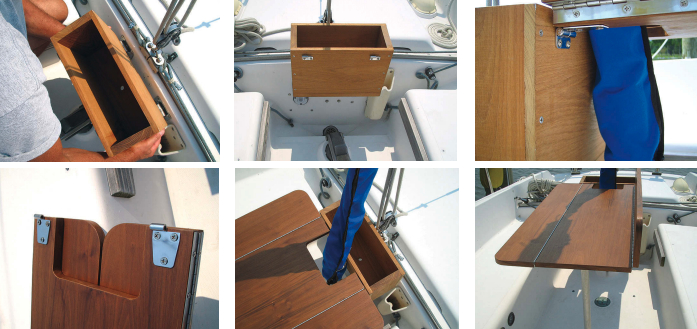
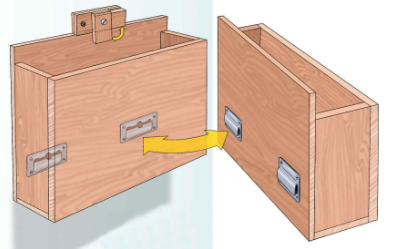
For starters, I needed to bridge the distance in the cockpit between the base of the tiller and the cockpit’s aft bulkhead. I decided an open teak box could bridge the gap, hold food-service items, establish the proper height for the table, and provide a sturdy place for attaching the aft end.
While seated in the cockpit, I used a tape measure to establish the height the table needed to be based on knee clearance. With that measurement in mind, I designed the teak condiment box as an integrated accessory for the table. The table would mount directly to the box. The overall size of the box that works best for my boat is 14 x 5 1⁄2 x 8 3⁄4 inches, but other boats will be different. I used 1⁄2- x 14-inch teak for the front and back of the box and 3⁄4-inch teak for the ends and bottom. I added a drain hole in the center of the bottom of the box for ease of cleaning.
Easy fit, easy stow
The next design consideration was to make the table so I could set it up and put it away without using tools. I used stainless-steel table brackets, mounting the bracket receivers (they are pintle-and-gudgeon style) on the
aft bulkhead in the cockpit just ahead of the lazarette. I mounted a second set of bracket receivers in the hanging locker in the cabin so I can store the condiment box there.
My design for the box allows the tiller, when pivoted to its vertical position, to clear the front face of the condiment box. To attach the table to the box, I used a pair of stainless-steel pull-apart hinges, with half a hinge on the box face and the mating hinge fastened to the underside of the table. For stability, I spaced the hinge halves as far apart as possible.
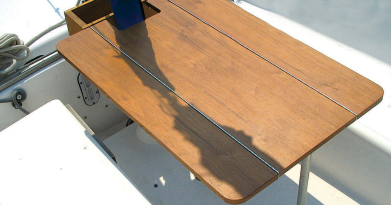
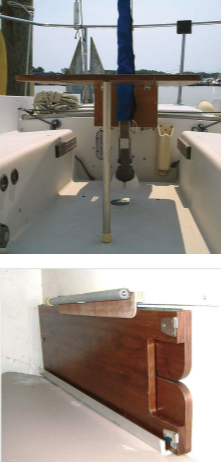
I built the table of 3⁄4-inch walnut-veneered plywood that I happened to have on hand, and it matched the teak condiment box well enough. The table when open is 24 x 36 inches. Its fixed face is 12 x 36 inches and it has two 6- x 36-inch folding wings attached with 36-inch-long stainless-steel continuous hinges, also known as piano hinges. I notched one end of the table’s fixed face to accommodate the tiller in its stored position. I completed the tabletop by covering the edges with veneer edge-banding tape (available in hardware stores), then finished it with clear polyurethane.
Single support leg
Rather than fitting two legs at the corners, I made a single aluminum-tube leg for the forward end of the table, which makes it easy for a body to slip in and out with the table in place. I centered a 1⁄4 x 20 female threaded insert on the underside of the forward end of the table to receive the 21 1⁄2-inch-long, 1-inch-diameter aluminum tube, into which I fitted a 1⁄4 x 20 male table-leg insert. (These threaded inserts for tubing are readily available in hardware stores, and some are available as either female or male fittings.) To finish off the bottom and to protect the deck, I added a 1-inch-ID rubber foot over the tube.
I store the folded tabletop below-decks on supports attached to the inboard vertical face of the quarter berth on the starboard side. The leg snaps into a nearby plastic holder.
I used walnut plywood that I had in stock for the table. As alternatives to teak, I would recommend birch or oak plywood with matching veneer tape. These woods are cost-effective and readily available.
Gary Gerber, a retired industrial designer, has been sailing for more than 40 years in coastal New England, the Caribbean, and the Mediterranean. He lives in Annapolis, Maryland, and sails his 1970 Morgan 33 on Chesapeake Bay.
Thank you to Sailrite Enterprises, Inc., for providing free access to back issues of Good Old Boat through intellectual property rights. Sailrite.com