Sailing solo and being social
Issue 102 : May/Jun 2015
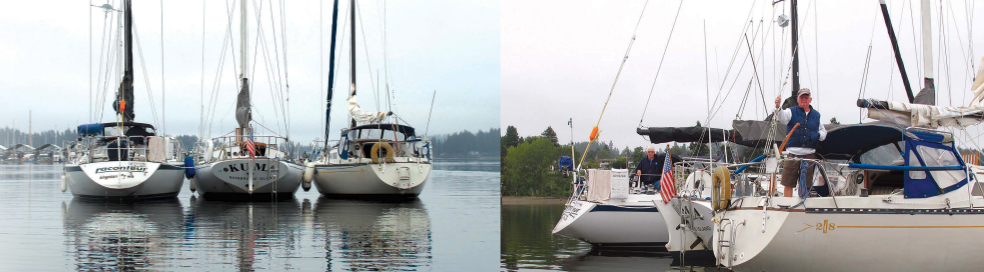
We three set off on an autumn day bound for nowhere in particular. Jerry in Raconteur, his race-worthy Ericson 32; Stuart in Over Easy, a well-found Islander 28 ideally suited to the singlehanded habits of her skipper; and I in Kuma, my trusty Ericson Cruising 31. Weather over Puget Sound and the Hood Canal was settled and the 10-day forecast showed clear skies and smooth seas with nothing more than 15-knot winds. There would be the usual morning fog in patches, burning off well before noon. Conditions were ideal for a three-boat raft.
Our first anchorage would be Manzanita Bay on Bainbridge Island. Rumor had it that Charles Lindberg chose this beautiful elongated harbor as the site for one of his homes. Its shape and location were ideal for landing a seaplane and, as a small-craft anchorage, it was well protected and had a good mud bottom. Because I knew Manzanita well, I would anchor Kuma and the other two boats would join up on either side of me. I chose a spot near the head of the bay to get good shelter and clear swinging distance from the shoreline, buoys, and other anchored boats. Because of the settled conditions and the bottom’s good holding, I thought a single anchor would be sufficient and we’d avoid the prospect of tangling lines.
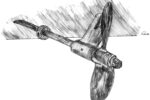
Finding a good spot, I slowly brought Kuma into the wind and shifted into neutral. When she was fully stopped, I went forward, dropped the Bruce, paid out rode to equal the indicated depth plus 10 or 15 feet more, and walked back to the cockpit. I gave Kuma a little reverse thrust before returning to neutral and, while she was making some sternway, I went forward again to pay out enough line to give us about a 4:1 or 5:1 scope at high tide. Back in the cockpit, and once Kuma was wind-cocked, I ran up to about three fourths throttle to dig in the anchor and called it done. We’d have about 5 feet under Jerry’s keel at low water.
Assembling the raft
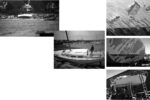
Once dug in, I signaled the others that all was ready. Stuart came up slowly from astern along my starboard side. We were careful to ensure our spreaders couldn’t touch. Rafted boats roll and pitch independently and the effects of that movement can cause mayhem. The rafting boat should provide the fenders and Stuart was well prepared. I added a fender of my own to keep it all snug.
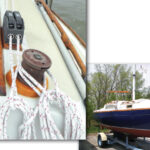
Kuma has a large bow mooring cleat that can handle the anchor line plus two additional bow lines. The boats rafted outside should be secured to the anchored boat at bow and stern and use long springlines as necessary to prevent them from moving forward or aft. Bow lines should be kept a little slack so the wind will tend to part the boats, easing pressure on the fenders and assisting a quick getaway should that be necessary. It is common sense to align the lifeline gates when practicable to ease movement between the boats, and also to keep sheets, halyards, mooring lines, and other lines and extraneous gear off the deck or stowed as neatly as possible. Moving about at night on boats other than your own can be especially hazardous.
Enjoying the benefits
Once rafted, we gathered in Kuma’s cockpit, admiring the fine situation and making sure we weren’t dragging. We planned to share the cooking. My wife, Beth, had sent us off with a hearty stew for dinner. I made a salad and provided the wine. With an average age of 71.33 years, we three sail with a variety of afflictions, none of which detracted from the sailing or the spirited company in the cockpit. Stuart was in charge of entertainment and provided a selection of movies, complete with subtitles for the aurally challenged.
We awoke to dense fog. Being on the middle boat, I couldn’t moor my dinghy to the rail overnight as is my habit. Instead, I tied her to Over Easy. Clambering over the Islander as quietly as possible, I stepped into the dinghy and made ready to go for an early morning row about the bay. I had conveniently secured the dinghy fore and aft to the Islander’s slotted toerail, but when I reached up to unbend the stern mooring line, I found my “somewhat original” knot wet with dew and impossibly jammed in the toerail slot. I climbed back aboard Over Easy and tried again. After about 10 minutes’ work with cold and arthritic fingers, I managed to free the line and shoved off. This is probably the best example I can think of for always using standard knots that can be easily released even when wet and tight.
After I had rowed about the bay, chasing seals and great blue herons and watching the mist move about the shoreline, I returned to the heady aroma of coffee. Picking up Stu, we stepped aboard Raconteur, where Jerry had prepared a good pile of fried Spam, eggs cooked to order, toast, and jam.
After breakfast, we enjoyed an informal race back to Kingston in some considerable breeze. To simplify things and learn a little more about our boats, we decided to compare our boats’ individual performances under genoas only. Each boat performed well both on and off the wind and the homeward trek was both more convenient and safer than it would have been if we were hoisting, trimming, lowering, and furling our mainsails.
Some may say rafting combines the disadvantages of singlehanded cruising with those of an over-socialized flotilla, but it appeals to many nonetheless. The number of boats involved is an important consideration. I prefer having just one or two other companion boats. Sailing your own boat without a crew provides a sense of independence and self-sufficiency that’s at the heart of cruising, but it’s good to know help is nearby should it be necessary. A smaller flotilla also provides a greater appreciation of individual efforts while under way and makes the occasion seem more special when anchored.
Richard Smith, a contributing editor with Good Old Boat, is an architect. He specializes in designing and building very small houses and has built, restored, and maintained a wide variety of boats. He and his wife, Beth, sail their Ericson Cruising 31, Kuma, on the reaches of Puget Sound.
Thank you to Sailrite Enterprises, Inc., for providing free access to back issues of Good Old Boat through intellectual property rights. Sailrite.com