A fun factor with a bonus safety feature
Issue 102 : May/Jun 2015
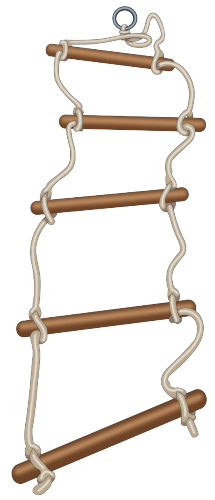
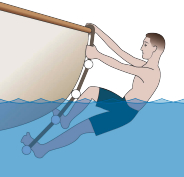
A boarding ladder not only gives sailors an easy way to get in and out of the water, but can also be a lifesaver after an accidental fall overboard. I’d like to be able to brag that I’ve never fallen overboard accidentally, but I did just that when anchored alone in a secluded cove and not paying attention to what I was doing. Fortunately, I had an emergency rope ladder. I reached up over the coaming, pulled it down, and climbed back on board.
Emergency ladders
Today’s emergency rope ladders are modern versions of the old Jacob’s ladder, named after the rope ladder the biblical Jacob used to climb to heaven. The Jacob’s ladder has been around for hundreds of years. Harbor pilots use it to climb up the sides of commercial vessels and it can also be used for recovering someone from the water.
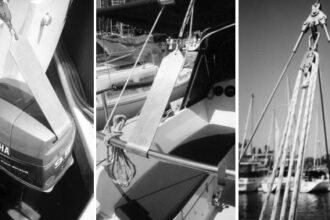
Modern emergency ladders used on recreational craft are made with synthetic rope and plastic rungs. They can be suspended from a cleat or stanchion base and folded on deck when not in use. On a high-freeboard boat, it helps to tie a length of nylon line to the bottom rung and leave this hanging over the side where someone in the water can reach it to deploy the ladder in an emergency.
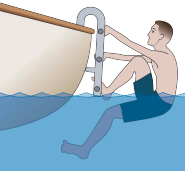
When someone attempts to climb a rope ladder, the lower rungs are forced under the curve of the boat’s hull. To reduce this tendency, the ladder should be placed where the hull sides are as vertical as possible, usually amidships. Since the ladder has no standoffs to hold it away from the hull, climbers with bare feet will find their toes get pinched between the rungs of the ladder and the hull.
Even though emergency boarding ladders have drawbacks, I think it would have been very difficult, if not impossible, for me to have gotten back on board without my emergency ladder, especially since I was fully dressed at the time.
Swim ladders
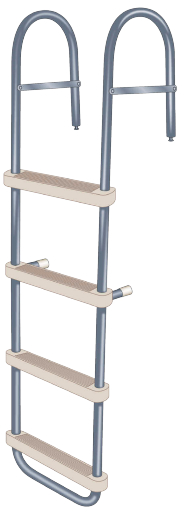
All boarding ladders should extend well below the water, with 2 to 3 rungs below the water as the minimum. Rigid ladders should have standoffs from the hull to prevent pinched hands and toes, and the treads should be as broad as possible and have non-skid surfaces. Rungs made of tubing are painful to use with bare feet, especially for heavy adults. Side rails that extend well above deck level make stepping from the top tread onto the deck much easier.
Most boarding ladders are difficult or impossible to use in rough seas. When a ladder is on the stern, it will be somewhat protected from wave action when the bow is pointing into the waves, but it will be more susceptible to the boat’s pitching motion.
Many ladders have a lower portion that folds or telescopes so the upper portion can be left in place and the lower portion raised out of the water when under way. A lower portion that can be reached and deployed by a swimmer adds another safety benefit.
Ladders are made from a wide range of materials, including wood, stainless steel, aluminum, structural foam, and plastic. The material selected will often determine whether the ladder will float if accidentally dropped overboard.
When purchasing a ladder, take into account the manufacturer’s rated weight limit.
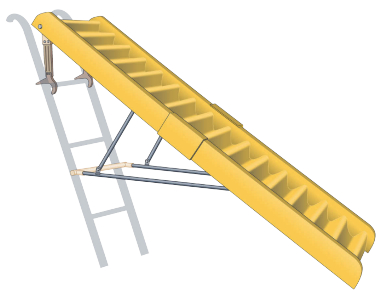
Boarding ladder variations
Gunwale ladders mount on the side of the boat and fasten to sockets on the gunwale or deck.
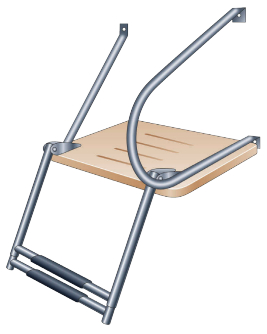
Transom ladders provide an easy and practical way of getting in and out of the water unless the boat is pitching in large waves. Some models of transom ladder incorporate a small platform. However, not all sailboat transoms will accommodate a ladder.
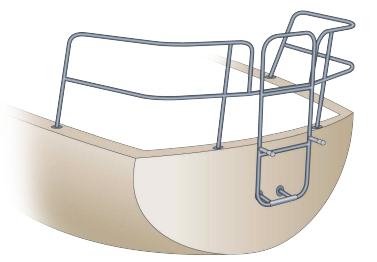
Swim platform ladders are often attached in a way that allows them to be folded up out of the water when under way. There are even canine boarding ladders available that mount on a stern swim platform or low transom.
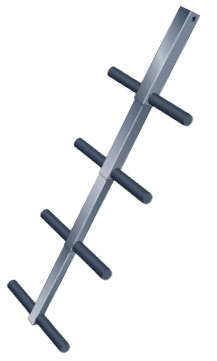
Center-pole, sport, or dive ladders have a center pole with steps off each side of the pole. On some models, the steps fold against the pole, making stowage easier, and some, even though made of metal, have positive flotation.
All in all, it’s good to have a ladder of some kind available for that time when you, too, find yourself swimming next to your boat, whether by accident or on purpose.
Don Launer, a Good Old Boat contributing editor, built his two-masted schooner, Delphinus, from a bare hull. He has held a USCG captain’s license for more than 40 years and has written five books. His 101 articles through November 2011 are available for downloading as a collection from the Good Old Boat download website. Look under Archive eXtractions at www.audioseastories.com.
Thank you to Sailrite Enterprises, Inc., for providing free access to back issues of Good Old Boat through intellectual property rights. Sailrite.com