A handsome design that excels as a cruiser and club racer
Issue 102 : May/Jun 2015
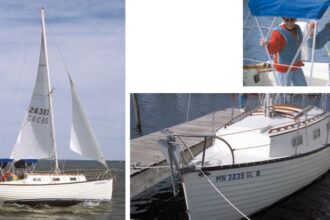
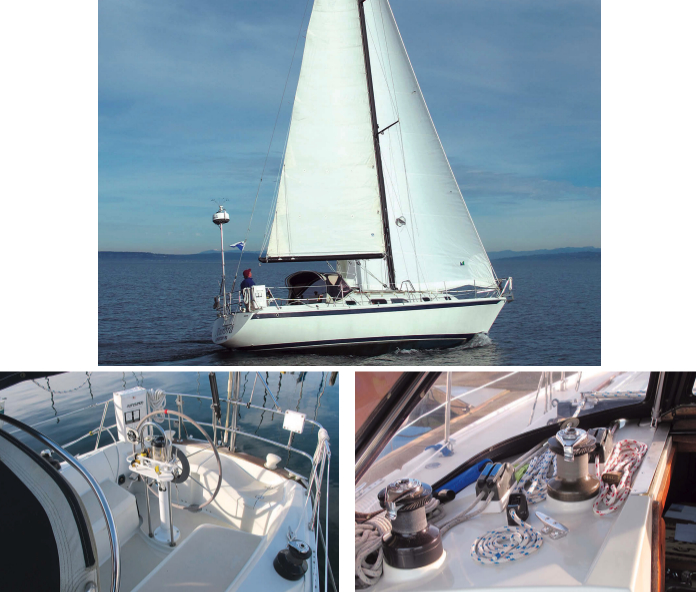
Boats designed by Bruce King for Ericson Yachts share a strong family resemblance, from the smallest of the line, the Ericson 23, to the largest, the flush-deck Ericson 46, and the many models in between. They all show the Ericson pedigree in a jaunty, sharply raked stem, a well-drawn transom, a graceful sheer underscored by a wide and contrasting sheer stripe, and freeboard and trunk heights carefully proportioned to produce a harmonious design.
Ericsons are also recognizable for their characteristic portlight shape. Bruce avoided extreme design features in favor of a more pleasing traditional stance that serves the practicalities of good cruising and racing.
Joseph Charnes, who bought his 1987 Ericson 34, Aurora, in 2011 after owning a succession of boats — including a Cal 21, Catalina 22, Santana 26, and Newport 27 — was drawn to the boat by its steadfast character. Approaching Aurora from dockside there is little doubt she’s an Ericson as she echoes features shared by so many sister ships.
Joseph and his partner, Ilse, both love this new boat, but in different ways. Joseph is a whitewater guide on the Wenatchee and Tieton rivers in eastern Washington and sails mainly in the fall when the whitewater expedition season tapers off. Ilse is uncomfortable on the water, but she likes nothing better than taking long weekend drives that end in a rendezvous with Joseph in an endless variety of interesting ports and anchorages. Joseph likes singlehanded sailing, but welcomes his partner aboard by preparing a good meal that he serves in a sunny cockpit or down below where it’s snug and cozy on an autumn night. They hike the island trails together during the days and find good restaurants before spending the night aboard.
History
Ericson Yachts had its beginnings in the 1960s. Although the history is convoluted, it appears that Mark Pitman and Del Walton purchased Ericson in 1965, but the names most commonly associated with the Ericson brand are Don and Gene Kohlman, who ran the company until 1990, when it finally ceased operations. Naval architect Bruce King joined the team in the late ’60s to design a long series of models, including the Ericson 23, 30, 35-2, and the 41. The Ericson 34, sometimes referred to as the 34-2, was in production in one form or another from about 1987 to 1996. Pacific Seacraft acquired the molds in 1991 and called it the 34-200.
Pacific Seacraft bought a few of the Ericson molds in 1991 and produced boats that carried the Ericson Viking insignia until that company, too, was sold in 1998. It’s a wonder that Ericson was able to continuously produce a high-quality product throughout such checkered times.
Construction
Construction of the Ericson 34 is consistent with good practice at the time it was built. The hull is a solid hand-laid laminate of fiberglass and polyester resin. The coachroof and deck are laid up with alternating layers of fiberglass mat and cloth and are balsa-cored. Plywood is substituted for the end-grain balsa core where deck hardware is mounted and unidirectional rovings are employed in high-stress areas. An aluminum rubrail is bedded and screwed to the toerail to fend off superficial damage and finish off the hull-to-deck joint.
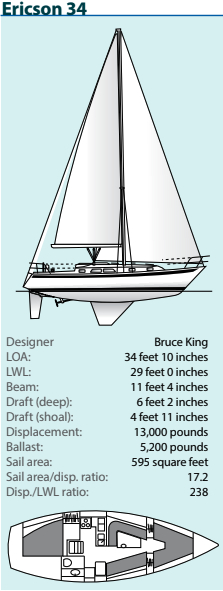
A hand-laminated fiberglass pan, that Ericson called the Tri-axial Force Grid System, is bonded to the interior of the hull to provide structural rigidity. As well as stiffening the hull, the TFGS supports the mast compression and rig tension forces and distributes the loads from the 5,200-pound lead keel, which is attached to the hull and the TFGS with 12 stainless-steel bolts. The grid also provides accurate alignment and support for the engine and anchors the bulkheads and furniture. Both the standard and shoal-draft keels are designed to NACA airfoil sections.
The 27-year-old Aurora is in remarkably good condition on deck and below, attesting to good construction and subsequent careful maintenance and handling by her owners. I could find no stress cracks in the gelcoat in high-stress areas or at tight mold radii in the cockpit coaming where they often occur.
On deck
Joseph maintains that there is a strong connection between running white-water in a heavy-duty inflatable and cruising a sailboat in the generally less boisterous Puget Sound. Reading the water is essential to getting the most out of the boat, whether avoiding rocks at high speed in a raft or chasing zephyrs to maintain speed in a sailboat.
Being well organized is equally important. I noticed how well Joseph took care of his mooring lines when leaving the dock and, later, how he neatly and almost unconsciously tucked halyard and sheet ends up under the dodger to keep them out of the cockpit. Eliminating clutter requires constant attention and is part of the satisfaction and joy this skipper takes in sailing his boat well.
At the bow, 10-inch mooring cleats are placed at openings in the toerail on either side of a large flush anchor locker. Similar cleats are located at the stern. The Ericson 34’s chainplates and genoa tracks are well inboard to facilitate close-winded sailing and the stanchions are snug against the toerail. Both of these features make moving fore and aft along the wide sidedecks easy and safe. The embossed gelcoat is in good condition and provides reasonable security underfoot, although the compromise between good traction and easy maintenance is always a difficult one. Aurora carries a 33-pound Seahook claw anchor with 35 feet of 5⁄16-inch chain and 250 feet of 1⁄2-inch nylon rode that runs over a heavy bracket and bow roller. This makes for some heavy lifting and an electric windlass has high priority on Joseph’s project list.
In the generously sized T-shaped cockpit, a “gull wing” hatch in the starboard seat gives access to a voluminous locker and the 25-gallon holding tank. A lazarette contains the CNG tank. Joseph is pleased to have the safer lighter-than-air stove fuel and he accepts that compressed natural gas is less available than propane — it requires a yearly trip across Puget Sound to Seattle for a refill.
The helmsman stands at the 36-inch wheel on a raised portion of the cockpit floor. Water drains, moat-like, around this steering platform and into the two cockpit drains.
The rig
The Ericson 34 carries a 250-square-foot mainsail and a 100-percent foretriangle of 345 square feet for a total sail area of 595 square feet. Aurora is presently equipped with a 130 percent genoa trimmed on two Barient #27 2-speed winches mounted on the cockpit coamings and handy to the helmsman.
The double-spreader mast is keel-stepped and supported by cap shrouds, intermediate shrouds, forward and aft lowers, a headstay, and single backstay. It’s a tall rig with a high-aspect-ratio mainsail befitting a close-winded boat. The mainsail is sheeted from the middle of the boom, which keeps the mainsheet out of the cockpit.
Control lines are led aft to either side of the companionway. The mainsail halyard is led to a Barient #21 2-speed winch mounted on the starboard side of the companionway alongside the boom vang control line and the mainsheet, which are handled by a Barient #21 2-speed winch. The traveler lines run directly through Spinlock rope clutches. Across the companionway, on the port side, a Barient #17 single-speed winch handles the first and second reefing lines, while the headsail and spinnaker halyards are worked by a Barient #21 single-speed winch. Rope clutches are mounted appropriately.
Belowdecks
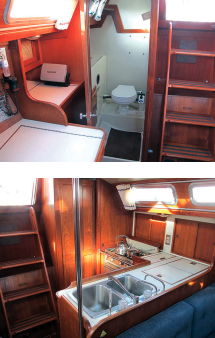
Stepping below, the first impression is of the generous use of teak in the bulkheads, cabinetry, companionway ladder, dining table, overhead handrails, and the trim around portlights and hatches. All the joinerwork is first class and finished to a high standard. The cabin sole is teak-and-holly plywood veneer. A white vinyl overhead and white laminate galley and nav station worktop surfaces balance the large amount of teak. Expansive views below extend forward into the forward cabin and aft to the bulkhead that separates the saloon from the head and quarter berth, creating an air of openness and light throughout the accommodations.
The V-berth is 6 feet 6 inches long, but Joseph prefers the quarter berth double located to port of the companionway ladder. It’s also 6 feet 6 inches long and convenient to the head on the other side of the ladder. The head location is also handy to the cockpit crew and a good place to stow foul weather gear. The nav table is forward of the head and incorporates a small electric refrigerator under its work surface. The galley is to port, opposite the nav station, and is fitted with a deep double sink close to the centerline, the two-burner CNG stove, an icebox, and good storage in a number of locations.
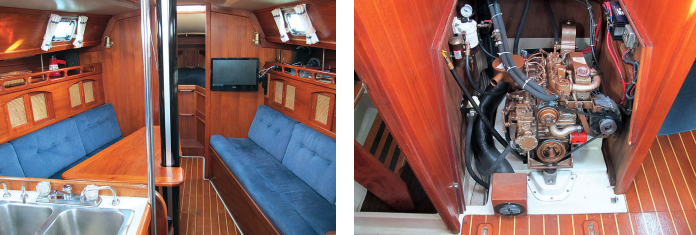
The large saloon table is fixed in place to port of the mast. A 22-gallon freshwater tank is under the port settee that makes up into a 6-foot 8-inch single berth. A 20-gallon freshwater tank is located under the starboard settee that can be arranged to provide a 6-foot 6-inch single berth. Storage spaces are built in behind and above the settees. A factory-option 25-gallon freshwater tank is located under the forward berths.
The engine
The standard engine fitted to the Ericson 34 was a 3-cylinder Universal M25 XP, 21-horsepower diesel. Access to the engine is gained by removing the companionway ladder and a plywood enclosure. A 30-gallon fuel tank is located under the quarter berth.
Some owners would like a few more horsepower to cope with more challenging wind and wave conditions, but others feel that the smaller M25, with its lighter weight and better fuel economy, is a good match for the boat’s fine sailing qualities.
Under way
The Ericson 34 backed out of her slip precisely, with as much control as going forward. I may have been overly impressed, as my own Ericson 31C with the scimitar keel has a will of her own when backing into wind and current.
We quickly cleared the ferry landing and entered the wide reach of Puget Sound between Seattle and the Kitsap Peninsula. I asked Joseph to go about things as he does when singlehanding, even though our friend Jerry Riggs, who owns an Ericson 32, was also aboard. I was curious as to how Jerry would compare the 34 with his boat.
Although the autopilot was available, Joseph says the wheel clutch holds the boat just off the wind well enough for him to use both hands to handle the main halyard, roll out the genoa, and tend the sheets.
The mainsail went up quickly with the halyard coming in hand over hand. A wrap around the winch sent her up higher and Joseph snugged up the last few inches with the assistance of a handle. As Aurora paid off on starboard tack, he shut down the engine and rolled out the genoa, all the while keeping control lines tidy and out of the way as if another crewmember were helping. In apparent wind of around 8 knots and with both sails drawing, the knotmeter read a little above 4 knots.
I sailed the boat close-hauled and she pointed well and didn’t become confused when pinched. But when the wind gusted, I thought we heeled a bit much for a boat of this size. We didn’t have an inclinometer, but Jerry said his Ericson 32 heeled a little more under similar conditions.
The 34 was exceedingly light on the helm at these low wind speeds, showing minimal weather helm. She came about smartly, almost like a dinghy, as Bruce King boats tend to do. With sheets eased, we could hear the increased rustle in our wake as we accelerated.
I wondered how the boat would handle in higher winds. Joseph said that in 25-knot winds off Foulweather Bluff once, at the entrance to the Hood Canal, he double-reefed the main, rolled in the genoa about halfway, and made headway to windward through a 4-foot chop. All in all, he thought it a good boat in the wind conditions he’d met so far. Jerry thought his Ericson 32 didn’t carry momentum in a chop quite as well as the heavier 34.
In fleets around the country, PHRF ratings for the Ericson 34 range from 144 to 150 seconds per mile, while a Catalina 34 comes in at 147. As a good performance benchmark, the racier J/34 rates 117.
Conclusion
The Ericson 34, like the entire line of Bruce King-designed boats, avoids extremes and achieves a handsome compromise between the requirements of comfortable cruising and club racing. She’s a remarkably maneuverable sailboat in close quarters, well balanced and light on the helm. The 34 has wide sidedecks and no serious faults under power or sail. Her conservative character serves her well, and she’s a safe and forgiving boat in a blow. The interior is well thought out and finished to a high standard.
In addition to the Ericson 34 in our marina, there is an Ericson 32 and an Ericson 35. They are close in appearance and performance and offer interesting variations in accommodations. Prospective buyers with a bias toward Ericsons in this size range might well pay careful attention to all three. On the Internet site Yachtworld, I saw four Ericson 34s for sale from $49,850 to $54,900.
Richard Smith, a contributing editor with Good Old Boat, is an architect. He specializes in designing and building very small houses and has built, restored, and maintained a wide variety of boats. He and his wife, Beth, sail their Ericson Cruising 31, Kuma, on the reaches of Puget Sound.
Thank you to Sailrite Enterprises, Inc., for providing free access to back issues of Good Old Boat through intellectual property rights. Sailrite.com