Let there be light, even in the cold and wet
Issue 105 : Nov/Dec 2015
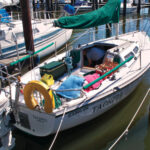
Before we left home for a year-long land-and-sea cruise around the continent, during which time we would live aboard our 25-foot Catalina, it occurred to us that life inside the cabin would be more pleasant if we could somehow exchange the existing hatchboard with something that would let in light while keeping out the cold. After all, we would spend much of our time below. It would not only brighten the inside of the cabin and give a roomier feeling, but it would also provide an unobstructed view from inside a closed cabin into the cockpit and beyond the stern.
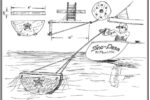
We started looking around for transparent material that would be suitable for making a hatchboard without a frame. It had to be tough to withstand frequent use, easily stored and readily accessible, and require little or no maintenance. It just so happened that a stair railing framework with 3⁄8-inch clear Plexiglas panels was being taken down at my place of work. Seeing the material, I knew at once that, if it could be shaped to fit the companionway opening, I would have exactly what I was looking for.
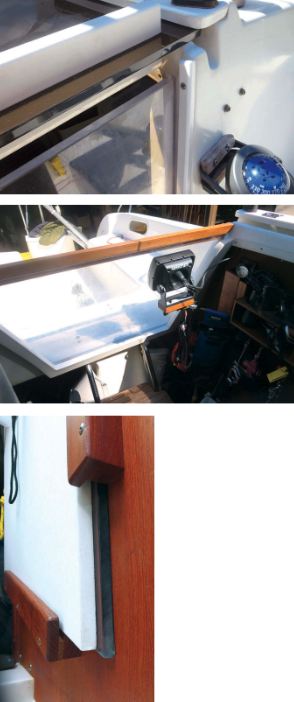
Although the available material was sufficiently wide, it was 2 inches shorter than the height of the companionway opening. Nevertheless, using the existing hatchboard as a template, we placed our pattern on the Plexiglas for scribing. I cut it to size using a standard table saw and smoothed the edges and corners with a wood plane. It slid perfectly into the hatch opening while leaving a 2-inch “vent” at the top.
On the day I test-fitted the Plexiglas hatchboard it rained, and I observed that the water that dripped from the horizontal sliding hatch fell onto the Plexiglas just below the 2-inch opening — no water splashed inside.
Since our summer weather in coastal British Columbia includes a fair number of rainy days, having a vent in an otherwise closed-up boat is not a bad thing. However, we needed to add a “vent closure strip” for when the wind drives the rain from astern.
To close this area effectively when it rains, is windy, or is miserable and cold outside, we made a 2 1⁄2-inch-wide by 5⁄8-inch-thick teak strip with a 3⁄4-inch Plexiglas overlap. We also added a spacer so we can store the Plexiglas hatch alongside the regular hatchboard in its storage slot. Since it is not a problem to drill Plexiglas, we could add a hasp lock for security if we felt the need.
Smoked/stained 3⁄8-inch Plexiglas would be a good alternative, but 1⁄4-inch Plexiglas might be a little too loose and likely to rattle unless it’s placed in a frame and reinforced in the center. To prevent the Plexiglas hatchboard from slipping when we place it upright in the cockpit, we split and fitted a length of 3⁄8-inch-ID pressure-water hose to its bottom.
Henk Grasmeyer, a native of Holland, learned to sail at the age of six in a rowboat with an oar and a bedsheet. Later, when living in British Columbia, he owned a Hobie Cat for years. Now retired, he and his wife, Johanna, sail and trail their Catalina 25 all over North America.
Thank you to Sailrite Enterprises, Inc., for providing free access to back issues of Good Old Boat through intellectual property rights. Sailrite.com