Life lessons from an early affair
Issue 105 : Nov/Dec 2015
There was no name on her hull when I found her, so I called her Frankly Scarlett in reference to the closing line of Gone With The Wind. That perfectly summed up my attitude at that point in my life.
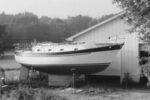
She stood alone: stark, barren, skeletal — a bone-white hull exhausted upon a scarred, rusted trailer mired past its hubcaps in dark, soupy mud. Alone in the middle of a 2-acre field, she sat on a small island of untouched earth, while all around her neat furrows of freshly broken sod made her look adrift on a choppy, black sea of soil. It was early spring in Hyde Park, Ontario, just north of London, and the owner and I looked out at her with our chins perched on hands resting on the top rail of a split-rail fence.
“I can’t sail any more with the arthritis being this bad,” said the weather-beaten man painfully. “Now, with the wife gone, it’s just a reminder I don’t need.”
Owning a sailboat was the last thing on my mind. I’d been content to rent J/24s for afternoon sails on Lake Ontario and cruise the North Channel of Georgian Bay on friends’ boats. But the man’s next words proved seductive. “You’ll need to buy a new motor for her. The lads around here swiped that over the winter. I’ve got all the sails and gear in the barn. If you can get her out of that field, she’s yours for a song.”
Someone else’s dream
I sat alone in the loft of the barn looking through the pictures and documentation. She was a 1975 MacGregor Venture of Newport, 23 feet in length with 7 1⁄2 feet of beam. She had a 600-pound lead daggerboard that cranked up and down. With it up, she drew 21⁄2 feet; 4 with it down. A pop-top cabin roof lifted to give 6 feet of headroom down the center of the main cabin. A canvas tent covered this extended roof to protect it from the elements.
Easy to rig, easy to sail, and easy to trailer, the sales literature called her the “perfect pocket cruiser.” But along with the original sales brochures, I leafed through a thick stack of invoices from various marine stores in the Ottawa area. In all, the total came to nearly $21,000! The original owner had completely redesigned the sail plan. His dream had been to buy a 40-foot sloop and take chartered cruises around the Mediterranean. To test the sail plan and his ability to singlehand a vessel with it, he completely refurbished the MacGregor from the deck up.
Although the length from bow to stern was 23 feet, a 4-foot wooden bowsprit extended her sail platform by more than a sixth of her length. Three roller-furlers on the bowsprit controlled the headsails, their lines all leading to the cockpit. I found the four sail bags and spilled their contents out on the floor of the hayloft. It was all brand-new fabric, pure white with blood red UV trim on the foresails. I gathered everything up and put it in the back of my Toyota 4Runner, then sought out the man rocking on his back porch to ascertain just how much he felt a song was worth.
Resistance
We quickly came to an agreement and, as it turned out, he wound up rescuing me, my Toyota, and the boat when I found I couldn’t budge it. He hooked his tractor up to the front bumper of the 4Runner and — with both vehicles under full power — she begrudgingly came out of her muddy grave and finally sat passive, yet angry, upon his driveway. I looked at the rusted trailer, the flattened tires, the mud-splattered hull and could almost hear her saying, “What the hell do you think you’re doing? I’m retired . . . I’m finished . . . why didn’t you just leave me in peace so I could live the rest of my life as a planter in a farmer’s cornfield?”
As I put air in the cracked old tires and replaced bulbs and wiring to make the trailer legal, I felt like a nervous kid who’d summoned a long-forgotten spirit from a genie bottle: “What the hell have I done?”
I checked the thin yellow plastic lines holding her on the trailer. They were old and frayed, but I didn’t have anything to replace them. It was quickly getting dark and it would be a long, slow drive down the 401 to Toronto.
I climbed up on her deck and she bounced like a trampoline on the trailer. The yellow rope creaked and strained, but seemed to hold. Then I noticed the triangular anchor hatch at the bow. I opened it to find about 100 feet of coiled, thick anchor line. For no sensible reason that I can think of now, I pulled a length of it up through the opening and tied it to a forward cleat. Then I bounced once more and convinced myself that it would all hold together for the 200-kilometer (124-mile) trip. No doubt, the captain of the Titanic had similar convictions about getting through the icebergs of the North Atlantic.
A white-knuckle ride
Driving down the highway at the required hundred clicks per hour (62 mph), I glanced back through the rearview mirror at the bowsprit that was almost touching the rear window of the Toyota. As if afloat upon a gentle sea, the bow rose and fell with a constant rhythm, but never did it rise above the top of the window. It was a cool brisk evening. As traffic sped past me, my knuckles were clenched hard white on the steering wheel. Only 100 kilometers to go.
By the time I was cruising across the top of the city, I had become almost comfortable with the gentle sway of the Toyota and the sharp tugging when we hit a bump. It had been a few minutes since I’d looked back and seen the bowsprit’s regular motion up and down in the rear window. But now, at the height of its bounce, the bowsprit passed out of sight above the rear window. The strain on the 4Runner became more urgent, the nape of my neck tingled the way it did before sailing into a storm front, and my gut delivered an unmistakable message to my brain. It was a tough call. Only about 20 kilometers to go until she’d sit safely on my driveway. Pulling over on the eight-lane highway in this heavy traffic would be dangerous. Checking the lines with cars whizzing past me at 120 clicks (75 mph) could be fatal. Still, the bowsprit seemed to stay out of sight above the window for longer periods each time. I gulped hard, flipped on my turn signal, and began to gently pump the brakes. My dim flashlight traced the line of the yellow rope as trucks howled past me six feet away, their backdraft threatening to pull me under screaming wheels. The three braided yellow strands across the bow had become just one thin cord holding 2,000 pounds of boat to the trailer. I wanted very badly to believe that one strand would hold for the rest of the trip. I reached up, grabbed the edge of the deck and, with all my strength, pulled it down. The strain eased on the thin yellow plastic strand and it became loose. I felt the full strength of the forces that were pulling the bow up, threatening to slide the entire boat stern first off the trailer and onto the hard pavement of the highway. I tired and released my grip on the deck. The bow jerked up, and the final strand of yellow rope snapped with a loud ping.
As the bow was heading skyward, I jumped with both hands to grab the deck and felt stomach muscles that hadn’t been used in years get ready to pop. I knew I couldn’t hold on for long. Then I remembered the anchor rode I’d left out for no sensible reason. Holding the bow down with one hand, I reached up with the other and groped around the foredeck until I felt the thick round line still wrapped around the cleat. I pulled and it snaked out of the hole in the anchor locker. I quickly switched my handhold on the deck onto the rope. I didn’t have the strength to hold it, but somehow managed to get the other end wrapped around the yoke of the trailer. I couldn’t pull the bow down to where it had been, but at least I had stopped it from sliding up and back any farther. I secured one knot, then pulled out more anchor line and duplicated the tiedown on the other side of the bow. When it was done, I suddenly felt weak and sat down on the fender of the trailer, my arm, shoulder, and stomach muscles strained and aching, almost oblivious to the steady blur of hurtling traffic before me.
That was the first time Scarlett spoke to me, telling me of the danger, letting me know that somehow we’d get through it — together.
Assembling the puzzle
For the next month she sat on my driveway. I took every piece of brightwork off her and refinished it. There was the 4-foot by 18-inch by 2-inch bowsprit, wooden rails with spindles running down both sides of the cockpit, handrails across the top of the cabin, and wooden trailboards that graced her bow. Below, I discovered a propane stove, assorted charts for Bras D’or on Cape Breton Island, and a Porta Potti.
In the V-berth was a tangle of lines, poles, blocks, and swivels, all of which must have had some function. I laid it all out in my driveway and set about figuring it out. The four thick color-coded halyards were obvious: four sails, four halyards. However, there was no forestay on the mast. It took a while for me to figure out that whoever had designed this rig felt that three headsails, each with a wire running the length of the luff, would be more than enough to secure the mast to the bowsprit.
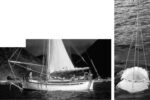
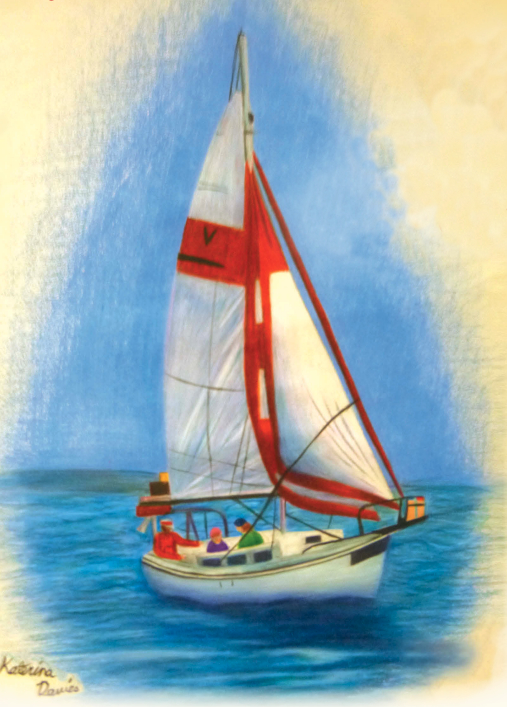
Identifying the mainsail was easy as it had no red Sunbrella, but the remaining three sails had the material running the full length of the leech. It was not until she was in the water with the mast up that I figured out what the designer might have intended. The sail that shackled to the first (sternmost) cleat on the bowsprit was a self-tacking staysail. It was short and ran back to just before the cabin front where its clew attached to a free-sliding traveler. With just these two sails up, tacking was as easy as putting the helm alee: the main would slide around on the stern traveler and the staysail would tack on the front traveler. Somewhat ingenious, I thought. The large headsail turned out to be a genoa that ran back amidships. The smaller headsail was a Yankee meant to fly high and farther out in front, so it secured to the forward furler. Once she was rigged, all the lines came back to the cockpit, where a singlehander could furl the headsails and adjust the sheets.
Adventures shared
While at sea, the only problem was that aside from sailing on a beam reach, Frankly Scarlett . . . like the fictional character. . . had a mind of her own. She wouldn’t point worth a damn and the thin daggerboard meant that on any other point of sail she would respond to the helm pretty much at her whim. Once when we were sailing into Toronto harbor’s eastern gap, a very large cruise ship taking tourists around Centre Island signaled loudly that we were in her path. I threw the helm over to the rail, but Scarlett being Scarlett — together with the dirty air from the huge hull — was dead in the water. With her horn honking and the captain staring daggers at me from his bridge about five stories above, the cruise ship altered course to avoid a collision by no more than 10 feet. The wake almost swamped us, but within a few minutes we were back on course and Scarlett was obediently responding to her helm once again.
Later, I was determined to get her home in spite of a 70-mile-per-hour wind right on the nose, a driving rain, and 1 1⁄2-meter waves. Out on open water, I tacked her back and forth with water to my ankles in the cockpit. After four hours, I had made less than 100 yards headway. It was as if she was laughing at me for my foolishness in being out in a storm like this. Still, her rigging held, she stayed upright, and by nightfall it was all over and I drifted into the darkness of my home harbor in a flat calm sea.
In the years I had her, we had many adventures. Frankly Scarlett took me through gales and brought me home safely. She forgave all my mistakes — carrying too much sail, venturing out when all the others stayed in harbor, running aground when the only solution was to crank up the keel and carefully motor out to deeper water — and once she found her way back with only the compass when a wall of fog closed in after we left our dock. I suppose she taught me how to sail, how to endure, how to overcome, and how we are at the whim of the wind gods whenever we set out upon the waters.
After a while, I sought something larger and more comfort- able for longer cruises and an enthusiastic young man bought her to sail on Lake Simcoe. As he drove away with a beaming smile on his face, I waved . . . not to him, but to Scarlett, knowing she would now embark on the task of teaching this eager young man how to sail. Goodbye Scarlett. Fair winds. Safe harbor. And thank you.
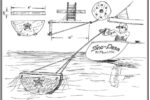
Don Davies, after a lengthy career as an advertising copywriter, marketing consultant, and speechwriter, turned his attention to film scripts, novels, magazine articles, and grandchildren. He lives with his wife, Jacqueline, in Toronto and sails his good old Grampian 30 on Lake Ontario. His website is www.dbdavies.com. Don’s granddaughter Katerina, who was 14 when she created the illustration, studies art in Toronto. This is her first published artwork.
Thank you to Sailrite Enterprises, Inc., for providing free access to back issues of Good Old Boat through intellectual property rights. Sailrite.com