Diodes overcome a dearth of switches
Issue 106 : Jan/Feb 2016
I recently replaced the fragile and outdated original plastic circuit breaker panel on Nurdle, my 1979 Bristol 35.5. As part of this project, I added some more circuits and separated a few circuits that had previously been combined. As a result, I had to be selective in my use of the limited number of circuit breakers available to me on the new panel.
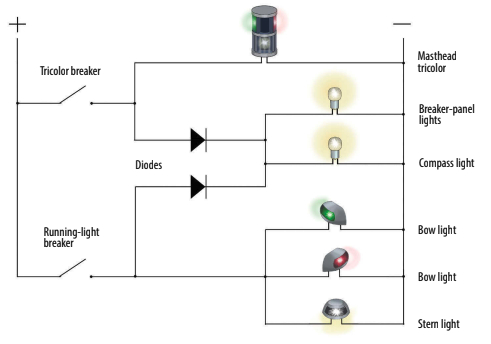
One of the circuits on the old panel had been for the compass light. I had installed a tricolor running light at the masthead in addition to the existing deck-level running lights. I could free up a circuit breaker for the tricolor by making the compass light illumination automatic, but I wanted it to turn on with whichever set of running lights I was using — the deck-level lights or the tricolor. I am not aware of any commercially available devices that achieve this, so I made my own.
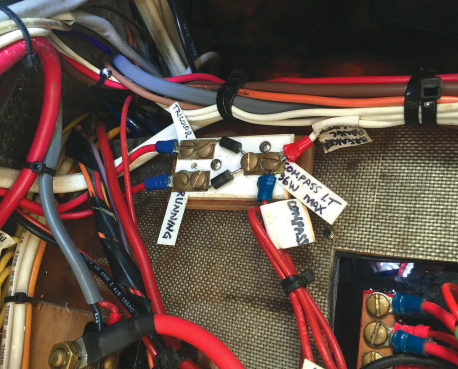
Dual-diode device
The solution was to control the current by using diodes, which are small electronic devices that conduct current in one direction only. They are available in a wide variety of voltage and amperage capacities. This current-blocking feature is not free, however, as there is typically a 0.6-volt drop across the diode. While this decrease in voltage is somewhat problematic when used in battery-charging or other critical circuits, it would make little difference for a small incandescent bulb used to illuminate a compass.
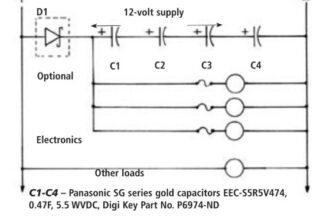
I placed small diodes in the circuit from the tricolor and deck lights to the compass light. This arrangement allows current to flow from either breaker to the compass light, but prevents it from flowing the opposite way and energizing the other circuit.
For a non-conductive mount, I used a piece of 1⁄4-inch scrap acrylic about 2 inches by 3 inches. Into that, I drilled and tapped three pairs of holes for 3⁄8-inch 10 x 32 brass machine screws. (I happened to have binding head screws on hand that are typically used for electrical connections, although round or pan head screws would have been fine). I connected each pair of screws with a small strip of brass to create paired terminals, which allowed me to connect the diodes separately from the circuit wires.
I sourced the 3-amp barrel diodes from Radio Shack ($1.99 for two, part number 276-1141). The diodes allow a load of about 35 watts at nominal 12 volts, are good for up to 50 volts, and have stiff and substantial leads that are easily contoured around the terminal without soldering. This is an important feature as diodes are easily damaged by the heat needed for soldering. As on most diodes, a painted stripe identifies the cathode.
I wired the cathode (downstream) ends of the diodes together at one terminal and the anodes separately at the other two, then used the other screws of each pair for the wires to complete the circuit. The wire feeding the compass light goes to the cathode terminal. Having a second screw allowed me to connect the wires without disturbing the diodes.
I screwed the device to a small block of plywood into which I had cut recesses for the tips of the machine screws that stick out the back of the acrylic. The plywood was easy to glue to the bulkhead behind the panel and allowed me easy access to connect the wires. As an extra, I even connected my breaker-panel backlighting to the device.
With the device installed, the compass light illuminates when I throw a single switch to turn on either the tricolor or the deck-level running lights.
John Churchill grew up in Indiana as a boat-crazy kid. He built a raft at age 6, sailed Snipes as a teenager, and worked his way toward salt water and bigger boats as an adult. He has sailed a Cape Dory 26 singlehanded to Bermuda and back and a Bristol Channel Cutter transatlantic with his father. Now in Florida, John races and daysails Nurdle, a former repo Bristol 35.5, while rehabbing her for extended cruising after he retires.
Thank you to Sailrite Enterprises, Inc., for providing free access to back issues of Good Old Boat through intellectual property rights. Sailrite.com