Thoughts about the little boat that tends the big boat
Issue 108: May/June 2016
Conditions at Fire Island Inlet on the south shore of Long Island were “a bit sporty,” as they say in New England, but not too bad. The wind was out of the southwest, 12 or 15 knots right up the inlet, but the waves had a fetch of thousands of miles . . . plenty of room to build up. They were only a few feet high offshore but, as they hit the shallows, they grew to big rollers of 8 feet or more.
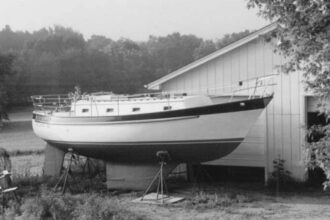
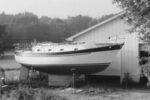
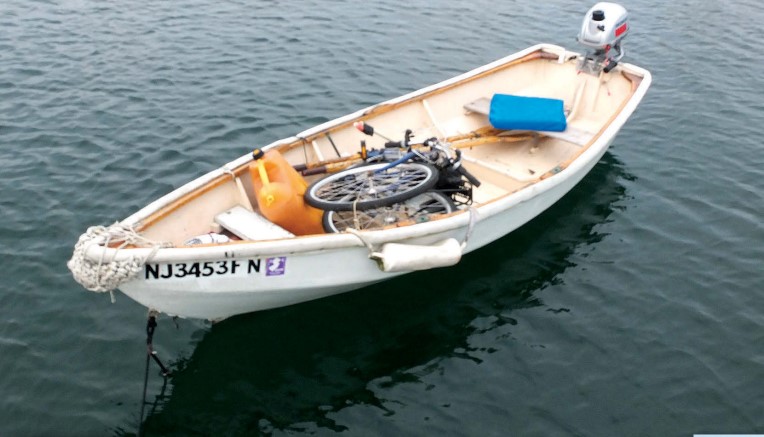
My boat, a 26-foot Paceship, is steered with a tiller, and I had no trouble keeping the transom square to the waves through the inlet. But when we were halfway through the inlet I saw my dinghy, an 11-foot 6-inch Bolger Cartopper, surfing alongside on a wavetop at eye level. It seemed to be trying to pass. Clearly, it was in God’s hands. At that moment it occurred to me that I’d better get serious about fenders on the dinghy. If it hit the transom, it has enough weight that it could do some damage.
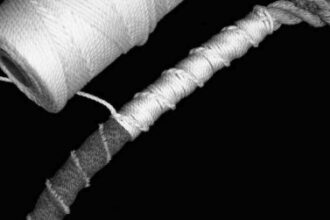
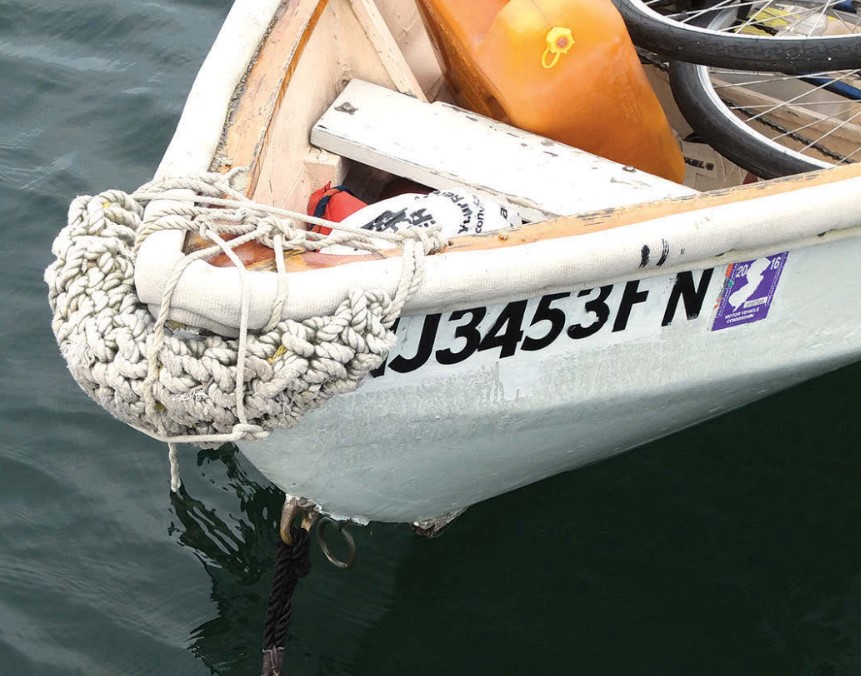
My winter project that year was a bow fender from old rope, tugboat style. It already had synthetic gunwale guard, now $9 a foot. That helped, but I added one fender on each side for times when I would come alongside another boat. They were easy enough to install, but the lines securing them had to be covered with flexible hose. Otherwise, over time, the 1⁄4-inch line cut like a knife into the heavy canvas cover of the gunwale guard.
Hard, soft, big, or small?
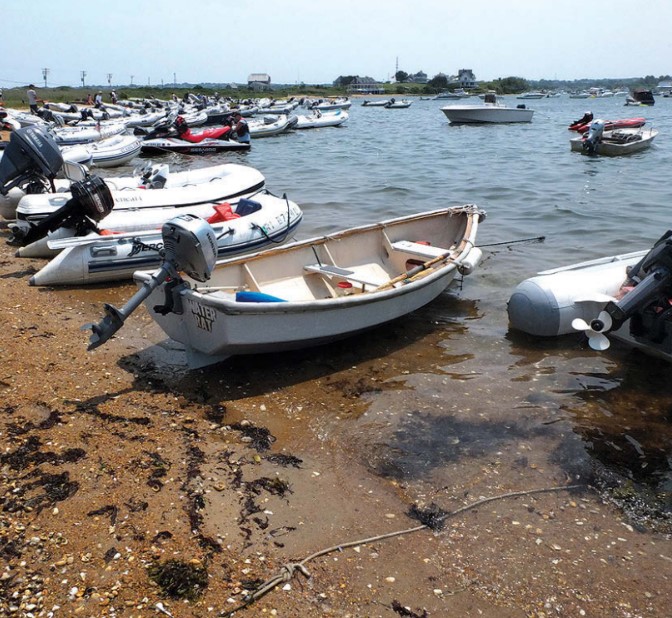
I won’t get into the old bitter fight over what kind of dinghy is best: rigid or inflatable. Whatever you have is what you have to use. However, I have noticed that inflatables sometimes become airborne in high winds, twirling like whirligigs, merrily tossing the contents — and the motor — into the drink. That doesn’t happen with hard dinks.
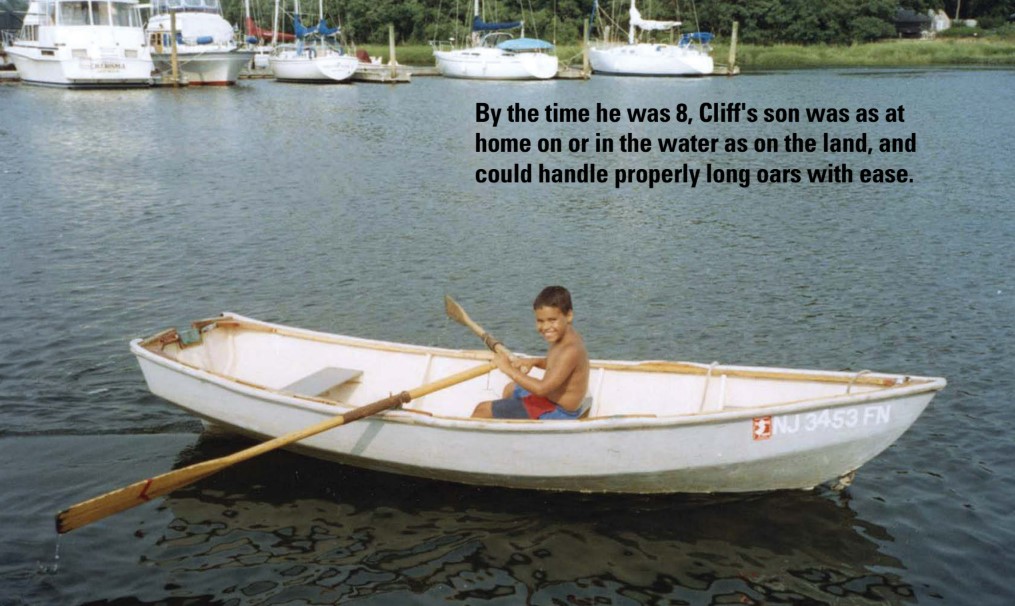
Bigger is often better, and generally not more trouble to tow than the usual short dink, especially the blunt-bowed sort. It’s good to have a dink that can carry four adults safely in a chop under oars, that tows well in big seas, and doesn’t need much of a motor to drive it.
I’ve towed my dink every summer on my cruise to New England, including through New York’s Hell Gate, and further, at Plum Gut and the Race with no trouble at all. It has the happy quality that if water comes in over the bow, it ships out over the transom. But why push my luck? I always remove the engine before setting off into big seas.
Little ship outfit
Over the years, I’ve made a few other improvements to my dinghy. For one, the painter, 1⁄2-inch nylon triple-strand, is 60 feet long, but at times that’s not long enough. I’ve had to bend on another 50 feet to keep the dinghy on the backs of the big following seas offshore a few times. Otherwise, when the painter’s too short, it dances around.
The ring eye at the bow was too low, which forced the bow too high at anything faster than 4 knots. And it rattled as the painter jerked at it. I hate noises at night when I’m trying to sleep. So I added an eyebolt a few inches higher that proved just right.
At 4 knots or more, the painter is entirely out of the water. At more than 5 knots, the bow rises high enough that the bottom chine clears the bow wave.
I also had the experience of wrapping the painter around the prop one time. Now there’s a float rigged on the painter about 6 feet out from the bow to keep it safe at short scope.
There are two cleats on the inside of the transom, high up, one on each side, and a wooden cleat at the forward thwart. Sometimes I run the painter to a cleat at the dock, then aft to one of the cleats on the transom.
Once, when I had engine troubles with the big boat, I tied the dink alongside at bow and stern and used the 2-horsepower outboard to push the big boat safely into port.
The aft thwart, where I sit when steering the dink under outboard power, has to be high enough for me to see over the bow as it rises. Sitting on a cushion adds another couple of inches of height.
Also, I added sacrificial rails on the bottom, a big one up the center like a keel and one on each side, pieces of 1- x 1 1⁄2-inch oak. That way I don’t worry about rubbing through the fiberglass along the bottom when I drag the dinghy up a beach or a ramp. It also lets the dinghy track pretty well. Once pointed in the right direction, it tends to hold its course without a hand on the tiller. Every couple of years, I replace the sacrificial strips.
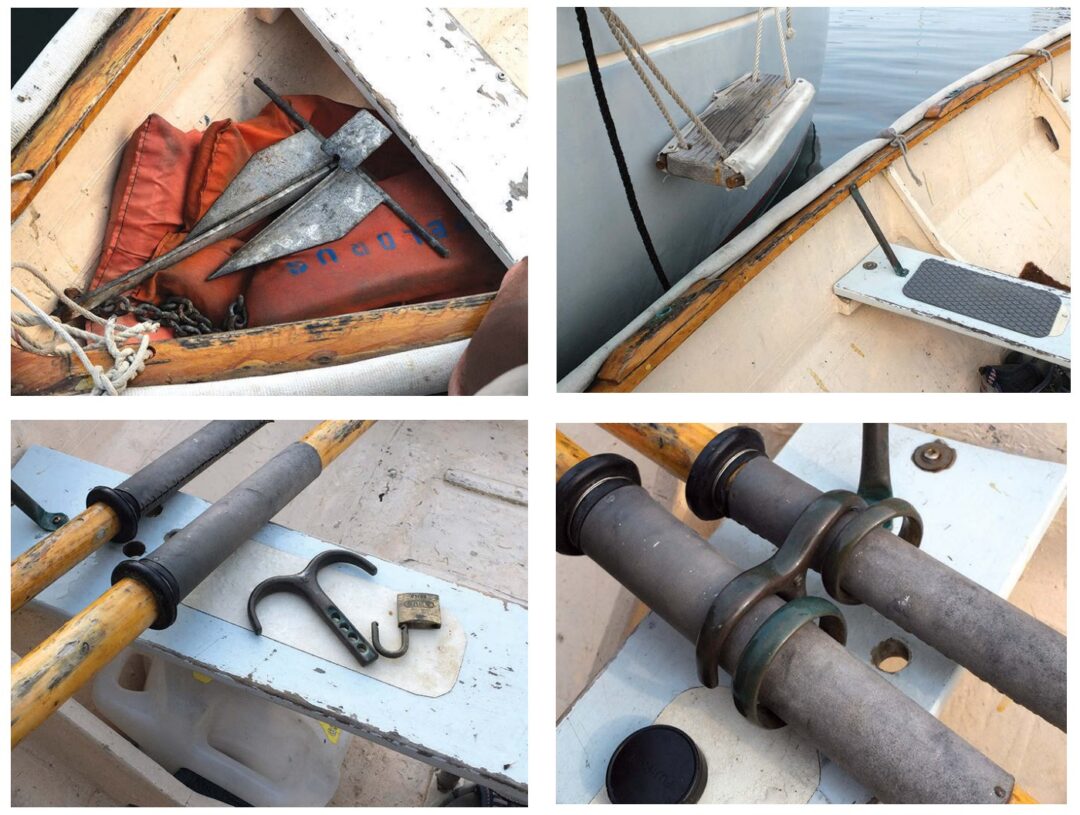
Something else I learned the hard way is to never paint or varnish the thwarts. Otherwise, they’re very slippery when wet. A piece of non-skid decking placed where I generally set my foot while stepping up onto the big boat helps, though, and I keep a piece of doormat in the bottom of the dinghy for getting the sand out of my boat shoes.
The big boat has a step dangling alongside, like a bosun’s chair made of a piece of 2 x 8 pine and old three-strand nylon anchor line. It makes getting back aboard after a run ashore a lot easier.
A recycled plastic jar with a lid and big enough to hold a wallet, a camera, and my cell phone keeps these things dry. It floats and the price was right. But like most small boats, when heading into a chop, especially at an angle, my dinghy can be wet if there’s any wind blowing. At times like that, I take a foul weather jacket with me.
About oars
The oars, which have proper leathers and brass tips, are secured against theft with a bronze one-piece device. I had to drill holes in the center thwart on one side for the oarlocks and a hole in between for the locking device. The locks for the outboard and for the oars are keyed alike. My oars are 6 1⁄2 feet but could easily be longer, say 7 feet, as the beam on my boat is a little over 4 feet.
Oars that are too short are a bane to boaters. Why settle for the short oars that come with inflatables? Long oars provide greater leverage. If possible, get oars that are at least 50 percent longer than the beam of the boat. Take a look at the oars used in whaleboats sometime — monsters at 10 or 12 feet. They look impossible to row with, but they aren’t. Long oars may be the only thing you can use to get you to windward some stormy night while trying to row out a spare anchor. Even if the oars aren’t locked on the thwart, the blades should be tucked under the after thwart in case the dinghy rolls and fills. That way, they’re less likely to float off.
There are two sets of sockets for the oarlocks, so I can row from the center thwart or, if carrying passengers, from the forward thwart. I was reminded of that recently while I was anchored in Cuttyhunk. I noticed a married couple rowing a small dink, round bowed, maybe 8 feet long. Both were seated on the center thwart and each had an oar gripped firmly in hand, little things about 5 feet long. The dink was headed from the beach, with a pooch seated on the rear thwart after a run ashore. Their dink made little headway in a slight breeze, mostly moving in a serpentine course as they windmilled more or less toward their boat. Seldom were both oars in the water at the same time. Each seemed to flail the water independently. Occasionally they stopped rowing in order to coordinate their actions. When they did, the dink drifted to leeward. The dog didn’t care.
Outboards
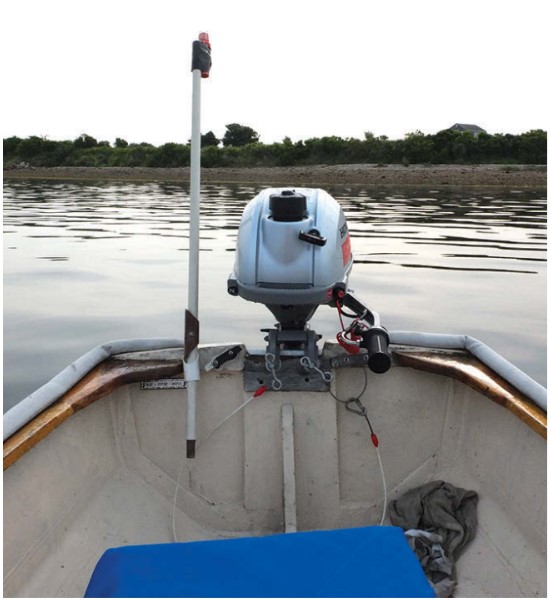
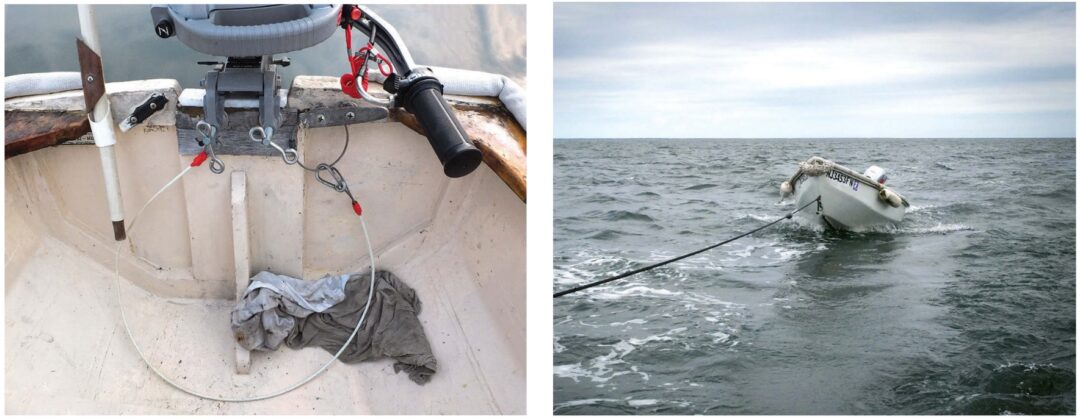
I had been cursed with a Seagull outboard that I’d bought in a moment of weakness. Happily, it fell off the transom somewhere in Raritan Bay, disappeared without a trace . . . gone forever, I hope. I replaced it with a real outboard, a 2-horsepower Honda. But having learned the hard way, I put a stainless-steel wire keeper on it. It’s a piece of recycled lifeline, properly clamped at one end, with a big eye in the other. I can lock the keeper to the transom, by a snap shackle generally, but with a padlock if I happen to be someplace where that matters.
That happened once. I had the dinghy at the dinghy dock in Edgartown, a posh sort of place. The next morning, no dinghy. I reported it to the harbormaster, who said, “We’re just bringing it in now.”
What happens, he explained, is that visiting boaters sometimes stay a little too late at the fair and miss the last water taxi. So, they look around for a ride, seize on whatever is handy, in this instance my dinghy, and use it to get back to their own boat. Having gotten home, they abandon their ride, in this case, my boat. “Bye, little boat!” they blearily cry, as their temporary transport drifts off into the night. Oy!
After that, I got into the habit of taking the kill switch clip with me if I leave the dinghy overnight and locking up the oars. Always carry a spare kill switch clip in your wallet (see “Why a Kill Switch?” below).
Dinghy equipment
The Coast Guard has a few requirements for dinghies: there should always be a life jacket for every person on board, and proper lights at night, as well as some means of making an effective signaling noise.
I always carry two life jackets, stuffed under the forward thwart with the anchors. Each one has a light and a whistle. I stuck a light on the end of a length of PVC that fits on the transom for motoring at night, but I keep a high-power LED flashlight on board also, just in case.
Every dinghy should have an anchor with chain, just like the big boat. I carry a 2-pound Danforth and a folding grapnel-type. It’s nice to have a choice. I used to carry 100 feet of nylon rode but got rid of it when I realized it was easier simply to tie the end of the painter to the anchor. I seldom need the whole length of it, so I secure the shortened rode to the cleat at the forward thwart.
Who hasn’t read The Riddle of the Sands, especially the part where the protagonist has to follow a compass bearing through the channel? Something similar happens in big harbors such as the Great Salt Pond on Block Island during fog or at night. If I know that my boat bears 30 degrees from the dinghy dock for 10 minutes under power, it’s easier to find it with a compass. So I learned to carry a hand-bearing camper’s compass with a glow-in-the-dark face. There’s also a compass app in my cell phone and a Navionics app with the anchorage waypoint on it. It’s come in handy a few times.
When ashore, I keep the dink right-side-up on a wheeled trolley. This is a great aid for getting it up and down the boat ramp singlehanded. But right-side-up means it will collect water when it rains, so I have a drain plug that I sometimes don’t remember to remove. No matter, there’s a bailer, made from an old plastic bottle, with a sponge and a rag for cleaning up oil and gas spills and fish guts.
Just remember to put the plug back in before launching.
Why a kill switch?
Most new outboards are now built so the operator can be attached to the engine with a strap, at the end of which is a key or clip of some sort. Often the key is just a flat piece of plastic, so if the operator falls overboard, the plastic is pulled from the engine, which then cuts electric power to the spark, “killing” the engine. Removing the kill-switch key reduces the chances of anyone stealing the engine.
When my son was about 5, we were anchored in Mattituck, a notoriously dirty hole-in-the-wall. It has a great draw at the end of it — a free hot shower and a nearby town with all the necessities: a bank, a good hardware store, two pizzerias, and two supermarkets. He pointed out something odd, a dinghy circling in the water under power with no one in it. I could see someone in the water struggling to get to a nearby anchored sailboat.
We rowed over and were able to snag his dinghy, which had no kill switch. It turned out that he had been stepping from the dinghy to the sailboat and his foot hit the gearshift on the outboard, which was still running. He fell in the water and the engine ran over his knee, cutting it badly through the kneecap into bone. We got him into my dinghy and rowed him and his dink back to the dock, where the rest of his crew had been waiting for him. They called the EMTs, who took him to the hospital. Later, I found out he had surgery and they kept him for a week, pumped full of IV antibiotics. That’s why every outboard needs a kill switch and its operator must wear the key.
Cliff Moore is a Good Old Boat contributing editor. His first boat was a Kool cigarettes foam dinghy with no rudder or sail. Many years and many boats later, he’s sailing a 26-foot AMF Paceship 26 he acquired and rebuilt after Hurricane Bob trashed it in 1991. He is the editor of a community newspaper.
Thank you to Sailrite Enterprises, Inc., for providing free access to back issues of Good Old Boat through intellectual property rights. Sailrite.com