Obscure tools the the gymnastics out of routine jobs
Issue 106 : Jan/Feb 2016
We have owned our Pearson 386, Lakota, for more than 20 years. She is a lovely and reliable good old boat that has served us very well on cruises throughout Long Island Sound and beyond. She is powered by a Perkins 4-108 configured as a V-drive.
A V-drive has pluses and minuses when compared with a direct drive. In the minus column for the V-drive are two maintenance jobs that require the arms of an orangutan and the flexibility of Plastic Man. Fortunately, these two hurdles can be cleared with two “friends in low places” (with apologies to Garth Brooks).
The first job concerns the far-away stuffing box that’s concealed beneath the engine block. To make this adjustment, one must be prone on the cabin sole, cheek pressed against the transmission’s shaft coupling, and have one arm stretched as far as possible while gripping an adjustable wrench with a sawed-off handle in an attempt to turn the nuts. Even if the locknut and packing gland can be reached, there likely is no swing room for the wrench. Thus stuffing box adjustments are often hit or miss at best.
The second is the secluded accessory belt that hides belowdecks and is reached by way of the cockpit locker. Correct accessory-belt tension has become more critical with the trend toward high-output alternators for charging large banks of house batteries. If the belt is too loose, it will slip and screech during startup when the alternator must achieve maximum output. If the belt is too tight, it can destroy the freshwater pump’s bearings.
Both problems can be avoided when the belt tension is right, but this involves squeezing into a tight space designed for neither man nor beast and groping around various obstacles to reach the alternator’s two locking nuts. Then, after loosening the nuts and with the previous adjustment lost, the sagging belt must be retightened with a lever such as a hammer handle. When it is approximately tensioned, the locknuts must then be retightened. This is very simple to do if you happen to have a third arm or you have the world’s smallest leprechaun as a helper.
As someone who is not too mechanically inclined, I have stumbled onto a couple of tools that have made these two jobs entirely doable. What is it they say about necessity being the mother of invention?
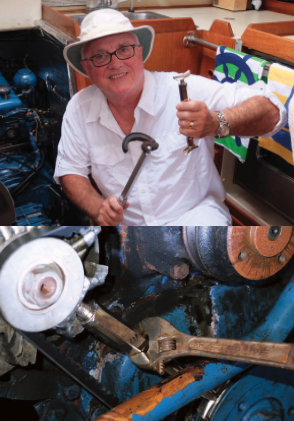
To adjust the stuffing box I use a basin wrench. Not one of the tiny ones found in big box home-improvement stores but the large jaw-type wrench found in plumbing-supply stores. This tool has a 2 1⁄2- to 3-inch spring-loaded jaw that can be turned at a right angle to the arm that telescopes to 16 inches. The arm is square in cross-section so a wrench can be applied. This $30 friend reaches where no arm can and can be turned in very little space. It takes care of the stuffing box nicely.
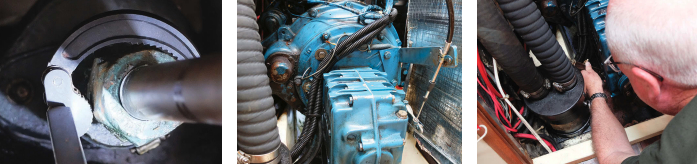
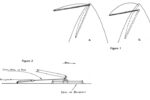
For adjusting the accessory belt I have discovered a tool called a belt-tensioning jack. This turnbuckle-type tool has convex brackets on both ends that conform to the belt pulleys. It is spring-loaded and can be expanded to fit before putting it in place. Once it’s in place, the current belt adjustment is not lost because the jack can be tightened to hold that tension prior to loosening the locknuts. The turnbuckle can then be turned with a wrench to make the adjustment to the belt tension, and the tensioning jack holds that adjustment until the locknuts are retightened. It is available on the Internet for about $25.
These two new friends have transformed two jobs from mission impossible to jobs well done.
Jim Norris is a retired newspaper operations executive. He and his wife, Loy, are originally Midwesterners from Nebraska and South Dakota who became interested in sailing after relocating to Long Island, New York, in 1985. As corporate nomads from the upper Midwest, they decided Lakota would be a fitting name for the Pearson 386 they have owned for 22 years. They enjoy cruising and daysailing out of Centerport Harbor on Long Island Sound. They find sailing an excellent retirement hobby.
Thank you to Sailrite Enterprises, Inc., for providing free access to back issues of Good Old Boat through intellectual property rights. Sailrite.com