Getting the kinks out of long-term storage
Issue 107 : Mar/Apr 2016
Sailing the waters off the West Coast of British Columbia brings great joy along with the occasional challenges. Pacific Northwest sailors cope not only with tides and currents, but also with rapidly changing wind and weather patterns. For many seasons my wife, Johanna, suggested that we equip our 1995 Catalina 250 WB (water-ballast) with a furling headsail to replace our hanked-on 110 percent jib. She pointed out with some regularity that this would make reducing sail safer and eliminate having to work on a wet pitching-and-heaving foredeck when we wanted to douse or set the headsail. This is not what you call, on a petite 25-footer, the safest job, even though over the years we had developed a quick way to douse the sail, bag it, and tie it off to the rigging.
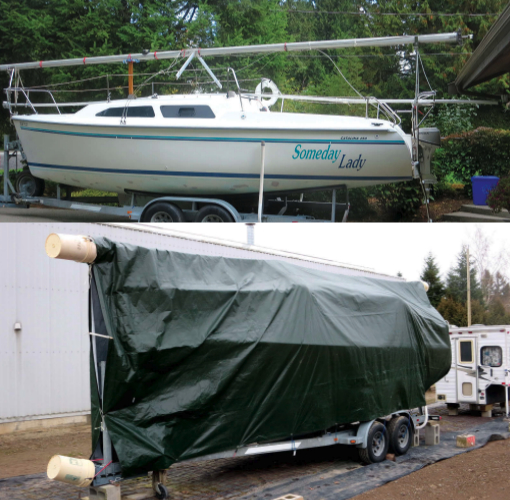
Two sailing seasons ago, I gave in and had a Schaefer 700 plastic extruded snap-on furler installed and ordered a new furling jib. Once that had been accomplished, however, we did not launch the boat even once during two entire seasons for a number of reasons. The boat stayed in storage, tarped over and out of the way. The new untried extrusion was tied off to the mast over the spreader. Where it protruded past the mast foot, it was supported with a PVC pipe.
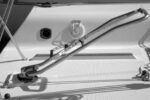
During the two seasons it spent on the trailer, our furler took on significant bends and sags where it passed over the spreader and where it was obviously inadequately supported. I vaguely remembered reading in the Schaefer specifications that the plastic snap-on extrusion should not be exposed to temperatures above 130°F (54°C). Despite vent openings under the tarp at either end of the mast, we imagine that the temperature rose higher than that. This led to the deformation of the extruded foil.
Stubbornly deformed
The next season brought big sailing plans, so I towed the boat home for outfitting and provisioning prior to moving her to a summer marina slip. To make sure the added masthead toggle and newly cut and swaged forestay fit properly, we raised the mast, even though we had misgivings about the bends in the furler extrusion. We had hoped the extrusion would straighten out once it was no longer draped over the boat, but this was not the case. In fact, the bent shape made it extremely difficult to connect the forestay. By loosening the backstay turnbuckle to its limit, we finally managed to insert the pin and secure the forestay. However, the bend in the furler extrusion stubbornly remained, even after several days under tension.
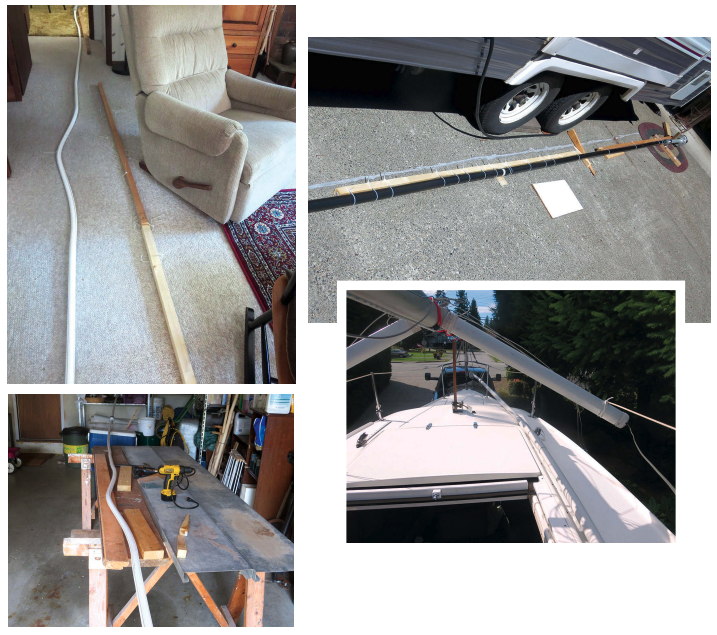
Having little choice, we struck the mast and took the furler off. At just under 30 feet long, it is an awkward, unwieldy extrusion. We zip-strapped the extrusion to 2 x 2s and left it on the family room floor for the next several weeks. It made no difference. The minute it was released, it snapped back.
We then placed the extrusion in a black 2-inch PVC tube, sealed the ends, and laid it on the driveway for several weeks where it was exposed to the summer sun. Even though we had some very hot days at the time, the furler retained its bend and sagging shape.
Desperate by now, we made a jig and used a heat gun in the hope of correcting the bends. It still made no difference. In frustration, I contacted Schaefer. After a few fact-finding questions and establishing our location north of the border, the representative sent us a new replacement foil that arrived quickly. (I am grateful to Schaefer for taking such good care of this customer.)
Making a straightjacket
Now that we had a good extrusion once more, we faced the dilemma of how to best store it over the coming winter season. While roaming through the Home Depot plumbing department, I noticed white 10-foot-long, 2-inch thin-wall central vacuum tubing. It was much more rigid and resistant to bending than anything else I had seen so far. It took only a minute to sink in. We could use these central vacuum tubes to store and protect the furler extrusion over winter.
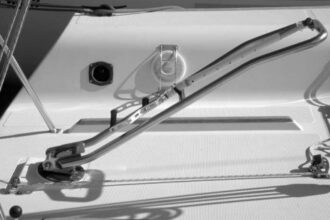
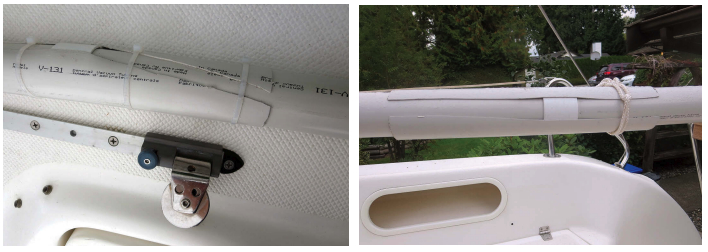
Sure enough, since we’ve been using these tubes on deck with the furler stored neatly inside and the much larger drum still sticking out by about a foot, there has been no deformation or sagging where the tube protrudes past the cabin roof and extends over the cockpit and foredeck areas. The weight of the drum is supported in line with the foil by a simple strap from the pulpit. If required for extra security, the tube can be supported at intervals from the unstepped mast.
Since we launch, retrieve, and transport our boat on a trailer, we had to find a way to store the empty tube when the mast is raised. A 28-foot tube would not fit within the confines of the trailer frame. We solved that problem by permanently coupling and zip-strapping two 10-foot sections end-to-end. The empty 20-foot section, with an 8-foot-long third section bungeed alongside it, fits within the length of the trailer and is easily strapped to the trailer frame.
Problem contained
In preparation for the winter, we tested our new storage plan for several weeks with the system on deck. No deformity occurred.
We are confident that, stored inside the rigid tube, the plastic snap-on furler extrusion will remain straight and protected. It is also more convenient to insert the extrusion into the tube and place the rigid structure on deck rather than doing the same thing with the awkward and unprotected foil by itself.
We hope to have eliminated the potential for the extrusion to deform and, as a bonus, the vacuum pipe keeps the foil perfectly clean.
Henk Grasmeyer, a native of Holland, learned to sail at the age of 6 in a rowboat with an oar and a bedsheet. Later, when living in British Columbia, he owned a Hobie Cat for years. Now retired, he and his wife, Johanna, sail and trail their Catalina 25 all over North America.
Thank you to Sailrite Enterprises, Inc., for providing free access to back issues of Good Old Boat through intellectual property rights. Sailrite.com