Two boys buy a big wooden boat with their hearts, not their heads
Issue 119: March/April 2018
On a warm June evening in 1969, my friends Scott and David drove with me from the Chicago suburbs to Michigan City, Indiana, to buy Hobart, a lovely 1940s-era, 26-foot Rhodes Idler sloop that was, in retrospect, suspiciously low-priced. The seller, Ed, was asking $4,000. Hobart was a beautiful boat, but a wooden boat well into her third decade. We were 18 and too excited about owning her to arrange a survey.
Just before sunset, Ed showed us Hobart at her slip, no doubt marveling at our wide-eyed naiveté. He then took us out for a $4-a-plate fried chicken dinner. After the meal, Scott and I each handed over a $2,000 check, and the three of us slept on the boat, firmly believing our dream was coming true. We planned to rename the boat Eureka.
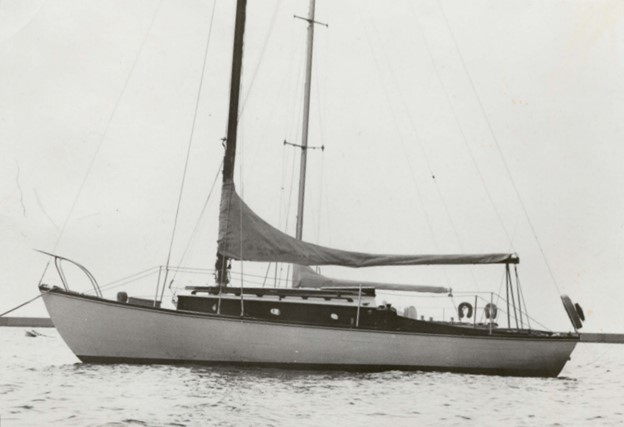
The next morning, we cast off for Chicago. It should have been an easy daysail to the west-northwest across Lake Michigan. Nearly out of sight of land and approximately 15 miles north of the steel mills of Gary, Indiana, we lounged in the cockpit with Hobart making about 3 knots in a dying southerly breeze. Scott headed below for suntan oil, and a few seconds later our lives as wooden-boat owners were forever changed.
“Geesus, we’re sinking!” came the startled yell from the small cabin.
David and I roused ourselves from our naps and peered through the companionway. The floorboards were awash. I tried to start the engine to support the battery to run the bilge pump, but the engine was dead, and so was the electric pump. We had no life raft, dinghy, or radio.
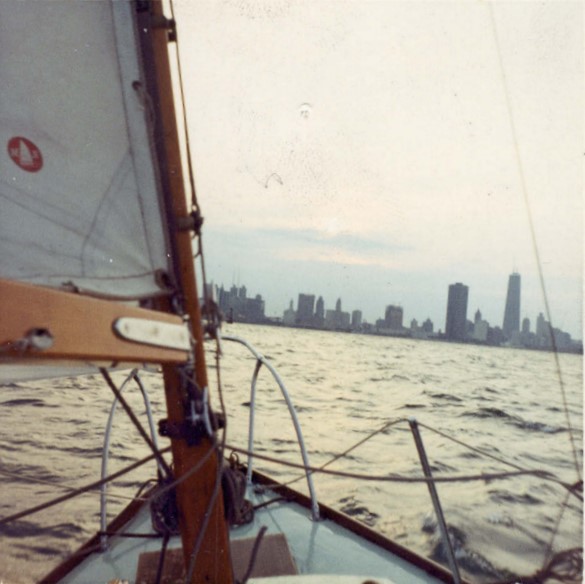
There ensued a frantic bucket brigade, with one of us bailing from the cabin and handing the bucket up through the companionway, one tossing the contents over the side, and the other steering. The wind stayed between 3 and 8 knots, and much later that day we maneuvered Hobart into Chicago’s huge Monroe Harbor considerably more seasoned than when we had cast off from Michigan City that morning.
In the vast overconfidence of youth, we had planned on renting a slip on arrival. Instead, we learned some Chicago-area boat owners had been on the waiting list for a slip or mooring for 10 years or more.
So we ghosted, engineless, to a transient pier and were putting out fenders when a street fight began between two gangs on the adjacent roadway. Scott grabbed the spinnaker pole, and I took the boathook. The conflict eventually migrated down the street.
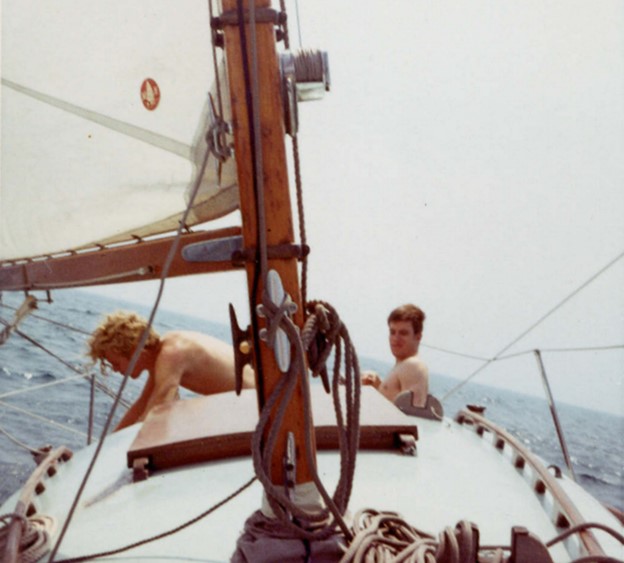
I don’t remember how we got home that night, but we knew we had to be back the next day — and every day thereafter — to pump out the boat to keep her from going under. For the rest of the summer, we alternated coming down after work each night to pump her out. I sailed the vessel three times, and Scott about the same.
Eventually, we found the main leak in rotted wood near the exit point for the prop shaft. Using underwater glue in the aft corners of the bilge, we attempted to patch it and occasionally reduced the inflow by 20 percent. On a good day, instead of Hobart sinking in 20 hours, it would take 24.
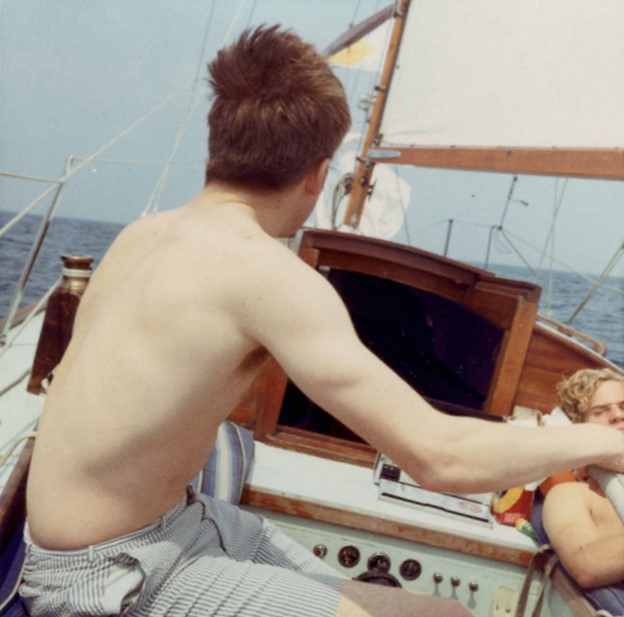
David felt sorry for our debacle and composed a song in honor of our misery, to the player-piano tune of “Bill Bailey, Won’t You Please Come Home?” It went like this:
Won’t you sell out, Big Ed, won’t you sell out?
You’ve got a l-e-a-k-y b-o-a-t.
It isn’t worth two cents but Frank’s got four thou,
He’s been saving up for a-l-l h-i-s l-i-f-e.
He’s only 18, it is kind of mean,
He’s got a few things to l-e-a-r-n.
Now Scott’s pumping by hand while Ed’s in
B-o-c-a Grande.
Big Ed won’t you please sell out!
At the end of the summer, my father tried to salvage the situation by buying the boat for a dollar and giving it to the Sea Scouts of Milwaukee, enabling a charitable gift tax deduction for himself and Scott’s father. Scott scheduled a delivery sail to Milwaukee with his girlfriend and mother as crew, but when the day came, the wind died mid-voyage, the engine would not start, and his girlfriend was seasick.
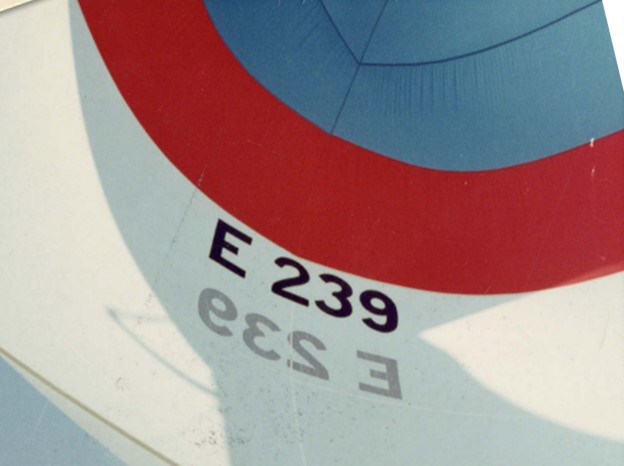
So they arrived quite late, tied up the boat, and got a ride home. Our friendship slipped through the latter stages of dissipation. A year later, after my father filed his 1969 tax return, he was audited by an unpleasant IRS representative. The red flag? That doggone boat.
Ten years passed. I returned to being an occasional dinghy sailor and in 1978 was an editor at a sailing magazine in New York. On a slow day, I assigned myself a follow-up story on Hobart. After a few calls, I tracked down someone from the Sea Scouts of Milwaukee who had been glad to receive the boat but soon gave up on her, owing to her inability to float for extended periods.
A year later, the Sea Scouts sold the boat for a pittance to an ambitious hobbyist. He worked for two years and then, overcome by pervasive rot, gave up. With a chain saw, he carved the boat into small sections and trucked it away, saving marina storage fees. The good ship Hobart morphed into soggy firewood and entered her final resting place at the county landfill.
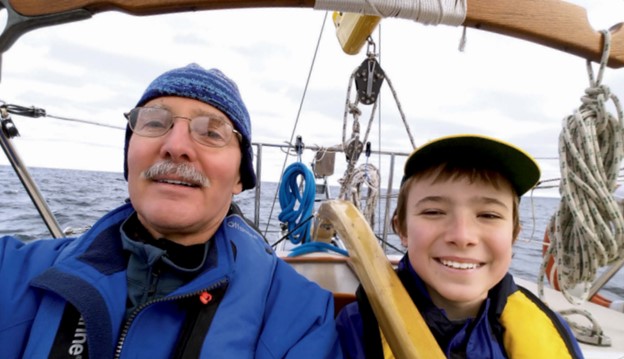
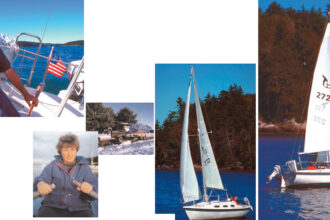
In 2008, when age caught up with me and I had to stop dinghy sailing and windsurfing, I realized it was time to transition back to a bigger boat. That winter of 2008/’09, my 6-year-old son sat on my lap after dinner each night while we perused the internet. After much research, we settled on the Nor’Sea 27 as the target boat.
Remembering our near-sinking on Hobart in the middle of Lake Michigan, I had four surveys done on four different Nor’Sea 27s — in South Carolina, Florida, San Francisco, and Seattle. I rejected the first three and three months later bought the one in Seattle. It had voyaged to Hawaii and Alaska with previous owners, had a new engine, and was in good shape. I found an empty marine-transport truck coming back to the Midwest and arranged a favorable price. A month later, we launched Blue Moon.
We are now in our ninth season of daysailing and regional cruising on the south shore of Lake Superior. The Lyle Hess-designed Nor’Sea 27 is solid fiberglass, built like a handsome mule, and looks as if it is made of wood. It is easy to single-hand, trustworthy in high winds, comfortable to cruise, and a joy to sail. Life is very good indeed.
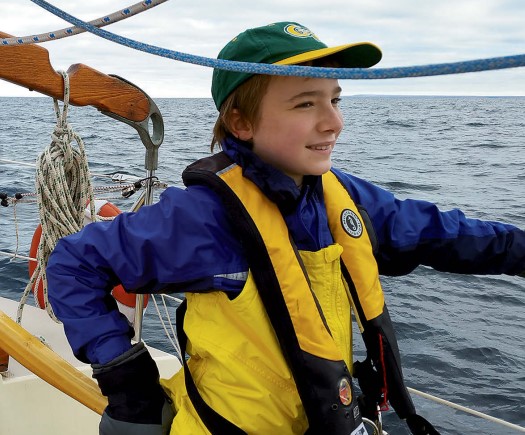
It is only now, in the wisdom of the ensuing 48 years, do I realize the magnitude of our wrong choice of boat in 1969. For $1,000 more, we could have bought a fiberglass Cal 25 that came with a trailer and a mooring in Chicago Harbor. I still kick myself when I imagine the sailing Scott and I could have done that summer and the headaches we would have avoided by purchasing the practicality of fiberglass rather than the romantic notion of wood.
But we would not have learned nearly as much, nor been able to choose wisely later on. Besides, we got a heck of a good fried chicken dinner into the bargain.
Frank Farwell, after three decades in New York and Madison, Wisconsin, moved north 12 years ago to be near the love of his life, Lake Superior. Two beater Sunfish, a stout Nor’Sea 27, and 11 canoes facilitate outings on the big lake and its tributaries. His book, Chicken Lips . . . : An Entrepreneur’s Wild Adventures on the New Silk Road, was a nominee for the 2011 Financial Times/Goldman Sachs Best Business Book of the Year award.
Thank you to Sailrite Enterprises, Inc., for providing free access to back issues of Good Old Boat through intellectual property rights. Sailrite.com